The crypto market continued to cool down in 2026. Under the deep bear market, its not just retail investors getting wiped out — even crypto exchanges have started lining up to “meet their end.”
According to RootData statistics, more than 100 crypto projects have died in 2026, covering exchanges, Layer 1 blockchains, Layer 2 networks, and DeFi protocols. In just the past month, four well-known exchanges — AscendEX, EXMO, BitMEX, and BitMart — have successively shut down. However, this may only be the beginning.
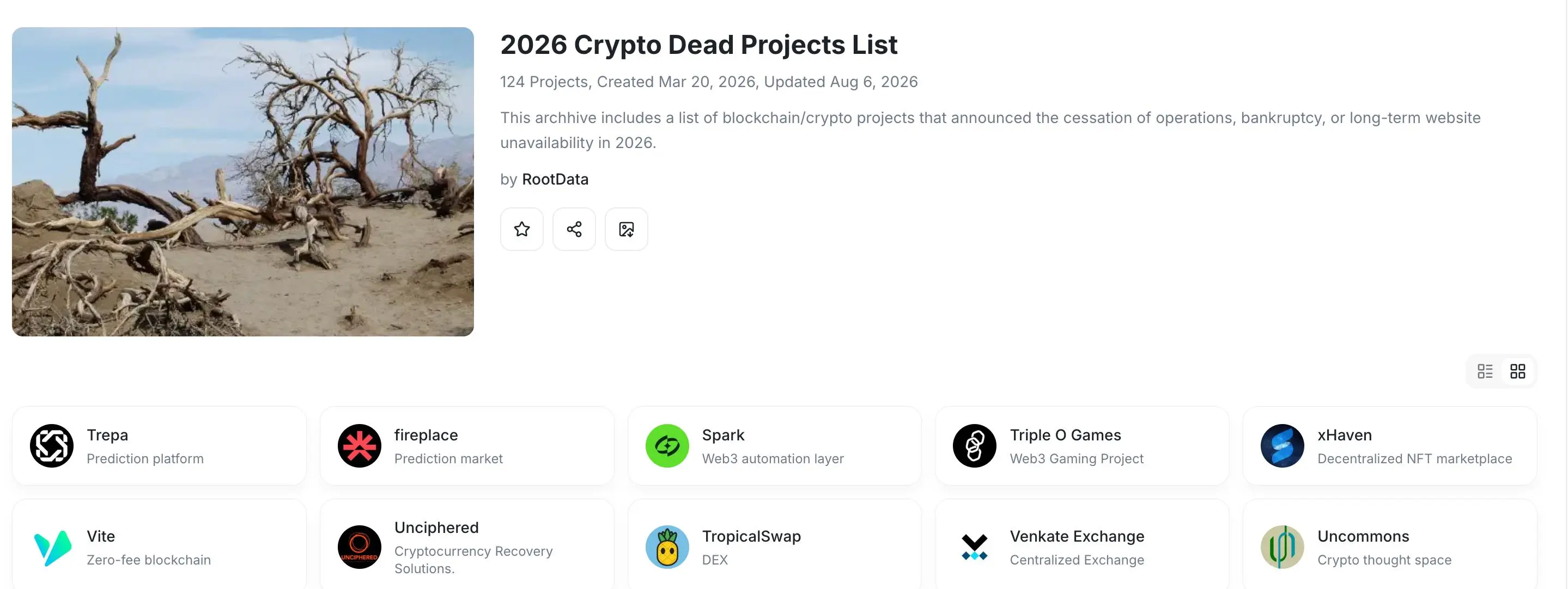
2026 Crypto Dead Projects List(Source: RootData)
This wave of exchange collapses is different from what happened in 2022. Back then, it was an explosion: Luna went to zero within three days, FTX suffered a bank run, and Celsius froze withdrawals — the deaths happened almost instantly. In 2026, however, most platforms are dying from starvation. There are no major hacks, no mass withdrawals, and no law enforcement raids — the business simply stopped making money.
But “starving to death” is more frightening than “being blown up.” An explosion is a one-time event; if you avoid it, you survive. Starvation is a chronic illness. You have no idea which exchange‘s account balance is already too low to even pay next month’s server bills.
Today, were taking a closer look at those exchanges that are still struggling to survive but could suddenly perform a disappearing act at any moment. The analysis will focus on several key dimensions, including regulatory compliance, withdrawal conditions, Proof of Reserves (PoR) transparency, internal operations, and team stability, with the goal of providing a realistic assessment.
The following “runaway risk watchlist” is divided into three tiers based on the severity of potential risks, with typical representatives selected from each tier. Evaluate your own exposure accordingly: withdraw when necessary, move assets when needed, and dont wait until an exchange disappears before realizing your funds are gone.
Disclaimer: The following analysis is based on publicly available regulatory information, user complaints, and on-chain data collected before August 2026. The risk status of cryptocurrency exchanges can change rapidly, so users should always refer to the latest information.
Tier 1: Red Alert — Exchanges That Could Collapse at Any TimeOverall characteristics: Questionable regulatory licenses, concentrated user complaints, and frequent withdrawal issues.
HiBT: “Accounts Get Frozen When You Make Profits, Withdrawals Get Blocked When You Try to Cash Out”
Regulatory Compliance: High Risk
HiBT claims to hold licenses from Australia‘s ASIC, Canada’s MSB, and the United States MSB framework. However, investigations found that Australia‘s ASIC does not have HiBT’s website or operating brand registered. The Canadian MSB and U.S. FinCEN MSB registrations only cover money service activities such as currency exchange and do not provide authorization or regulatory oversight for financial derivatives trading.
More critically, some regulatory bodies have labeled HiBTs regulatory status as a “suspicious clone” — suggesting that even its MSB registrations may have been misused or falsely represented.
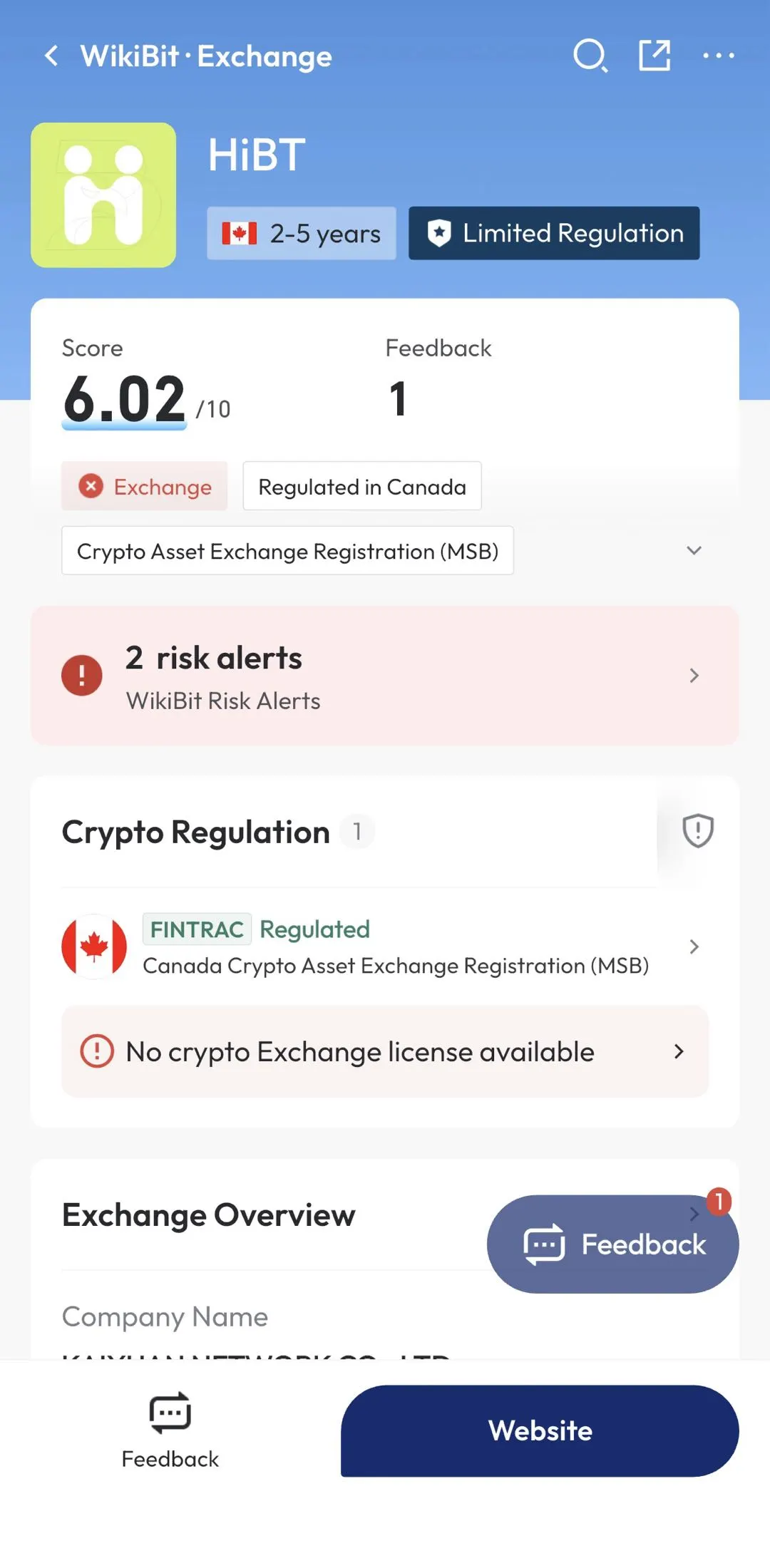
HiBT Risk Data (Source: WikiBit)
When it comes to the issues users care about most — account freezes and withdrawals — HiBT has performed extremely poorly.
On June 28, 2026, a user attempted to withdraw USDT from HiBT to Binance. The funds have still not arrived, with no final confirmation record found on-chain. Shortly afterward, HiBT unilaterally froze the account, citing “risk control” reasons, leaving the user unable to view or operate the account for 18 consecutive days.
Customer service only responded with generic messages such as “The review is currently in progress, please wait patiently,” without providing any specific evidence of violations or a clear processing timeline. However, HiBTs official help page states that risk control reviews typically take approximately 1–3 business days — meaning the actual freeze period exceeded the stated timeframe by more than six times.
Proof of Reserves (PoR) Transparency: Completely Opaque
HiBT claims that “90% of assets are stored in cold wallets,” but it has never released any third-party audited Proof of Reserves (PoR) report. Its so-called “compliance” and “security” are merely verbal promises, with no verifiable on-chain data.
HiBTs business model appears straightforward: users are welcome to deposit funds and trade, but once they start making profits — suddenly there are “account abnormalities.” This kind of “profitable users getting their accounts frozen” behavior is strikingly similar to user complaints seen before the collapse of platforms such as FCoin and CoinUp.
Overall Rating: Extremely High Risk
Questionable regulatory claims, long-term withdrawal freezes, no proof of reserves — HiBT faces the risk of a sudden collapse at any time.
KCEX: A Seychelles-Registered “Risk-Control Withdrawal Machine”
Regulatory Compliance: High Risk
KCEX was registered in Seychelles and established in 2021. The platform claims to “operate under U.S. and Canadian regulatory frameworks” and holds MSB registrations. However, it has not actually obtained authorization from any government financial regulatory authority.
In March 2025, South Korea‘s Financial Intelligence Unit (FIU) classified KCEX as an unregistered foreign virtual asset exchange and initiated sanctions procedures. Turkey’s Capital Markets Board also explicitly stated that KCEX does not hold any Turkish license.
Furthermore, KCEX does not even implement mandatory KYC (Know Your Customer) procedures, making its compliance framework effectively “running without protection.”
Account Freezes and Withdrawals: Extremely Poor
A user transferred 628 USDT from OKX to KCEX, after which the account was permanently restricted from withdrawals due to “risk control.” The platform required the user to submit handwritten holding documents three times. Only after complaints were filed did the account barely pass the initial review, yet the 628 USDT remains unavailable for withdrawal.
Even more concerning, some users reported that after opening positions and making profits on KCEX, the platform directly froze their accounts and marked their realized profits as “cancelled.” Users could only withdraw their original principal.
Proof of Reserves Transparency: Completely Opaque
KCEX has never published any Proof of Reserves report. Although the platform claims to operate under U.S. and Canadian regulatory frameworks, there is no on-chain data available to verify its asset reserves.
Internal Operations: Questionable
Registered in Seychelles, a typical regulatory gray zone, KCEX promotes features such as “zero trading fees” and “up to 5% flexible savings annual yield.”
During a bear market, this kind of high-yield deposit strategy is itself a major warning sign.
Overall Rating: Extremely High Risk
No effective regulation, long-term withdrawal restrictions, and direct cancellation of trading profits — KCEX displays characteristics of a typical platform that profits from user losses.
GOARBIT: A Textbook Ponzi Scheme
Regulatory Compliance: Completely Unregulated
GOARBIT has no valid regulatory oversight.
According to WikiBit records, the exchange is not regulated by any Tier 1, Tier 2, or Tier 3 regulatory authority. Although the platform claims to be registered in the United Kingdom, there is no authorization record from the UK Financial Conduct Authority (FCA).
Account Freezes and Withdrawals: Extremely Poor
GOARBIT has received alarming numbers of user complaints.
One user invested more than 100 million Colombian pesos (over $20,000 USD) and was unable to withdraw any funds. Another user reported being unable to withdraw more than $30,000 USD. Some users claimed that after investing $20,000, the platform simply disappeared with their funds.
The platform allows small deposits and displays fake profits, but when users attempt withdrawals, they encounter delays, “verification issues,” or unexpected additional fees.
Proof of Reserves Transparency: Completely Opaque
GOARBIT has never provided any Proof of Reserves report.
Multiple review agencies have pointed out the platforms lack of transparency, with numerous reports suggesting that it operates using a Ponzi-style model.
Internal Operations: Extremely Chaotic
Some users have claimed that GOARBIT is operated by Gofintech and functions under a pyramid scheme structure.
Essentially, GOARBIT is no longer just a “high-risk exchange” — it is a financial scheme disguised as a cryptocurrency trading platform.
Overall Rating: Extremely High Risk
No regulation, no reserves, no transparency — a typical Ponzi/pyramid scheme. Users are strongly advised to stay away and avoid depositing any funds.
Edgenex Capital: A “Fraud Platform” Flagged by Russian Authorities
Regulatory Compliance: Completely Unregulated
Edgenex Capital has been officially flagged by the Central Bank of Russia (CBR) as a suspected fraudulent platform.
The platform is registered in Saint Lucia and only provides a registered address and registration number. However, Saint Lucias International Financial Centre (IFC) does not regulate the forex market or issue licenses to forex brokers.
The platform has not disclosed any valid regulatory information or licensing details.
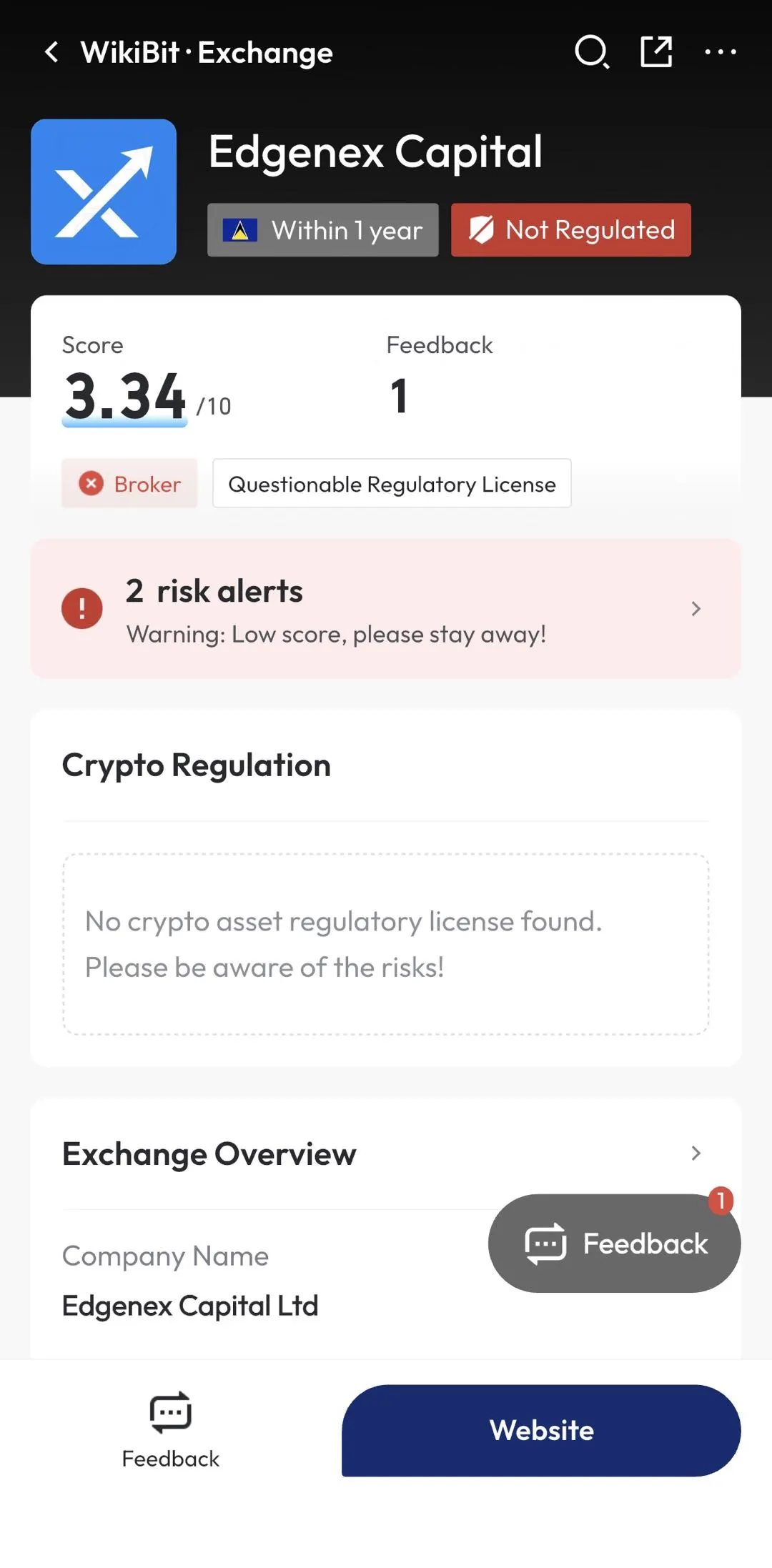
Edgenex Capital Regulatory Status (Source: WikiBit)
Account Freezes and Withdrawals: Extremely Poor
One user invested a total of $10,000 USD (two accounts with $5,000 each). The platform promised fast withdrawals and offered a high-value bonus of up to 300%.
However, the users withdrawal requests were repeatedly delayed, with various reasons given each time. The user had to repeatedly follow up and strongly pressure the platform before finally receiving a small amount of funds.
One of the accounts was emptied under suspicious circumstances. The other account had already closed positions with profits, but both the principal and profits have still not been received.
Proof of Reserves Transparency: Completely Opaque
There is no Proof of Reserves report.
The platform uses an internal trading system instead of widely used platforms such as MT4/MT5, meaning all trading data is controlled by the platform itself and could potentially be manipulated at any time.
Internal Operations: Extremely Chaotic
The platform attracts users with extremely high bonuses (300%/1000%), which is a classic “pig-butchering scam” tactic — offering huge bonuses at the beginning to make users feel they are getting an advantage, then making withdrawals impossible after users deposit larger amounts of capital.
Overall Rating: Extremely High Risk
Flagged by the Central Bank of Russia, lacking any effective regulation, withdrawals are nearly impossible, and the high bonus scheme is a typical scam trap.
Tier 2: Orange Alert — Exchanges Worth WatchingKey Characteristics: Larger scale but frequent negative reports, regulatory disputes, and concentrated user complaints.
MEXC (MEXC Exchange): A “License Collector,” but Its Withdrawal Reputation Has Collapsed
Regulatory Compliance: Medium-to-High Risk — Many Licenses, but Questionable Credibility
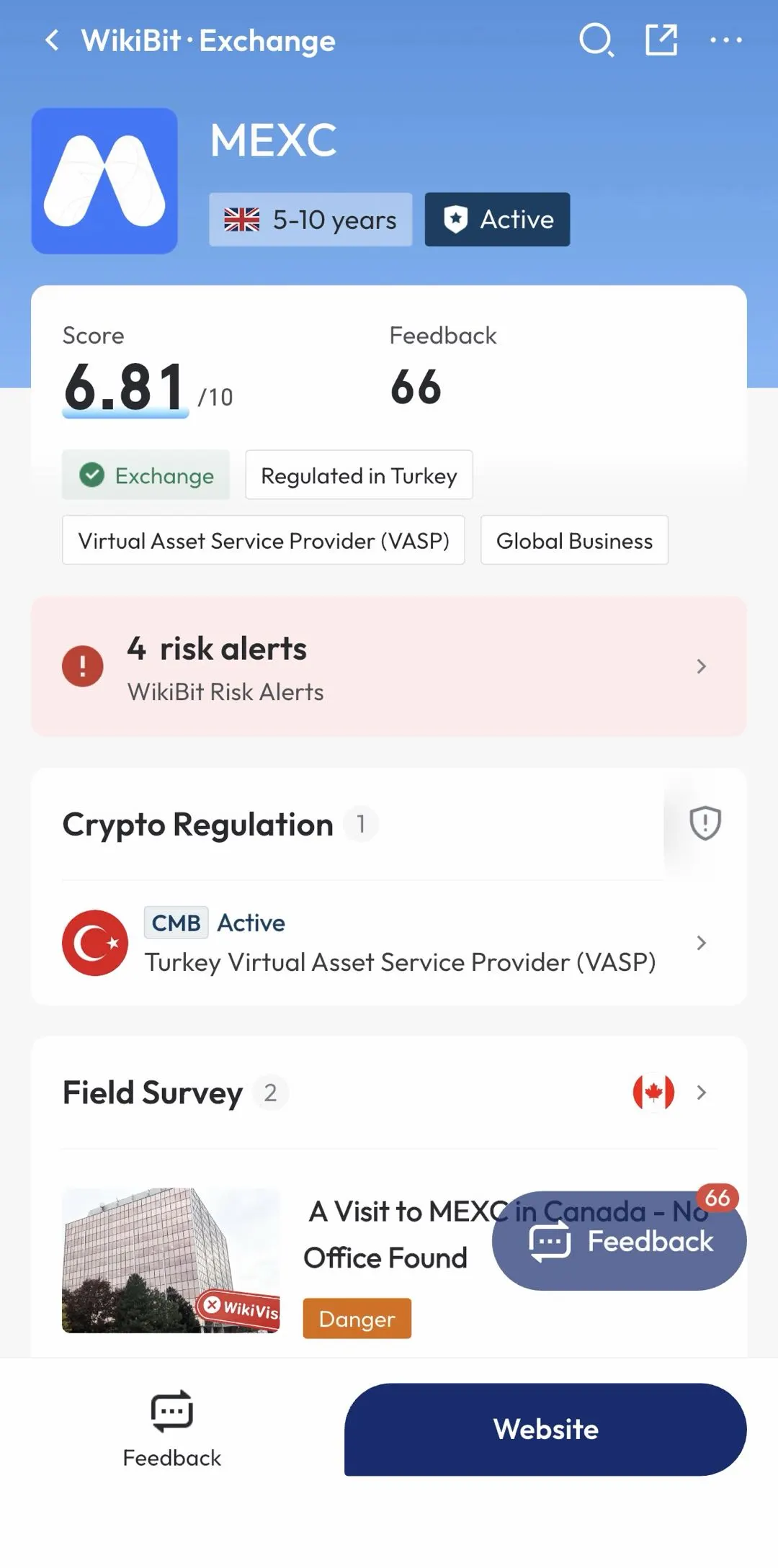
MEXC Risk Status (Source: WikiBit)
MEXC claims to have obtained multiple licenses, including Estonia‘s MTR trading operation license, the U.S. MSB registration, Australia’s AUSTRAC financial service registration, Canada‘s MSB registration, and Switzerland’s VQF compliance certification. The platform has also stated that it is applying for VASP licenses in regions such as Dubai.
However, the actual credibility of these licenses is questionable. MSB registrations, Estonia‘s MTR, and Switzerland’s VQF certification have limited recognition and regulatory value within the industry. MEXC still faces compliance challenges in highly regulated markets such as Europe and the United States. Although MEXC is registered as a PSA-compliant entity in Singapore, Singapore has not issued PSA licenses to any cryptocurrency exchanges — meaning MEXCs compliance status in Singapore remains in a “gray area.”
Account Freezes and Withdrawals: Extremely Poor — User Complaints Have Exploded
This is MEXCs biggest risk point.
A large number of users have reported that withdrawals were frozen indefinitely and trading permissions were restricted without explanation. The common complaint is: “Deposits go through smoothly, but withdrawals become extremely difficult.”
Some users reported that their accounts were frozen after purchasing cryptocurrencies, leaving their funds trapped on the platform. Customer service repeatedly responds with messages such as “Your account is under review, please wait patiently,” but never provides a specific timeline for resolution.
Even more seriously, some users claimed that their account balances were reduced without any clear transaction records, raising concerns about possible “backend manipulation” or “unauthorized deduction of user assets.” As of August 2026, users were still reporting that tens of thousands of dollars in assets remained frozen, while customer support only provided vague explanations such as “system maintenance” or “regulatory cooperation requirements.”
Proof of Reserves Transparency: Relatively Transparent — But Contrasts Sharply With Withdrawal Issues
MEXC regularly publishes Proof of Reserves (PoR) reports, which it says are verified by third-party security firms such as SlowMist and HashQuark. Users can access audit reports through the official website, and the platform claims its reserve ratio exceeds 100%.
However, the irony is clear: even if reserves are transparent, if users cannot press the withdrawal button, those reserves are meaningless from the users perspective.
Internal Operations: Questionable
MEXC underwent a management team transition in 2021, replacing the original team with a new board of directors and international management team. The platform claims operations across more than 170 countries and regions, with over 30 million users.
However, the scale and persistence of user complaints suggest serious problems may exist in its internal operations and risk-control mechanisms.
Overall Rating: High Risk
Although MEXC holds multiple licenses, their actual regulatory value is limited. Withdrawal issues continue to escalate, large numbers of users report trapped funds, and the platforms reputation has suffered significant damage. Users holding assets on MEXC should consider reducing exposure.
HTX (Huobi Global): The “Internationally Sanctioned Exchange” Facing UK and EU Restrictions
Regulatory Compliance: Extremely High Risk — Dual Sanctions From the UK and EU
HTX is facing one of the most serious regulatory crises in the cryptocurrency industry.
On May 26, 2026, the United Kingdom sanctioned Huobi Global S.A. under its Russia sanctions framework, alleging that the Panama-registered entity facilitated fund transfers involving networks linked to the Kremlin. Blockchain analytics firm TRM Labs reportedly tracked more than $4.9 billion in transfers from HTX to Russia-related sanctioned entities between 2021 and 2026. Other reports indicated that HTX processed approximately $21.06 billion in high-risk cryptocurrency flows over the past five years.
More critically, European Council Regulation No. 2026/1848 added HTX to the sanctions list, prohibiting any direct or indirect transactions with HTX within EU jurisdictions starting August 23, 2026. Corporate clients would have no legal exit channels after the deadline.
HTX previously stated that the sanctioned entity “Huobi Global S.A.” was separate from the online HTX exchange. However, later EU regulatory measures referred to both entities together, indicating that regulators did not accept this separation argument.
Account Freezes and Withdrawals: Medium-to-High Risk — Related Freezes Spreading
At present, HTXs own withdrawal system has not experienced large-scale failures. However, the sanctions have triggered a chain reaction.
Platforms such as Bybit and OKX have reportedly increased screening of addresses associated with HTX, causing some users whose funds previously passed through HTX to experience account freezes on other platforms. Services such as FixedFloat have also suspended deposits originating from HTX.
Some users reported that their HTX accounts had been frozen for more than four months, with customer service providing no explanation beyond asking them to “wait patiently.” The WLFI project team also froze WLFI assets held in HTX-related addresses.
Proof of Reserves Transparency: Relatively Transparent — 46 Consecutive Months of Disclosure
HTX is one of the earliest exchanges in the industry to continuously publish Merkle Tree-based Proof of Reserves reports. As of August 2026, it has disclosed PoR data for 46 consecutive months.
The latest data shows that major asset reserve ratios remain above 100%, including BTC at 103%, ETH at 100%, and TRX at 106%.
However, the key issue is that under international sanctions, even sufficient reserves cannot guarantee actual usability of user funds if compliance channels are cut off.
Internal Operations: High Risk — Survival Crisis Under Sanctions
Overall Rating: High Risk
HTX faces international sanctions, exposure of massive high-risk fund flows, and widespread account restrictions. The platform could face collapse pressure at any time due to regulatory challenges.
WEEX: A “Delete Negative Posts Before Withdrawal” Platform Behind a Polished Image
Regulatory Compliance: Medium-to-High Risk
WEEX claims to hold U.S. MSB and Canadian MSB registrations, and announced in July 2026 that it had obtained a financial license from Saint Vincent and the Grenadines Financial Services Authority (SVGFSA).
However, MSB and SVGFSA registrations have limited regulatory value. The platform is also applying for licenses such as Australias DCE registration and Philippines central bank approval, but it has not yet obtained top-tier financial regulatory licenses in major markets.
Account Freezes and Withdrawals: Medium Risk — But Complaints Are Concentrated
WEEXs complaint pattern is highly typical.
Some users reported that their account balances suddenly decreased by 2,200 USDT without notification. Customer service claimed it was a “risk reserve deduction” based only on a “system judgment,” instructing users to check the user agreement themselves.
Even more concerning, after users posted complaints on social media, WEEX allegedly contacted them and requested that they “delete related inaccurate statements, after which we can prioritize your withdrawal issue.”
Translated: If you do not delete the post, you may not get your money back.
On the FX110 complaint platform, users reported that WEEX blocked withdrawals and restricted both trading and withdrawals, with review periods lasting 14 days.
Proof of Reserves Transparency: Relatively Transparent
WEEX provides a Proof of Reserves page and regularly publishes reserve data. The platform has also established a 1,000 BTC investor protection fund.
However, it should be noted that these are self-disclosed platform data, and no independent third-party audit report has been issued.
Internal Operations: Questionable
An individual claiming to be a former BitMart employee and current WEEX employee posted on social media alleging internal management chaos and misleading practices.
On one side, WEEX presents itself as an official La Liga partner, backed by a 1,000 BTC protection fund and multiple registrations. On the other side are allegations involving unauthorized fund deductions, pressure to delete complaints before withdrawals, and sudden account freezes.
The contrast between its polished image and negative user experiences is significant.
Overall Rating: Medium-to-High Risk
Licenses have limited credibility, user complaints are concentrated, and there are allegations of internal management issues. While reserve transparency is relatively better, the lack of third-party audits remains a concern.
KuCoin: A Compliance “Tale of Two Extremes”
Regulatory Compliance: Medium-to-High Risk — Penalized by Some, Selected by Others
KuCoins compliance situation shows extreme polarization.
Negative developments:In March 2026, Dubai‘s Virtual Assets Regulatory Authority (VARA) issued an investor warning stating that KuCoin provided services to Dubai customers without proper authorization. On June 24, 2026, VARA officially fined KuCoin’s operator Peken Global Limited and ordered it to immediately stop all unauthorized virtual asset activities.
Previously, KuCoin had also been fined $500,000 by the U.S. CFTC and permanently banned from operating in the U.S.
Positive developments:In April 2026, KuCoin became the only global exchange selected for Nigerias central bank virtual asset regulatory pilot program. The platform has completed international certifications including SOC 2 Type II, ISO 27001, ISO 27701, and CCSS. It has also completed AUSTRAC registration in Australia and obtained a MiCAR license in Austria.
Account Freezes and Withdrawals: Risk Exists — User Complaints Continue
In July 2026, multiple KuCoin users reported on social media that the platform had frozen assets without explanation and blocked withdrawals.
A Reddit user claimed that withdrawals initiated in December 2025 were repeatedly rejected and remained locked for months, with no meaningful updates from KuCoin.
KuCoin stated that it was communicating with affected users to resolve issues.
Currently, the scale of these complaints has not reached a “systemic crisis” level, but continued user reports remain a warning sign. Additionally, increasing global regulatory pressure could potentially trigger liquidity risks.
Proof of Reserves Transparency: Industry Leading — 44 Consecutive Months of Disclosure
KuCoin has completed Proof of Reserves reports for 44 consecutive months and has undergone 14 independent audits conducted by cybersecurity firm Hacken.
Its reserve transparency remains among the strongest in the industry.
Internal Operations: Relatively Stable
Despite facing regulatory pressure in multiple jurisdictions, KuCoin has invested heavily in compliance, actively pursuing licenses and certifications worldwide. Its internal operations appear relatively structured.
Overall Rating: Medium-to-High Risk
Regulatory pressure from multiple jurisdictions continues to increase, and licensing challenges remain unresolved. However, its inclusion in Nigerias regulatory pilot and multiple international certifications demonstrate compliance efforts. The situation remains highly polarized and requires continued monitoring.
Bybit: “Regulatory Siege, Liquidity Under Pressure”
Regulatory Compliance: Medium-to-High Risk — Facing Global Regulatory Pressure
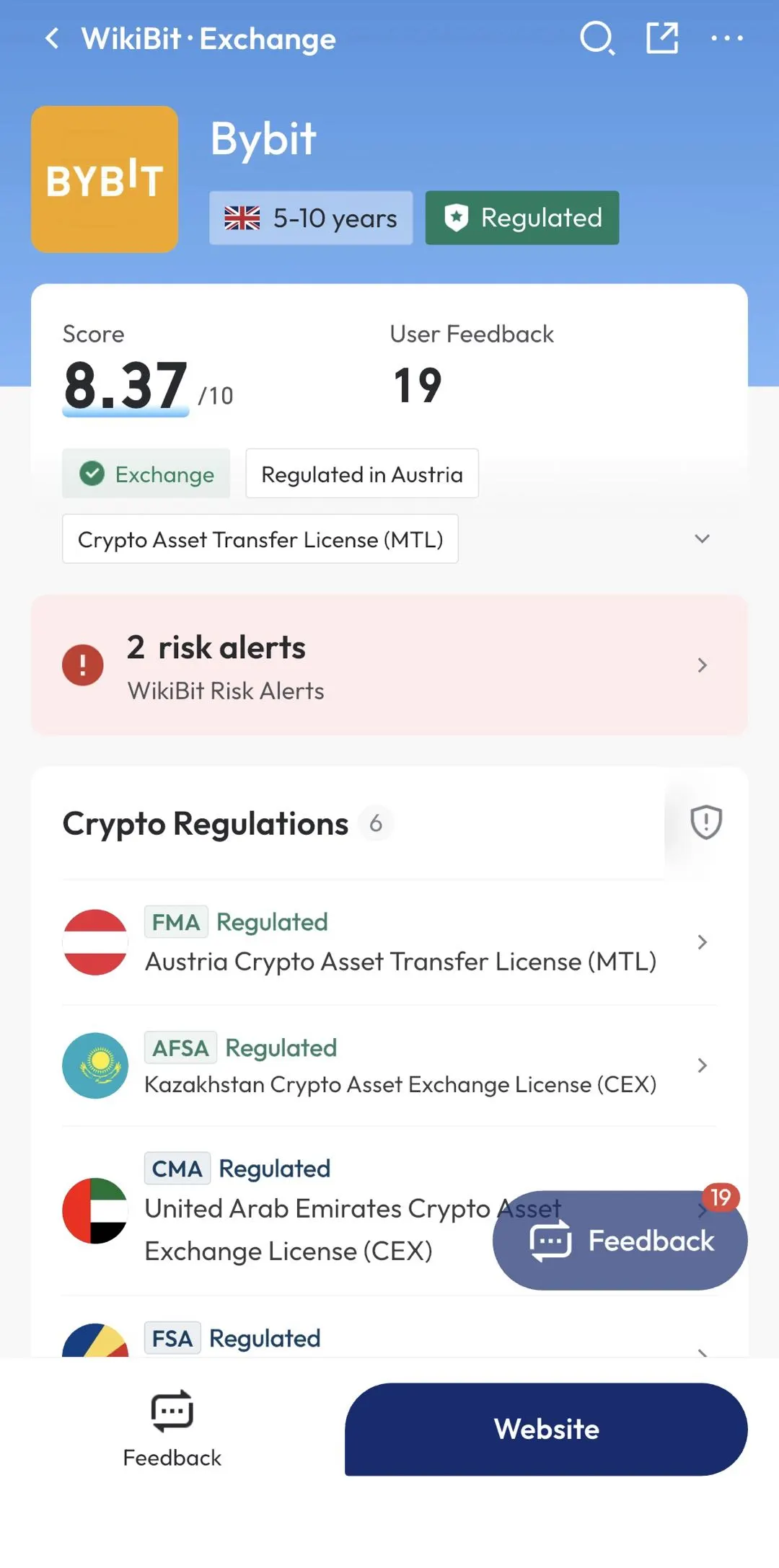
Bybit Risk Status (Source: WikiBit)
Bybit is facing increasingly intense regulatory pressure.
On June 18, 2026, the Monetary Authority of Singapore (MAS) added Bybit Fintech Ltd. to its Investor Alert List, explicitly stating that Bybit “has never been authorized to establish a licensed operation in Singapore.”
Previously, Malaysias Securities Commission took enforcement action against Bybit in December 2024, accusing the platform of illegally operating without registration.
In addition, Bybit has announced plans to gradually restrict European Economic Area (EEA) users access to certain services.
Bybit responded that it was communicating with MAS and had implemented geo-blocking for Singapore IP addresses. However, the logic of “I blocked access, so regulators should not take action against me” clearly does not hold up under regulatory scrutiny.
Account Freezes and Withdrawals: Medium Risk — Complaints Concentrated but Not Systemic
Bybits withdrawal functions are currently operating normally. However, the platform faces compliance pressure across multiple major markets worldwide. If regulatory enforcement escalates, user funds could face potential freezing risks.
Proof of Reserves Transparency: Industry Leading — 36 Consecutive Months of Disclosure
Bybit has released its 36th Proof of Reserves (PoR) report, with reserve ratios for major assets all exceeding 100%.
The USDT reserve ratio stands at 106%, and the platform continues to expand the range of assets covered by its PoR disclosures.
Internal Operations: Relatively Stable
Bybit has a large operational scale and a relatively mature internal management system.
However, regulatory pressure from multiple jurisdictions remains its biggest uncertainty. If fiat payment channels in major markets are disrupted, the risk of a liquidity crisis and potential bank run cannot be ignored.
Overall Rating: Medium-to-High Risk
Bybit has strong reserve transparency, but regulatory pressure is clearly intensifying, with Singapore MAS warnings, Malaysian enforcement actions, and European restrictions creating a growing compliance challenge.
Tier 3: Yellow Watchlist — Currently Stable but Requires MonitoringKey Characteristics: Large scale and substantial user bases, but recent warning signals have emerged.
Binance: The Worlds Largest Exchange Facing a Global Compliance Dilemma
Regulatory Compliance: Medium-to-High Risk — Global Regulatory Pressure Continues
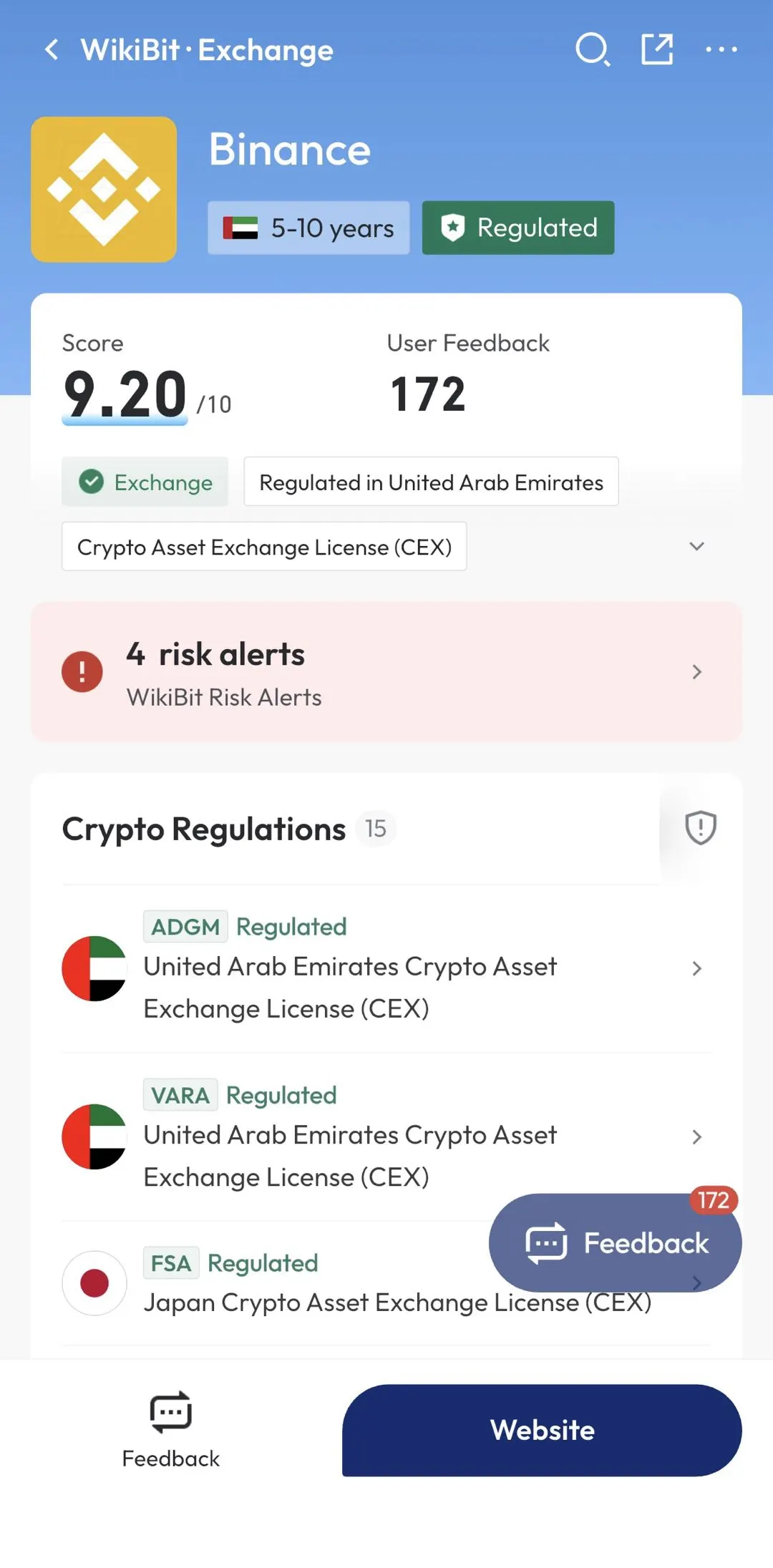
Binance Regulatory Status (Source: WikiBit)
Binance has obtained licenses in more than 20 countries and regions, including markets in the Middle East and India. However, the exchange is currently facing the most intense wave of global regulatory pressure in its history.
In 2023, Binance admitted violations of the U.S. Bank Secrecy Act and U.S. sanctions regulations, agreeing to pay more than $4.3 billion in penalties to the U.S. Department of the Treasury and the Department of Justice. The company also committed to fully exiting the U.S. market and accepted five years of independent compliance monitoring.
In May 2026, the U.S. Treasury Department requested meetings with Binance executives and access to relevant data to review the implementation of the settlement agreement. Failure to comply with the terms could result in up to $150 million in suspended penalties being imposed.
An even greater blow came from the European Union. Due to Binances failure to obtain a MiCA license, the exchange stopped providing services to EU customers starting July 1, 2026. Losing access to the European market represents a major revenue challenge for Binance.
The situation in the United Kingdom is also escalating. Nearly 1,700 UK investors have filed a lawsuit against Binance and its founder Changpeng Zhao (CZ) at the High Court of London, seeking at least £150 million (approximately $200 million USD) in damages. The lawsuit alleges that Binance sold high-risk cryptocurrency derivatives without proper regulatory authorization.
Binances Chief Strategy Officer Patrick Hillmann acknowledged that the company expects to pay additional fines to resolve ongoing investigations in the United States.
Account Freezes and Withdrawals: Medium Risk — Strict Risk Controls, But Many False Positives
Binances withdrawal functions remain generally stable, supported by strong liquidity.
However, its strict compliance and risk-control systems have resulted in a large number of users experiencing account restrictions. Cases involving frozen Web3 withdrawals and C2C trading accounts have also been reported.
Most freezes are related to Binances strict anti-money laundering (AML) reviews implemented to comply with regulatory requirements across different jurisdictions. However, cases involving legitimate users being affected by false positives are not uncommon.
Proof of Reserves Transparency: Industry Benchmark — 43 Consecutive Months of Disclosure
Binance has released its 43rd Proof of Reserves (PoR) report.
The latest data shows:
BTC reserve ratio: 100.25%
ETH reserve ratio: 100.02%
USDT reserve ratio: 103.76%
BNB reserve ratio: 101.26%
Internal Operations: Medium-to-High Risk — Compliance Team “Earthquake”
Binances internal operations are experiencing significant changes.
In April 2026, reports emerged that Chief Compliance Officer Noah Perlman was considering departure. Several senior compliance executives responsible for sanctions enforcement, financial crime monitoring, and investigations have also reportedly left the company.
Departures reportedly include key positions such as:
Global Head of Investigations
Head of Special Investigations
Asia-Pacific Intelligence Lead
Head of Financial Crime Investigations
Head of Transaction Monitoring
Binance stated that these personnel changes were part of “normal employee turnover and performance management.”
However, with the U.S. Treasury Department reviewing the execution of Binances settlement agreement at the same time, the timing of multiple senior compliance departures has attracted significant attention.
Overall Rating: Medium-to-Low Risk
As the worlds largest cryptocurrency exchange with highly transparent reserves, Binance remains relatively strong. However, global regulatory pressure has never stopped. The departure of key compliance executives, the loss of the EU market, and a potential $200 million UK lawsuit remain major uncertainties hanging over the platform.
OKX: Four Major Markets Secured With Licenses, But Regulatory Pressure Arrives
Regulatory Compliance: Medium Risk — $500 Million Settlement, But Only the Beginning
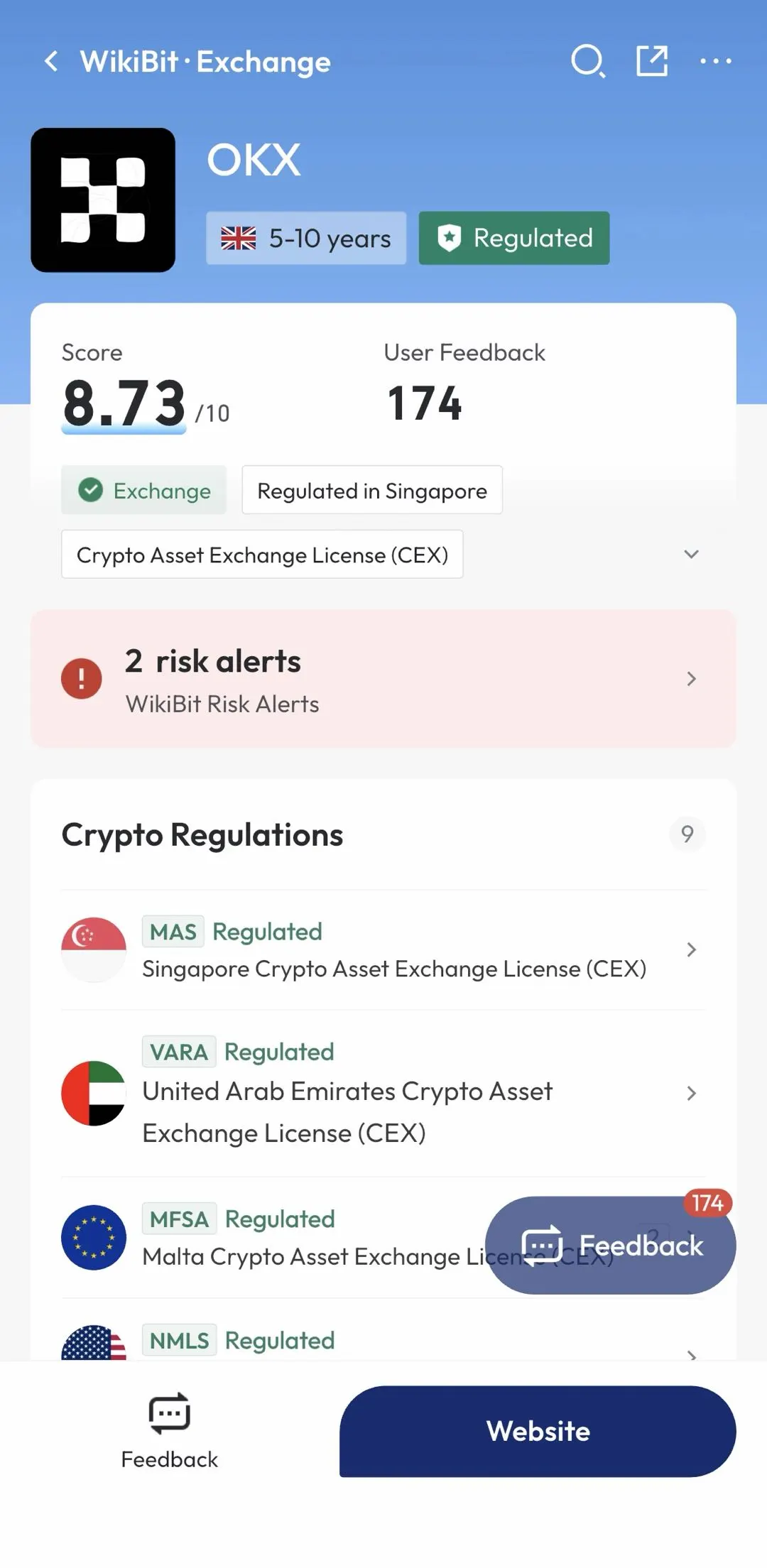
OKX Regulatory Status (Source: WikiBit)
OKX has obtained the EUs first MiCA license, U.S. multi-state Money Transmission Licenses (MTLs), Singapore MAS approval, and Dubai VARA authorization. It has secured licenses in all four major core markets, making it one of the cryptocurrency exchanges with the most comprehensive global compliance frameworks.
However, OKX faced the most significant regulatory blow in its history in 2026.
In July 2026, OKXs Seychelles subsidiary reached a settlement with the U.S. Department of Justice, admitting that due to insufficient historical compliance controls, a small number of U.S. customers had traded on its global platform.
Under the agreement, OKX agreed to pay an $84 million penalty and forfeit approximately $421 million in revenue generated from U.S. customers during the relevant period. The total cost exceeded $500 million.
The case established a new benchmark for penalties against exchanges for inadequate transaction monitoring, with the scale approaching that of major securities fraud cases. In addition, OKX has faced regulatory actions in regions including the EU and Thailand for operating without proper authorization.
Account Freezes and Withdrawals: Medium Risk — Occasional Freezes, Founder Personally Steps In
OKXs withdrawal functions are generally operating normally, but user complaints continue.
In January 2026, a user named Captain Bunny complained on X that OKX had frozen approximately 40,000 USDT across four accounts.
OKX founder Star Xu responded that after investigation, the user had purchased a KYC account, and the platforms services are only available to the verified account owner.
Other users have reported being unable to withdraw funds after participating in new token launches, with the exchange restricting withdrawals under reasons such as “lock-up periods,” “risk control,” or “project requirements.”
Proof of Reserves Transparency: Industry Benchmark — 45 Consecutive Months of Disclosure
OKX was one of the earliest exchanges to publish Proof of Reserves (PoR) reports.
It has now released its 45th PoR report.
The latest data shows:
All 22 major disclosed assets maintain reserve ratios of 100% or above
BTC reserve ratio: 105%
ETH reserve ratio: 103%
USDT reserve ratio: 112%
OKX maintains sufficient reserves and continues transparent disclosure.
Internal Operations: Medium Risk — Layoffs and Restructuring Ongoing
OKX conducted a major internal restructuring in early 2026.
Reports indicated that OKX reduced staff in its institutional business division by approximately 30%–50%. Chief Financial Officer Yana Vella also reportedly left the company.
At the same time, OKX plans to relocate up to 2,000 of its 5,000 employees to the United States.
This strategic shift deserves attention: after receiving a $500 million penalty from the U.S. Department of Justice, OKX appears to be increasing its investment in the U.S. market. The possible strategy is: “Since the penalty has already been paid, it is better to enter the U.S. market openly and compliantly.”
Overall Rating: Medium-to-Low Risk
The $500 million settlement temporarily resolved U.S. regulatory issues, but global compliance pressure remains. Internal restructuring and layoffs are ongoing, while transparent and sufficient reserves remain OKXs strongest advantage.
Bitget: Overall Strong, But Hidden Risks Remain
Regulatory Compliance: Medium Risk
Bitget registered as a New Zealand Financial Service Provider (FSP) in July 2026.
The platform also became the first exchange to obtain a compliance license in a Gulf country.
Bitget has open-sourced the code for its 100% solvency program on GitHub, a level of transparency that is rare in the industry. Private keys are stored using distributed key-sharing technology across vaults on three continents.
Account Freezes and Withdrawals: Requires Attention
Bitget has recently experienced multiple temporary withdrawal suspensions across different networks.
Affected networks include:
SOL
HIVE
BTC-BSC
SKR-Solana
ID-ERC20
CANTO
Although the official explanation was “wallet maintenance,” repeated large-scale withdrawal interruptions across multiple networks remain a point of concern.
Proof of Reserves Transparency: Industry Leading
Bitget is one of the industry benchmarks for reserve transparency.
As of June 2026, Bitget had published audited Proof of Reserves reports for 42 consecutive months.
The June 2026 report showed:
Total reserve ratio: 127%
BTC reserve ratio: 138%
ETH reserve ratio: 147%
USDT reserve ratio: 100%
USDC reserve ratio: 104%
Internal Operations: Relatively Stable
Although registered in Seychelles, Bitget has attempted to offset the risks associated with offshore registration through multi-country compliance expansion, including New Zealand FSP registration and Gulf-region licenses.
The platform has a relatively large operational scale.
Overall Rating: Medium-to-Low Risk
Strong reserve transparency, sufficient reserves, and expanding compliance coverage are major advantages. However, users should monitor frequent network withdrawal suspensions and the offshore registration structure in Seychelles.
Gate.io: Comprehensive Compliance Strategy, But Reserve Ratio Declining
Regulatory Compliance: Medium Risk
Gate.io continues expanding its global compliance footprint.
Its affiliated entities have obtained:
EU MiCA license
Dubai VARA license
Japan FSA license
U.S. MTL licenses
Australia AUSTRAC registration
Among major exchanges, Gate.io has one of the most comprehensive compliance layouts.
Account Freezes and Withdrawals: Normal
Currently, there are no widespread reports of withdrawal difficulties involving Gate.io.
However, an X user with the handle @jheioff disclosed that cryptocurrency assets worth $1.7 million in their Gate.io account were stolen.
The account had:
Identity verification enabled
Phone verification enabled
Google 2FA enabled
Email verification enabled
All security measures were reportedly active, yet the user did not receive any SMS verification code on their mobile device.
After the incident became public, Gate.io recorded a net withdrawal outflow of $207 million within one day.
This was not a single-day panic withdrawal — the platform experienced stable net outflows for seven consecutive days, suggesting that users were voting with their actions.
Proof of Reserves Transparency: Industry Benchmark
Gate.io is an early pioneer in reserve transparency.
As of August 3, 2026:
Total reserve ratio: 117%
Total reserve value: $8.182 billion
Covers nearly 500 user assets
However, attention should be paid to the declining trend:
The reserve ratio has fallen from 128% in 2025 to 117% in August 2026.
Although it remains well above the 100% safety threshold, the downward trend requires monitoring.
Gate.io has announced plans to move to biweekly proof-of-reserves updates in Q4 2026 and publish liability updates daily.
Internal Operations: Stable
Gate.io is a long-established exchange with a relatively long operating history and comparatively transparent team information.
Overall Rating: Medium-to-Low Risk
Comprehensive compliance coverage, transparent reserves, and sufficient excess reserves are major strengths. However, the declining reserve ratio and emerging trust concerns require continued monitoring.
Ten Warning Signs to Identify Exchange Collapse RisksBased on historical cases and blockchain analysis, the more of the following signals appear, the higher the probability of an exchange collapse:
1. Abnormal Withdrawal Delays
When exchanges frequently delay withdrawals under excuses such as “system upgrades” or “anti-money laundering reviews,” it is often a sign of liquidity pressure.
Withdrawal delays exceeding 72 hours should be considered a red alert.
2. Frequent Withdrawal Suspensions
If an exchange repeatedly suspends withdrawals for specific networks or assets with vague explanations, users should exercise extreme caution.
3. Sudden Executive Turnover or Mass Layoffs
Large-scale employee departures or sudden leadership changes are among the earliest warning signals.
4. Opaque Registration Locations or Regulatory Vacuums
If an exchange is registered in offshore jurisdictions such as the Cayman Islands or Seychelles but lacks licenses in major regulatory jurisdictions, users may have little legal protection when problems occur.
5. Never Publishing Proof of Reserves
After the FTX collapse, any exchange that refuses to publish third-party verified Proof of Reserves deserves scrutiny.
6. Abnormal Collapse of Platform Token Prices
The exchange token price is often a “health indicator” of the platform.
7. Warnings or Sanctions From Multiple Major Regulators
Examples include:
HTX being sanctioned by the UK
Bybit being placed on MASs warning list
KuCoin facing regulatory pressure across multiple countries
These are significant risk indicators.
8. Large Numbers of Withdrawal Complaints in the Community
When social media platforms are flooded with withdrawal complaints, it usually indicates the problem has become widespread.
9. Insufficient Hot Wallet Liquidity
Using blockchain tools such as Arkham and Etherscan, users can monitor exchange hot wallet balances.
A continuous decline in highly liquid assets such as ETH, USDT, and BTC in hot wallets is a clear warning signal.
10. Sudden Increase in “Risk Control” Requirements
If an exchange suddenly demands additional KYC documents, extends review periods, or increases restrictions under the name of risk control, it may be delaying withdrawals.
ConclusionThe cryptocurrency market in 2026 is undergoing a profound “supply-side restructuring.”
Shrinking trading volumes, rising compliance costs, and intensified competition are eliminating platforms that lack sustainable business models.
Unlike the catastrophic FTX-style collapse, this wave of shutdowns is more of an “orderly exit.” Some platforms are closing because their business models are no longer sustainable.
However, for users, the result is the same whether it is an “orderly exit” or a “runaway collapse”:
Your assets may become trapped on the platform and impossible to withdraw.
The cryptocurrency market is moving toward maturity, and one sign of maturity is the elimination of weaker players.
For ordinary investors, the most important lesson during this crypto winter is not hunting for the bottom — it is protecting asset security.
Remember: In a bear market, survival matters more than anything else.