






In a recent report, Bitfinex Securities highlights the relevance of tokenization in modernizing and streamlining Venezuelan market operations, democratizing investment options for companies facing capital-raising difficulties and investors seeking access to markets traditionally managed by large institutions.
Key Takeaways:
- Bitfinex says tokenization could help Venezuelan firms raise $50M+ despite a market with only 40 listings.
- Aaron Olmos sees tokenization attracting global capital in 2026, boosting Venezuelas recovery.
- Jose Grasso Vecchio says tokenized assets need compliance first; regulation is the next hurdle.
Bitfinex Report: Tokenization Might Drive Internationalization of Venezuelan Markets Forward
In its Securities Latin America Market Inclusion Report, Bitfinex Securities has highlighted the tokenization opportunities arising in Venezuela after the arrest of President Nicolas Maduro in January.
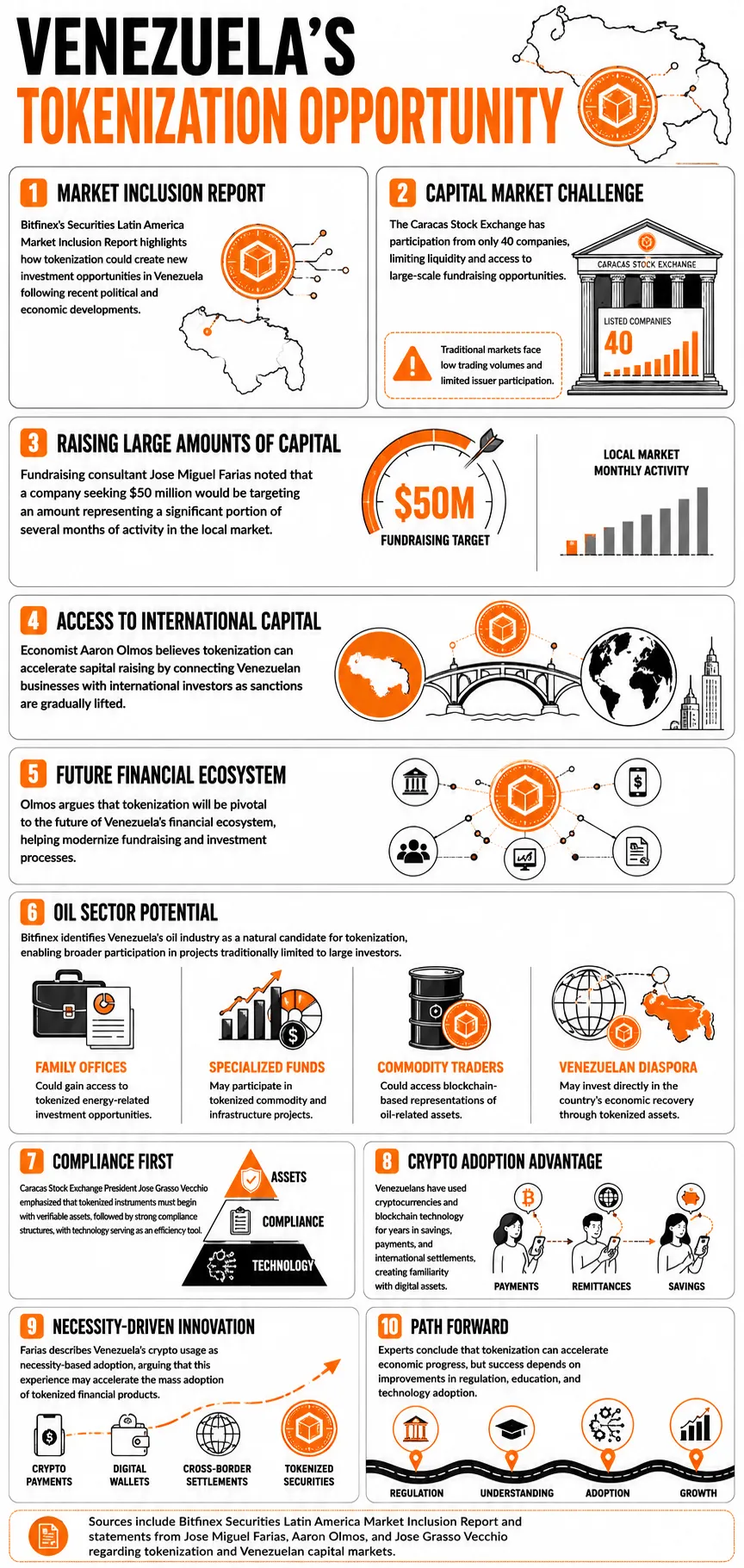
According to experts, this tech might help prop up traditional stock markets, like the Caracas Stock Exchange, and assist companies needing significant capital to reach international markets, sidestepping the low volumes and restrictions of the index, which has participation from only 40 companies.
Jose Miguel Farias, a fundraising consultant, stressed that any company raising large amounts of funds, from $30 million to $50 million, would be “aiming for an amount that represents a significant fraction of what the local market moves in several months.”
Economist Aaron Olmos highlights that tokenization might help fast-track capital raises in Venezuela, opening the doors to international capital with the gradual lifting of sanctions over the economy. In this sense, Olmos stressed that tokenization“will be pivotal to the future of the countrys financial ecosystem.”
Bitfinex pointed to the oil sector as a natural choice for tokenization, paving the way for family offices, specialized funds, commodity traders, and Venezuelans abroad to participate in the renaissance and mobilize capital toward it, simultaneously democratizing investments traditionally restricted to large capital holders.
Nonetheless, President of the Caracas Stock Exchange Jose Grasso Vecchio stressed that any tokenized instrument built on Venezuelan assets “must follow the inverse logic: verifiable asset, first; robust compliance structure, second; and technology as an efficiency tool, third.”
Venezuelans might have an edge over other markets, as they have been using cryptocurrency and blockchain technology for years in savings, payments, and international settlements.
Farias claims that the natural inclusion of crypto assets in Venezuelan daily lives constitutes necessity-based adoption and that it might help towards the massification of tokenization processes in financial markets.
“Tokenization can do a great deal to accelerate progress, but it cannot do so in isolation; it requires the country to advance in its understanding, regulation, and adoption of these technologies,”he concluded.
