






Stablecoin payments expanded in 2025, with a growing share of B2B transfers. According to Artemis, the tokens saw 70% more usage as a payment tool since February.
In 2025, stablecoin payments expanded by over 70% since February. The fiat-pegged market evolved, with payments becoming one of the key vectors of development, with Circles USDC leading the trend.
Artemis, one of the leading crypto data hubs, collected data from 22 crypto payment companies to estimate the real-life usage of stablecoins. An additional 11 startups were interviewed for extra data, coming from B2B, P2P, B2C, card payment, and prefunding payments.
The data collection tracked $136B in payments between firms, settled between January 2023 and August 2025. The time period already showed the evolution of the stablecoin market, as trends continued into Q3, with expanded supply and active users.
B2B payments dominated the market
Artemis discovered B2B payments were the biggest boost to activity, as the assets allow large, permissionless settlements. This type of payments reached $76B annualized, while P2P payments came second with $19B per year.
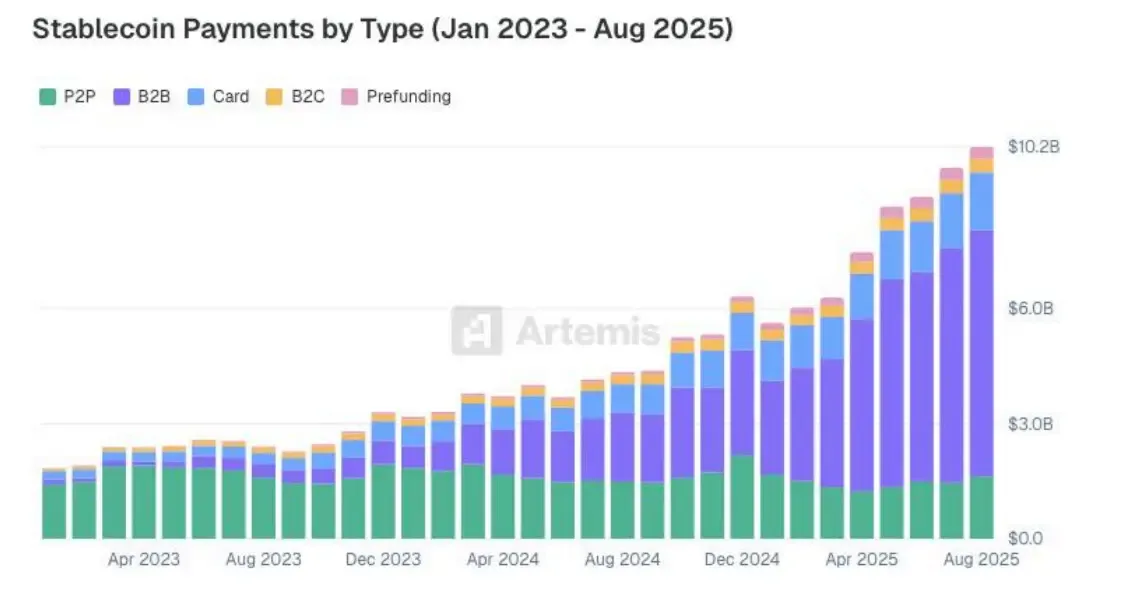
B2B payments were the most active segment for stablecoin usage. App and card payments expanded in 2025, showing mainstream retail adoption. | Source: Artemis
Crypto cards followed in popularity, with $18B in annual settlements. B2C payments were at $3.3B, while prefunded payment solutions settled $3.6B.
Despite the growing influence of USDC, Tethers USDT was still the most popular token used by firms. USDT had a 85% market share by volume, with Circle coming second. TRON carried the biggest stablecoin volumes, followed by Ethereum, BNB Chain, and Polygon.
The USA, Singapore, and Hong Kong posted the biggest transfer volumes for payments.
Payment solutions boosted stablecoin usage
One of the factors for the increased usage of stablecoins were the payment apps built by centralized exchanges. Most notably, Bybit Pay and Binance Pay emerged as activity hubs, tapping their exchange customers with additional transfer tools.
BVNK also emerged as a payment gateway, with infrastructure linking banks and blockchains. BVNK focuses on the scalability problems of businesses. The approach of BVNK is to allow businesses to use fiat, then complete the stablecoin transactions on the backend, using the fast, borderless infrastructure.
Stablecoin cards were the other factor to boost mass adoption. With clearer regulations, card usage expanded since its baseline levels in 2023. Crypto card volumes reached over $1.5B in monthly settlements as of August 2025.
Cards linked to stablecoin balances are trying to offer a seamless experience based on usual card usage patterns. The growth of crypto cards put payment providers like Exa and Gnosis Pay in line with conventional credit and debit card usage. The average size of payments for Exa was comparable to US debit card spending.
P2P payments did not see any big changes or new trends. Those types of payments had a lower average transaction size. The average size of P2P payments was lower compared to Zelle and Venmo. Overall, P2P is among the riskiest usages for stablecoins, as users flocked to curated apps.
Stablecoins are still widely used in scams, and only a fraction of the stolen funds is frozen or returned.