






The world‘s biggest stablecoins are increasingly becoming chain-specific financial products, with Tether’s USDt (USDT) and Circles USDC (USDC) serving distinct roles across the crypto ecosystem rather than competing head-on.
Dune‘s Digital Asset Brief found that USDT overwhelmingly dominates onchain payments. During the first half of 2026, the biggest stablecoin settled about $95 billion in identified commerce payments, compared with $14 billion for second-biggest USDC. It also accounted for roughly 92% of the $48 billion in business-to-business payment volume. On Tron, USDT’s largest network, around 93% of the tokens supply is held in ordinary wallets rather than on exchanges, underscoring its role as a payment and remittance asset.
USDC, meanwhile, has established itself as the dominant stablecoin in decentralized finance. USDC on Base processed roughly $2.6 trillion in transfer volume in June, the highest of any token-chain pair, while on Ethereum, that stablecoin handled another $1.6 trillion.
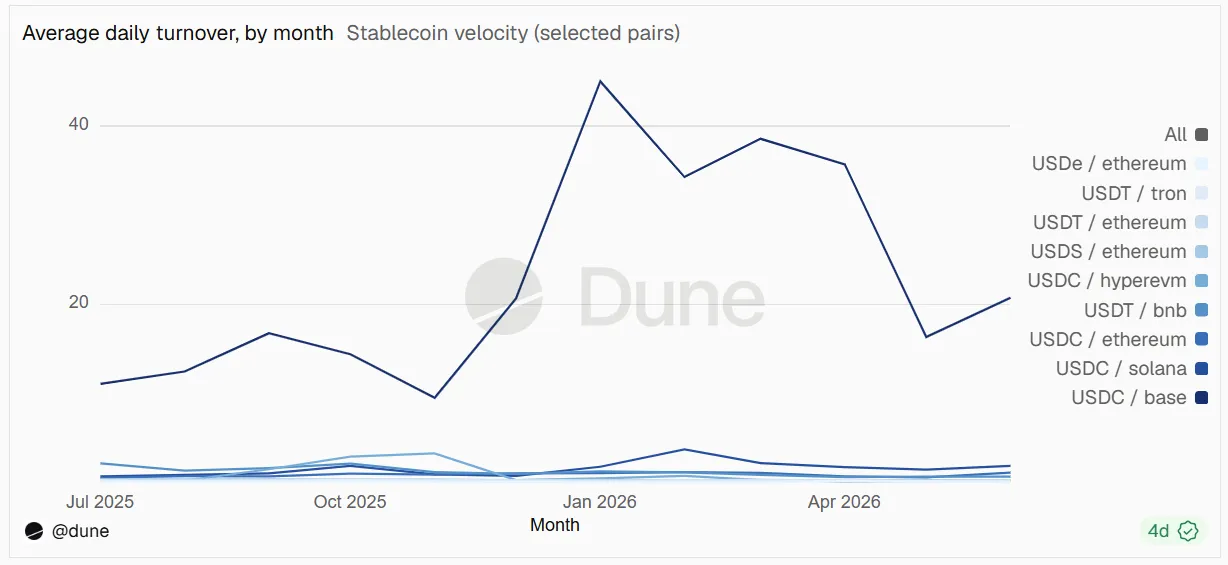
USDC on Base recorded daily velocity of about 20 times its circulating supply in June, reflecting its extensive use in trading and DeFi. Source: Dune
The findings suggest the traditional USDT-versus-USDC narrative is becoming less useful. Instead, each stablecoin is carving out its own niche, with USDT dominating payments and USDC underpinning much of cryptos trading and DeFi activity.
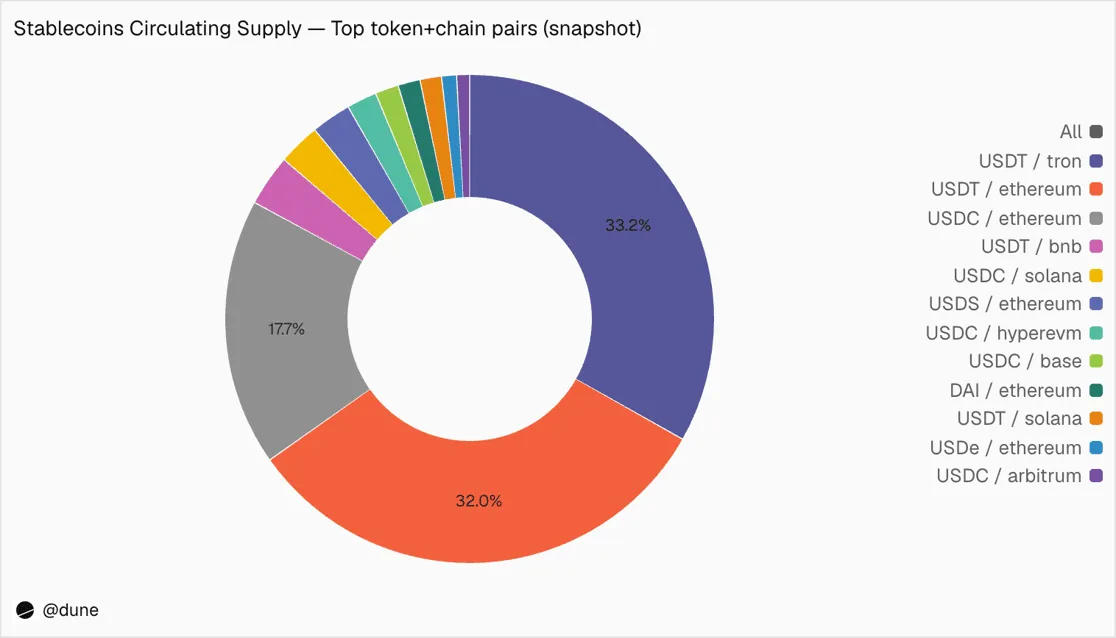
USDTs supply is split almost evenly between Tron and Ethereum, while USDC remains heavily concentrated on Ethereum despite expanding to newer blockchains. Source: Dune
The findings come as the two digital assets continue to dominate the stablecoin market. Together, they account for roughly 83% of the sectors approximately $315 billion market capitalization, according to Dune, which tracked more than 200 stablecoin tokens across multiple blockchains.
Related: UN agency moves Stellar blockchain payment initiative beyond pilot stage
US lawmakers reshape stablecoin rules
The stablecoin sector has gained momentum in the United States following the passage of the GENIUS Act. Signed into law in 2025, GENIUS established the first federal regulatory framework for payment stablecoins, paving the way for banks and other companies to issue US dollar-pegged digital assets.
Lawmakers are now debating the CLARITY Act, which would establish a broader market structure for digital assets by defining when crypto assets fall under the jurisdiction of the US Securities and Exchange Commission or the US Commodity Futures Trading Commission. While the bill does not regulate stablecoins directly, it would shape the broader regulatory environment in which stablecoin issuers, exchanges and DeFi platforms operate.
CLARITY cleared the Senate Banking Committee in May and could receive a full Senate vote before the August recess, although Galaxy recently trimmed its odds of passage before the break to 50% as lawmakers run short on time.
Magazine: Krakens $600M stablecoin firm, Huione scandal deepens: Asia Express