






Ether at $250,000 would make Ethereum a $30 trillion network, larger than the U.S. Treasury market and comparable to all the gold ever mined.
But that's the target Bitmine chairman Tom Lee laid out at Proof of Talk in Paris this week, with the move pitched as a 50x from current levels on the back of AI-driven payments and a corporate validator takeover of the network.
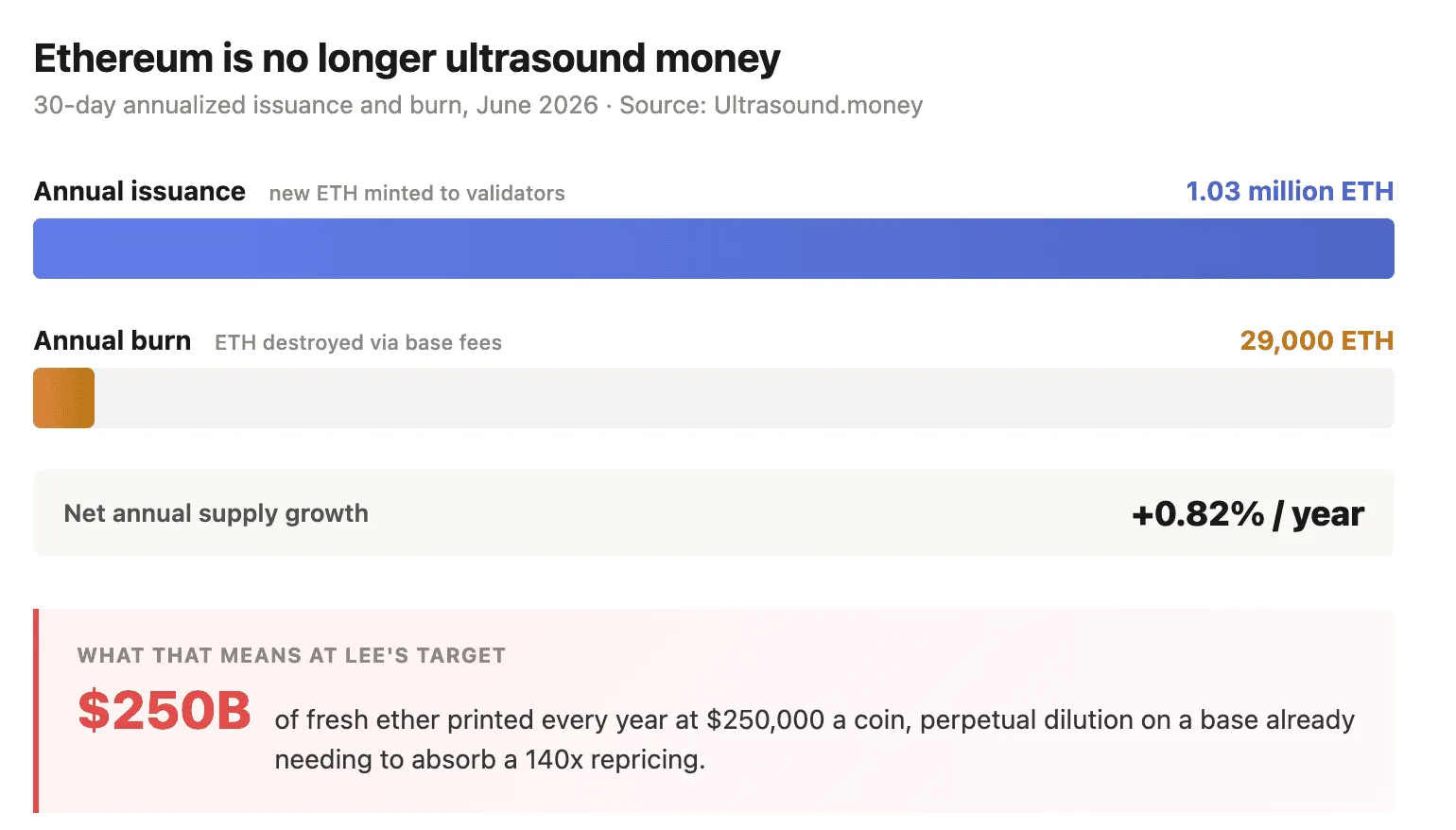
Lets dive into the math of how that target may be reached, starting with supply. Ethereum's circulating supply sits at 121.75 million $ETH and is growing at 0.82% a year, because since the Dencun upgrade pushed most fee activity to cheaper layer-2 chains in 2024, the burn mechanism has collapsed to roughly 29,000 $ETH a year against issuance of 1.03 million $ETH.
At $250,000 a coin, that 0.82% drift turns into $250 billion of fresh ether issued every year.
The supply growth is not huge by itself. Gold supply expands at a similar pace, and the U.S. Treasury market grows much faster. Big assets can absorb new issuance if demand is strong enough.
However it puts to rest the old “ultrasound money” trade that was built on the idea that Ethereum could become a shrinking monetary asset while usage kept rising. That setup is not here right now. $ETH supply is growing, slowly but steadily, so a 50x move has to come from demand doing almost all the work.
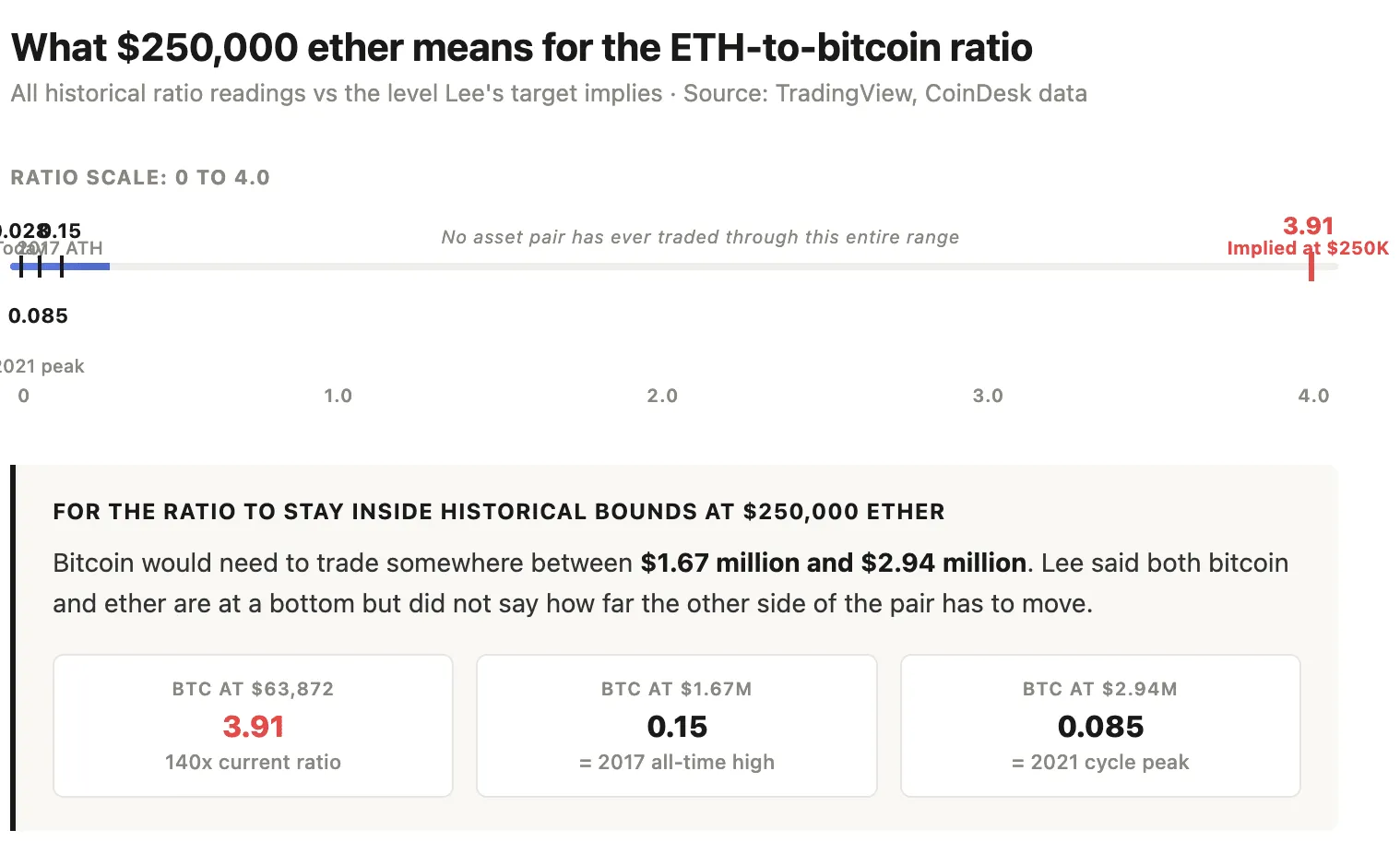
To get a sense of how far-out Lee's target is, look at the ether-bitcoin ratio, which tracks how ether trades relative to bitcoin. The ratio has never crossed 0.15, a level it touched briefly at the 2017 peak. At today's bitcoin price of $63,872, $250,000 ether would push that ratio to 3.91, more than 25 times that all-time high.
For the ratio to stay anywhere in its historical range while ether hits $250,000, bitcoin would have to rally to somewhere between $1.67 million and $2.94 million at the same time. So Lee's call needs either bitcoin running alongside ether at similar multiples, or the pair breaking historical bounds wildly. Neither is in motion right now.
Lee further argued the Ethereum Foundation has dropped to roughly 0.1% of supply while corporate entities like Bitmine and SharpLink now control 7% of circulating ether collectively.
Public companies and governments hold 7.43 million $ETH across 32 entities, or 6.16% of supply, with Bitmine alone at 5.42 million $ETH and SharpLink at 869,000.
But holding ether and validating the network are different jobs. Validators are the operators that actually run the software securing Ethereum and earn the staking yield.
Of the 39.25 million ether currently staked, Lido, a decentralized staking protocol governed by a DAO of token holders, controls 19.4%, followed by Binance, ether.fi, Coinbase and Figment.
The top corporate treasuries are not running validators at anywhere near the scale Lee's takeover thesis implies. Lido alone validates more ether than every public-company holder combined.

All in all, ether has to capture a chunk of global financial throughput that no asset has captured before, the burn has to outrun issuance again, the $ETH-to-bitcoin pair has to recover more steeply than at any point in its history, and the corporate validator thesis has to actually translate into validating power.
The $ETH-to-bitcoin pair turning on a real trend, not a one-week bounce, would be the first sign anything's actually changing. Right now, however, the data tells a different one.