






Bitcoins self-custody era may be ending as wealthy holders increasingly transfer assets into regulated exchange-traded funds (ETFs) amid tax incentives and improving institutional infrastructure.
In a Wednesday post on X, Martin Hiesboeck, head of blockchain and crypto research at crypto financial services platform Uphold, said the movement of large Bitcoin (BTC) wallets into ETFs marks the first significant decline in self-custodied BTC in more than 15 years.
“Another nail in the coffin of the original crypto spirit,” he wrote, noting that the “not your keys, not your coins” ethos that once defined the asset is giving way to a more traditional approach centered on compliance and financial optimization.
“The shift is driven by the convenience and significant tax benefits offered by ETFs, as well as the ability for major investors to manage their wealth through existing financial advisers and access broader investment/lending services,” Hiesboeck said.
BlackRocks Bitcoin ETF sees $3 billion in whale conversions
Leading the change is BlackRocks iShares Bitcoin Trust (IBIT), which has already facilitated over $3 billion worth of Bitcoin conversions from whales, according to Robbie Mitchnick, BlackRocks head of digital assets.
Mitchnick told Bloomberg that many early adopters now prefer the convenience of managing their holdings through established financial institutions while retaining exposure to Bitcoins price movements.
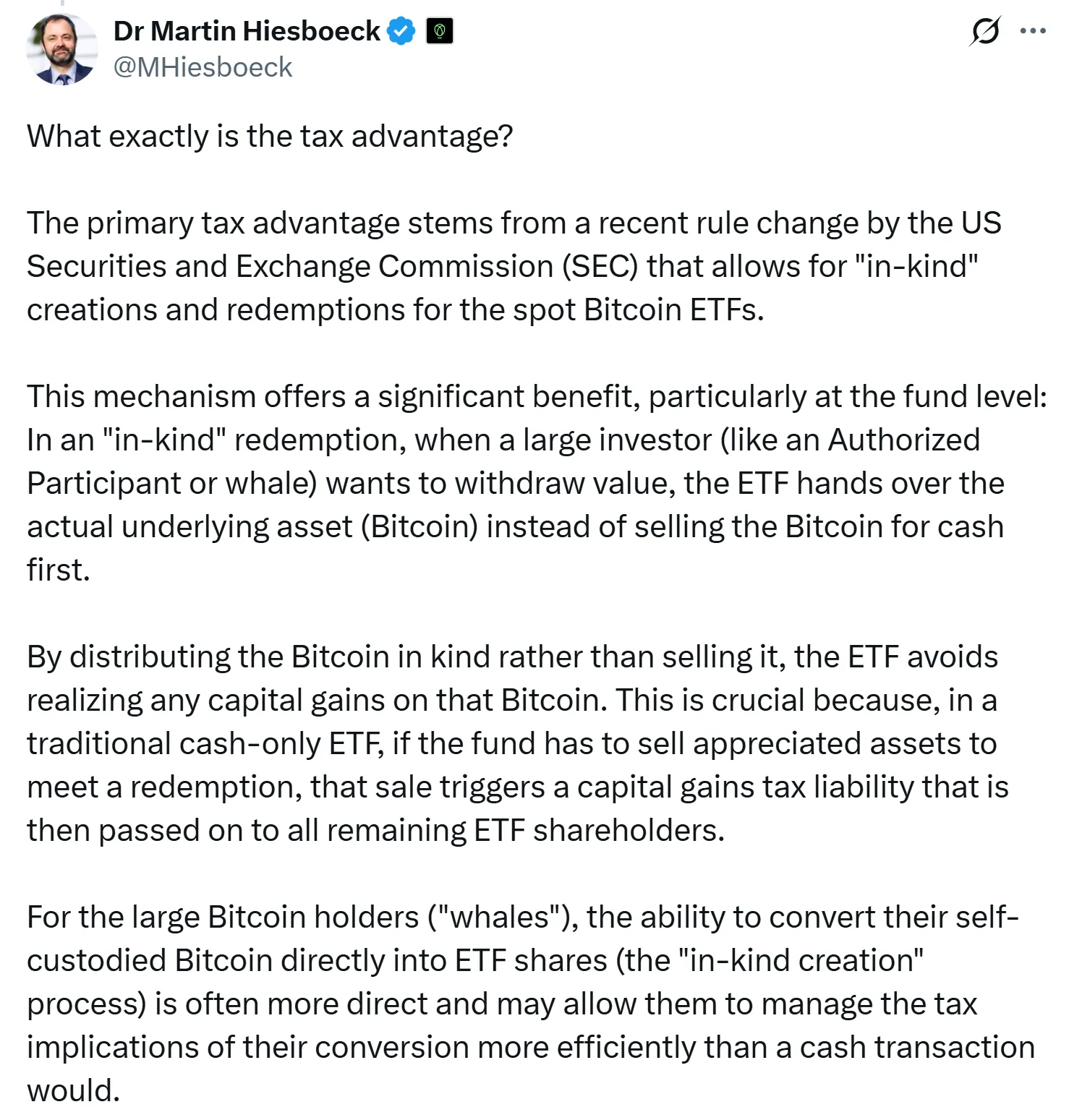
ETFs offer more favorable tax incentives than self-custody. Source: Martin Hiesboeck
A recent US Securities and Exchange Commission (SEC) rule change has accelerated this transition. The adjustment allows for “in-kind” creations and redemptions in spot Bitcoin ETFs, enabling authorized participants to exchange Bitcoin directly for ETF shares without requiring a taxable sale.
Tax advantage for big traders
The in-kind structure provides a tax advantage. In a traditional “cash” ETF, funds must sell assets to meet redemptions, which triggers capital gains that are passed on to shareholders.
In contrast, in-kind redemptions allow funds to transfer Bitcoin itself, thereby avoiding the taxable event and shielding investors from collective capital gains burdens, Hiesboeck said.
“The in-kind mechanism makes the ETF structure more tax-efficient for long-term holders by reducing the need for the fund to sell assets, thereby preventing the unwelcome distribution of capital gains to investors,” he wrote.