







Developed by tech giants Microsoft, Alibaba, and Carnegie Mellon University on top of the Ethereum public blockchain, Project Argus is set to reduce internet piracy. The partners recently released a report on the project, its objectives, and potential applications.
As the paper describes, companies, such as Microsoft, Apple, and others, spend a lot of time and money trying to prevent piracy and intellectual property theft. These programs are used to have people provide information on entities or individuals committing these illegal activities.
The success of these “anti-privacy” campaigns is usually limited due to several issues, mainly the lack of trust from the public.
Therefore, the partners proposed Argus, a “fully transparent incentive system” that allows its users to launch anti-piracy campaigns with the Ethereum blockchain. Thus, increasing the effectiveness of this campaign by tackling its core problems: fairness, opaqueness, credibility criteria.
As the paper claims, the piracy problems and the campaigns to prevent it are comprised of 3 main parties, the owner of a copyright-protected product, the informants looking to profit, and the perpetrators of the activity. The interests of these parties can be different.
Thus, Argus would fill in the role, already carried out by some companies, of operating as an “unbiased contract” solution with higher neutrality than other entities because it would be supported by Ethereum. Investigators from Microsoft, Alibaba, and Carnegie called it the “first public anti-piracy system”.
As such, participants can be “treated fairly”, not rely on the authority or trust on a third party, “resilient to greed and abuse”, with the potential to “resolve conclusively every” possible conflict. Argus has been created to benefit from the efficiency and economic advantages of running on top of Ethereum. Microsoft and its partners claimed:
“it achieves an impressive off-chain throughput of 82.6 data-trades per second per machine, and incurs only a negligible on-chain cost equivalent to sending 14 ETH-transfer transactions per report on the public Ethereum blockchain.”
Microsoft And Partners Harvest Power Of Ethereum Blockchain
Argus will be additionally supported by “four pillars” in its design: full transparency, incentive, information, and optimization. Combined they mitigate the problems with counter-piracy operations by assuring that informers get more rewards for reporting a copyright violation than by forging multiple reports.
“In other words, our model disincentivizes Sybil attacks, so the informers‘ interest is aligned with the owner’s.”
All information will be available on Ethereum making it hard for a report to be “re-submitted”. The report submission mechanism will be based on a multi-period commitment scheme with zero know proof properties for greater privacy and security for the informer.
As the image below shows, Argus will allow an owner to issue a license with a mechanism called oblivious transfer (OT). Licenses issued with it will have a unique watermarked unknown for third parties. Thus, when an informer wants to report a determined copyright infraction, this contract will retrieve the information (named OTRecord) stored on the watermark tied to the product.
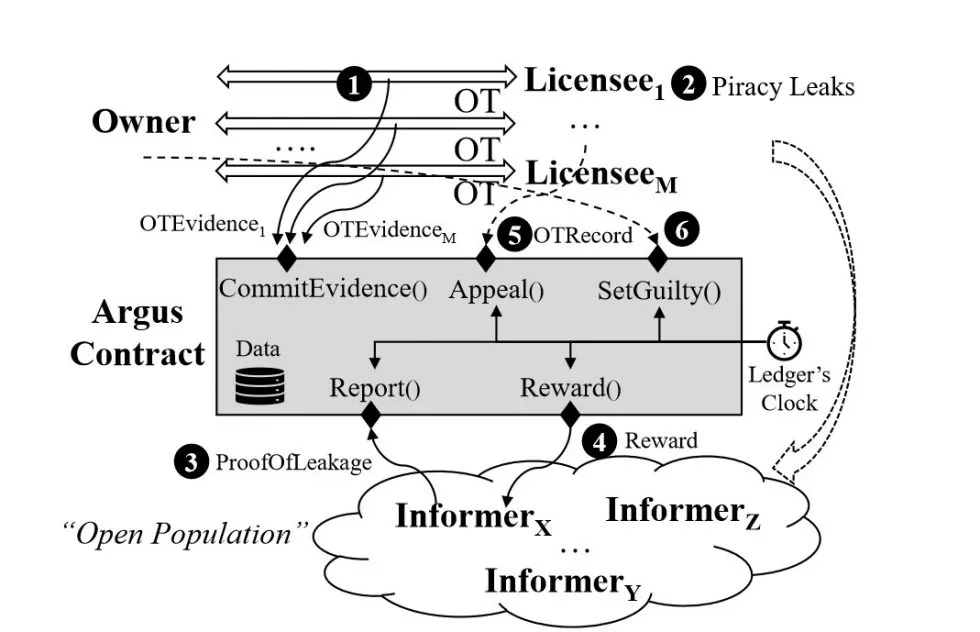
Overview of the Argus System. Source: Microsoft
Later, Argus will update the status of the license, from NORMAL to ACCUSED, with the data obtained from the report. This protects the system against potential Sybil attacks from bad actors and provides the accused entity with an appeal mechanism.
Microsoft and its partners acknowledged the potential that Argus and future applications could have to solve piracy and other use cases that rely on centralized systems and trust. The Ethereum blockchain enables what they called a “paradigm shift” in this sector:
“it is feasible to build a fully transparent solution without introducing a trusted role. This could enable a paradigm shift for anti-piracy incentive solutions. Also, it is a compelling application scenario for public blockchains.”
At the time of writing, ETH trades at $3,218 with a 2.1% profit in the daily chart.
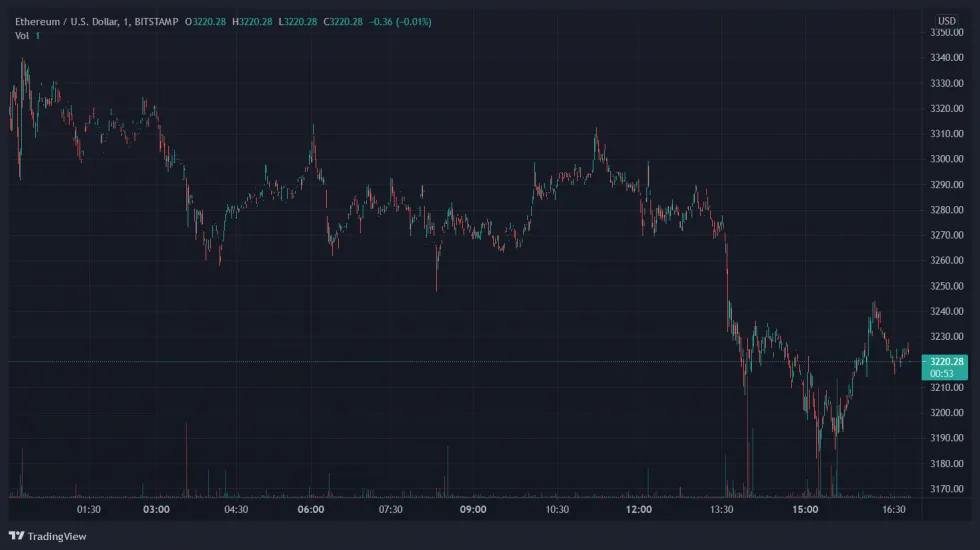
ETH is on a downtrend in the 24-hour chart. Source: ETHUSD Tradingview