
This is a segment from the Lightspeed newsletter. To read full editions, subscribe.
The Solana ecosystem revolves heavily around the aptly named Jupiter protocol, and for good reason.
Theyre an ambitious team trying to do damn near everything in DeFi.
In 2021, Jupiter launched a DEX aggregator on Solana, the dominant venue today for routing order flows to DEXs and prop AMMs. Alongside the aggregator, Jupiter founder meow also launched Mercurial DEX, rebranded today as Meteora.
A perps DEX followed in 2023, then a memecoin launchpad in 2024, and then a majority stake acquisition in the Moonshot memecoin trading platform earlier this year. Theres also the upcoming omnichain network “JupNet,” which plans to aggregate liquidity across chains.
But all eyes this week are on Jupiter Lend, the superapps first formal foray into the Lending vertical.
Loading Tweet..
Jupiter‘s lending product is built on Fluid’s liquidity/risk engine. If you‘ve never heard of Fluid, it’s a protocol that took the Ethereum world by storm over the past year.
To see the promise of Jupiter Lend requires a baseline understanding of how Fluid actually works. It‘s not the most straightforward product, but here’s the gist.
Fluid (previously Instadapp) is an integrated application consisting of DEX, lending and borrowing. All three draw from a unified liquidity layer, which enables unique features that just arent possible on other DEXs or lending protocols.
For instance, a borrower on Fluid can denominate their debt to serve as liquidity for Fluid DEX (what the team calls “smart debt”), rather than letting it sit idle as posted collateral.
This, in effect, puts a borrower‘s debt to “work.” As traders on the DEX side are paying fees to trade, that lets borrowers earn fees to reduce their debt. It’s somewhat unintuitive, for it inverts the logic of how we commonly think of debt as an unproductive asset that needs to be paid down.
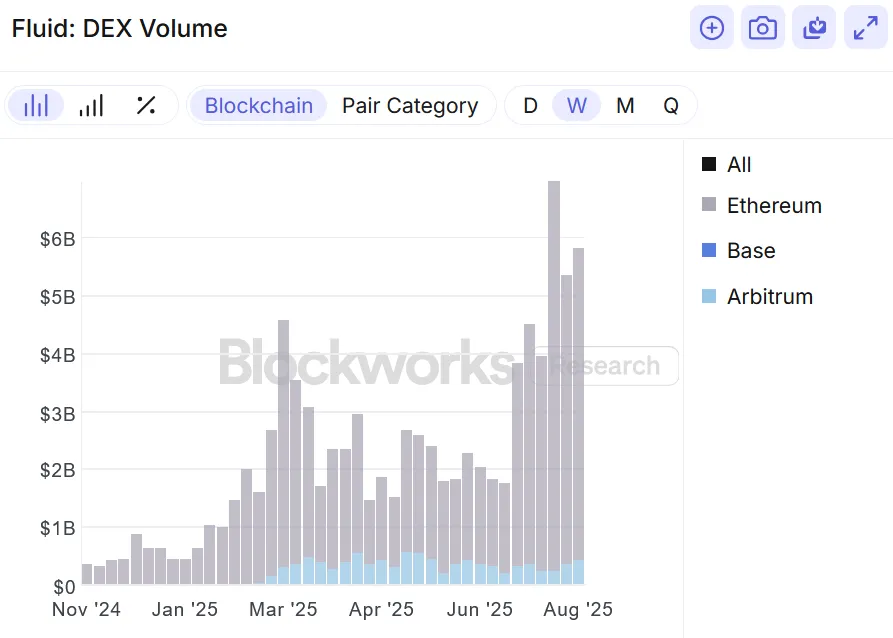
This is how Fluid opens up billions of dollars in “TVL” that isnt actually TVL, at least not in the conventional DeFi sense. Which leads to memes like these:

Fluid also has perhaps one of the most advanced liquidation engines in DeFi. Its borrowing vaults bucket positions into “ticks,” which liquidates positions partially as markets move, rather than in one fell swoop.
Again, Fluids tight integration allows liquidations to simply settle as ordinary swaps on its own DEX.
This combo drastically reduces slippage and penalties (~0.1%). And the end result is that it enables abnormally high loan-to-value (LTV) ratios of 90-95% on its lending product. For context, even highly liquid assets like WBTC/WETH have LTVs of 70-85% on Aave.
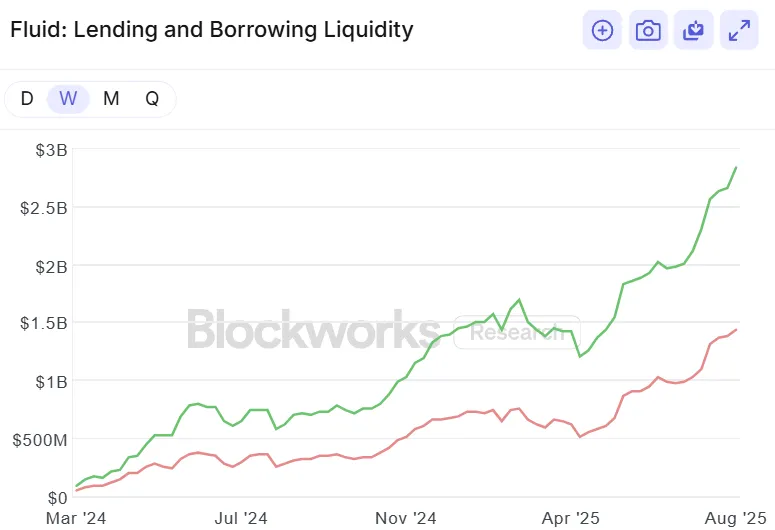
As a testament to Fluids success, its lending has $1.4 billion in active loans since its launch on Ethereum less than a year ago, per Blockworks Research data.