






Deutsche Bank opens up digital asset custody to paying institutional clients. The service includes storage, user experience improvements, and accessibility via the bank's own gateways. The bank announced the launch on November 11, as DB's official website reveals.
This is an improvement in the field of institutional adoption, even though it comes at a time when it might be unwarranted. The market is experiencing serious issues and constant outflows from both retail and institutional investors.
Warm and cold storage
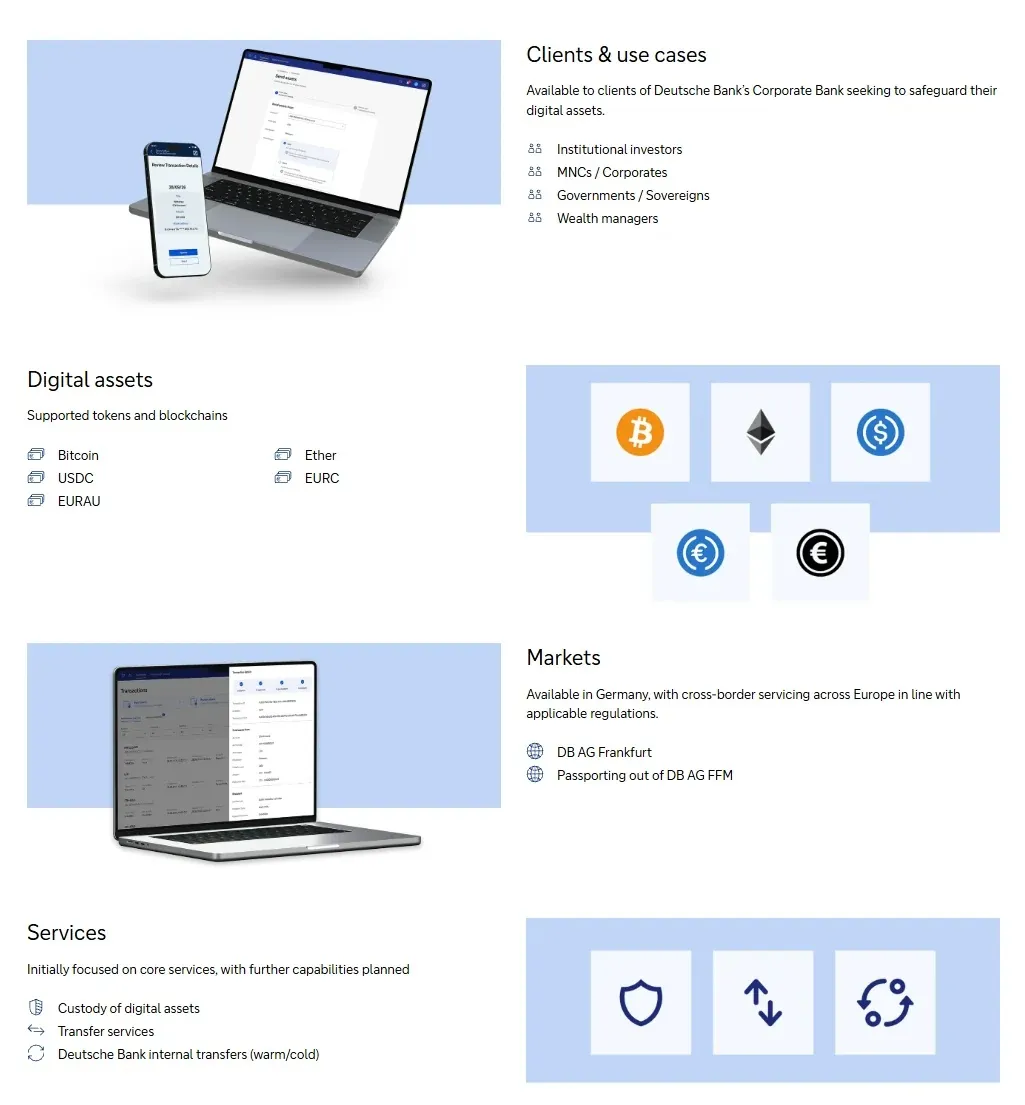
Surprisingly, the bank can provide both warm and cold storage options available directly through DB's infrastructure. According to the landing page, the platform will provide key storage via Hardware Security Modules. Access goes through Autobahn, the bank's own multi-channel gateway.
Source: DB
Compliance will also be handled by Deutsche Bank. Initially, the service will focus on core functions: custody of digital assets and transfers, with further capabilities planned.
The Asian market has yet to receive similar treatment. For now, the service is available in the EU, operating out of DB AG Frankfurt. An expansion to Asia is reportedly planned for 2027, though the details are yet to be confirmed.
Additionally, DB announced support for euro stablecoins such as EURC and EURAU, in addition to BTC, ETH, and USDC. This is an attempt to promote the adoption of EU-issued stablecoins as part of a strategy aimed at moving away from USDT dominance. EURAU is issued by AllUnity, a joint venture that includes DWS, the asset manager majority-owned by Deutsche Bank.
Self-custody or banks?
Self-custody or banks: that is the real question here. Industry experts such as Bloomberg's ETF analyst Eric Balchunas suggest that self-custody has been a worse option and that a custodian with funds protection and insurance is a better option for regular investors. Even Binance founder CZ admitted after the Ledger incident that self-custody comes with extra responsibilities.
Back in August, a Coldcard exploit drained 1,816 BTC from more than 5,000 cold-storage addresses, according to Fortune.
However, it puts some pressure on those who might receive their funds from grey sources. Unfortunately for them, a bank custodian creates another barrier, as every deposit has to go through the bank's compliance checks.