






Ethereums Glamsterdam upgrade has gone live on the Sepolia testnet, in one of the final major rehearsals before its mainnet activation.
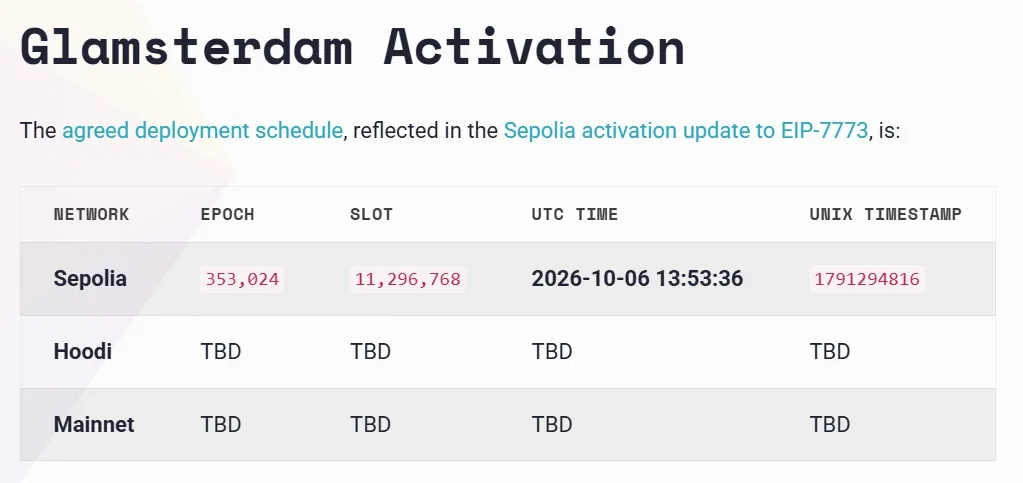
Glamsterdam went live on Sepolia on Tuesday at 1:53 pm UTC, Ethereum community contributor Pooja Ranjan announced in an X post.
The upgrade aims to advance Ethereums layer-1 scaling roadmap with enshrined proposer-builder separation, block-level access lists and changes to gas pricing that better reflect the cost of execution, the Ethereum Foundation announced in a Sept. 28 blog post.
The development marks one of the final testnet launches for Glamsterdam, arguably one of the most consequential upgrades of 2026, aiming to make the Ethereum network more scalable and efficient.
Following the testnet launch, developers will determine Glamsterdams activation date on the Hoodi testnet, before determining the final date of its mainnet launch.
Aiming to improve Ethereums efficiency and scalability
Glamsterdam marks the next major upgrade after Fusaka, designed to improve scalability, harden the layer-1 and make the network easier to use.
The upgrades headliner changes are enshrined proposer-builder separation (ePBS) and block-level access lists (BALs), which change how blocks are produced and validated to support greater throughput on the Ethereum mainnet.
Enshrined Proposer-Builder Separation, or EIP-7732, introduces separation between block proposers and builders on Ethereums consensus protocol, while also separating consensus validation from execution validation, giving validators more time to validate execution payloads.
Currently, Ethereum is running in single-lane mode, processing transactions in a single order. Parallel processing seeks to enable higher transactions per second on Ethereum and bigger block sizes, without raising the gas limit.
Related: Ethereum Institutional signals support for Ethlabs motion to reduce Ethereum block times
The second headliner change, EIP-7928, introduces enforced block-level access lists that record accounts and storage locations accessed during a block, along with post-transaction state changes. These lists enable clients to read state from disk in parallel, validate transactions in parallel and compute state roots more efficiently.
In a May blog post, the Ethereum Foundation said it established a 200 million gas limit floor for Glamsterdam, giving the network a major post-upgrade speed boost from its current gas limit of around 60 million.
Following Glamsterdams mainnet activation, Ethereum developers will begin implementing Hegotá as the next major upgrade. In August, Ethereum developers started reviewing 66 proposals to narrow them down as part of scoping Hegotá, with several proposals aimed at bringing more privacy capabilities into the protocol.