






Web 3.0, the next generation of the internet, has been envisioned by proponents to run on a fully-decentralized blockchain to create a user-friendly web wherein a users identity and data are their own.
Creating a multichain future
Polkadot was created with just that goal in mind—with the belief that no single blockchain can support the entire Web 3.0 economy and that multichains are the future of such an unconnected ecosystem.
But such an implementation requires blockchains to interact, exchange data (almost speak) to one other). This is where “bridges” come in, a technology that Polkadot looks to implement.
The project realizes that while its underlying infrastructure allows developers with the necessary tools required for scalability and high throughput, there are existing networks with strong communities outside of the Polkadot ecosystem which make the use of cross-network bridges necessary.
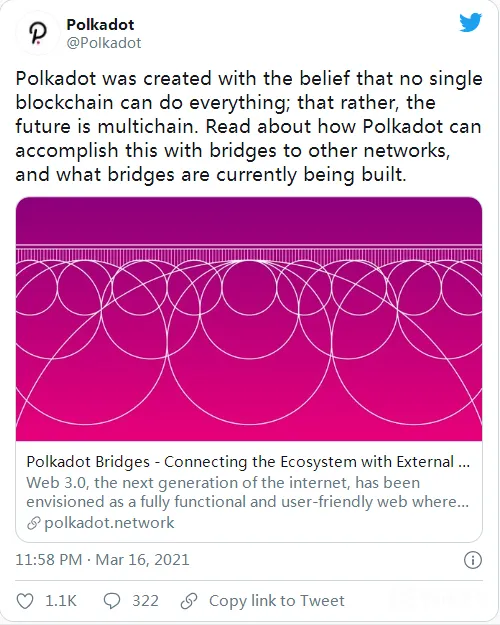
There can be two kinds of bridges: one, centralized and trusted protocols, where users rely on a third party to operate the bridge correctly, and two, decentralized and trustless, where users rely on a smart contract to execute transactions.
Polkadot falls in the latter group. It uses its smart contract technology to ensure trustless interaction rather than a mere promise or legal agreement. The protocol further allows developers to build out ‘Parachains,’ or Substrate blockchain-based chains (coupled with the Cumulus consensus engine) with their own consensus and security.
Bridges in the real world
As a practical example of bridging, consider a decentralized marketplace for insurance. One way to build this on Polkadot would be by deploying a specialized insurance parachain that acts as a marketplace for buyers and sellers of insurance.
In a situation where you purchased flight delay insurance, the policy could be constructed in such a way that it would pay out if both the oracle parachain confirmed that your flight was delayed and the IoT parachain confirmed that you were at the airport on time for your flight.
On-chain, if the insurance parachain received a signal from both the oracle and IoT parachains then it could use an Ethereum bridge to trigger a transaction using a stablecoin, such as Dai, from the insurance company‘s account to the policy holder’s. This is a relatively simple example of the power of interoperability.
Polkadot is designed for such a future, in which users not only see applications that primarily live on one network and occasionally leverage other networks for simple transactions, but also applications that actually go much further than this and live across different blockchain networks that have varying degrees of specialization.
Meanwhile, its not only Substrate-based chains that are building to connect with Polkadot. The Web3 Foundation grants programs have supported the development of many bridges to the Polkadot ecosystem, which includes several cross-chain bridges that work on various implementations.
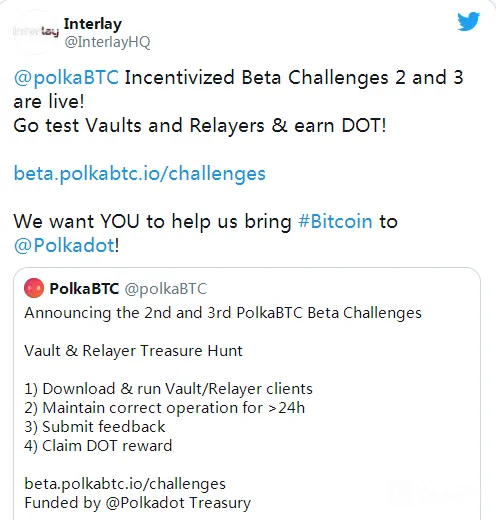
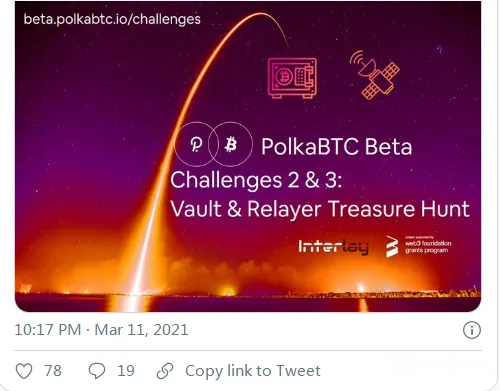
Examples include: Interlay, a trustless bridge from Bitcoin to Polkadot, Snowfork, a general-purpose bridge between Ethereum and Polkadot, Darwinia a permissionless non-custodial bridge protocol featuring efficient, low cost decentralization of cross-chain tokens and Non-Fungible Token (NFT) transfers, and Centrifuge, which collaborated with ChainSafe to develop a multidirectional bridge between Substrate-based blockchains and Ethereum.
For Polkadot, the real question is are you ready to build?