







If youve used Ethereum at least once in the last month, then you may have noticed one thing — the fees are terrible. Transactions which would have cost a few dollars just months ago can now cost an arm and a leg, making transacting on network an expensive task.
But while many users are griping about the fees, high volume traders and so-called whales are actually turning the current fee market to their advantage and have effectively monopolized two of Ethereum‘s biggest use cases right now — yield farms and decentralized exchanges. Here’s how.
Yield Farming Become a Whales Game
Right now, if you want to participate in a yield farm on Ethereum, then youre probably going to have to contend with the extremely high transaction fees that come with both depositing your investment and later withdrawing it.
Unfortunately, yield farms are almost all smart-contract-based and involve transferring ERC-20 tokens. This means the fee that comes with interacting with one is much higher than a simple ETH transfer. At peak times, it isnt uncommon to see deposit and withdrawals transactions come to more than $100 a pop.
Assuming a yield farm pays 10% APY, this means you would need to invest a minimum of $2,000 for one year just to break even on your transaction fees. However, for much larger investments, these costs can become negligible, making yield farms far more attractive to well-heeled investors.
This also has a second knock-on effect. By reducing the number of participants by pricing out smaller investors, yield farms offer a higher yield to those still in the game — since the yields are usually directly proportional to the total value locked up by investors.
Whales Take Over Decentralized Exchanges
Decentralized exchanges like Uniswap and Curve have been hailed as one of the greatest achievements in the blockchain space in the last couple of years — due to the flexibility and freedom they provide to traders. But while this may have been the case several months ago, decentralized exchanges are quickly becoming a hotbed for whale activity, since the transaction fees associated with Ethereum-based DEX platforms like Uniswap can be eye-watering. In the last week alone, the average transaction fees on the top four most popular DEXs have been ~$100 each.
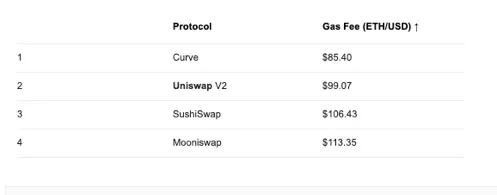
Image credits: crypto.com
This means you would need to spend around $100 just to purchase a cryptocurrency on a DEX, not including any authorization transactions you might need to make. Naturally, this means larger orders stand a better chance at achieving profitability when taking the fee hurdle into account.
This challenge also extends to arbitrageurs, who need to be willing to eat a potentially massive amount of fees in order to capitalize on a price discrepancy between a DEX and another platform. Since arbitrage opportunities usually mean capitalizing on a percent or two difference in value between one or more platforms, only whales can reliably turn a profit using arbitrage after fees are taking into account.
Is There a Solution?
Unfortunately, Ethereums high fees are not likely to go away any time soon. Due to the blossoming demand for DeFi products and a massive amount of interest in decentralized trading, the Ethereum blockchain is almost constantly operating at maximum capacity.
As a result, until Ethereum rolls out its long-awaited 2.0 upgrades and moves to a Proof-of-Stake (PoS) consensus mechanism with sharding or some other layer-1 scaling solution, we are unlikely to see a dramatic drop in ETH fees.
However, there are a number of solutions in the works to help massively boost Ethereum‘s scalability right now — thereby giving users a way to avoid the gas war that is Ethereum in 2021. Celer’s Layer2.Finance is currently the front-runner in this space, since it has a working product that is already helping to mitigate Etheruems fee issues.

The platform uses the Celer network to scale Ethereum by allowing users to move their layer-1 assets (e.g. ERC-20 tokens) to the second layer, which are then aggregated by Layer2.Finance and deposited to DeFi protocols as per the users choice — batching the transactions together to save fees. Current estimates indicate that Layer2.Finance can save users more than 99% compared with transacting on layer 1 directly.
Beyond this, there are a number of other solutions in the works, including Polkadot‘s parachain solution, Cosmos’ IBC, Polygons layer-2 solution, and more. But many of these are still somewhat experimental or have yet to see widespread adoption.