






The company that built decentralized finance (DeFi) powerhouse Balancer is closing.
Balancer co-founder Fernando Martinelli announced Tuesday that Balancer Labs, the corporate entity that incubated and funded the decentralized exchange protocol, will be shutting down.
The decision comes roughly five months after a v2 exploit in November 2025 that drained approximately $110 million in digital assets, as CoinDesk first reported, including osETH, WETH, and wstETH, the third known security breach for the project and the one that created the legal exposure Martinelli cited as the reason for shutting down BLabs.
“BLabs, as a corporate entity, has become a liability rather than an asset to the protocol's future and is just not sustainable as is without any sources of revenue,” Martinelli wrote in a governance forum post.
Martinelli added he “seriously considered” shutting everything down entirely. But he stopped short of calling for a full wind-down because the protocol still generates revenue.
Balancer was one of the defining names of the DeFi boom. At its peak in late 2021, the protocol held nearly $3.5 billion in total value locked, putting it alongside Aave, Uniswap, and Curve as foundational infrastructure for decentralized trading.
DeFiLlama data shows TVL at $2.96 billion as of October 2021, with fees spiking above $6 million annualized. But the TVL now sits at $157 million, a 95% drop from peak.
The market cap has fallen to $10 million. BAL trades at $0.16 against a fully diluted valuation of $11 million, meaning it trades far below net asset value.
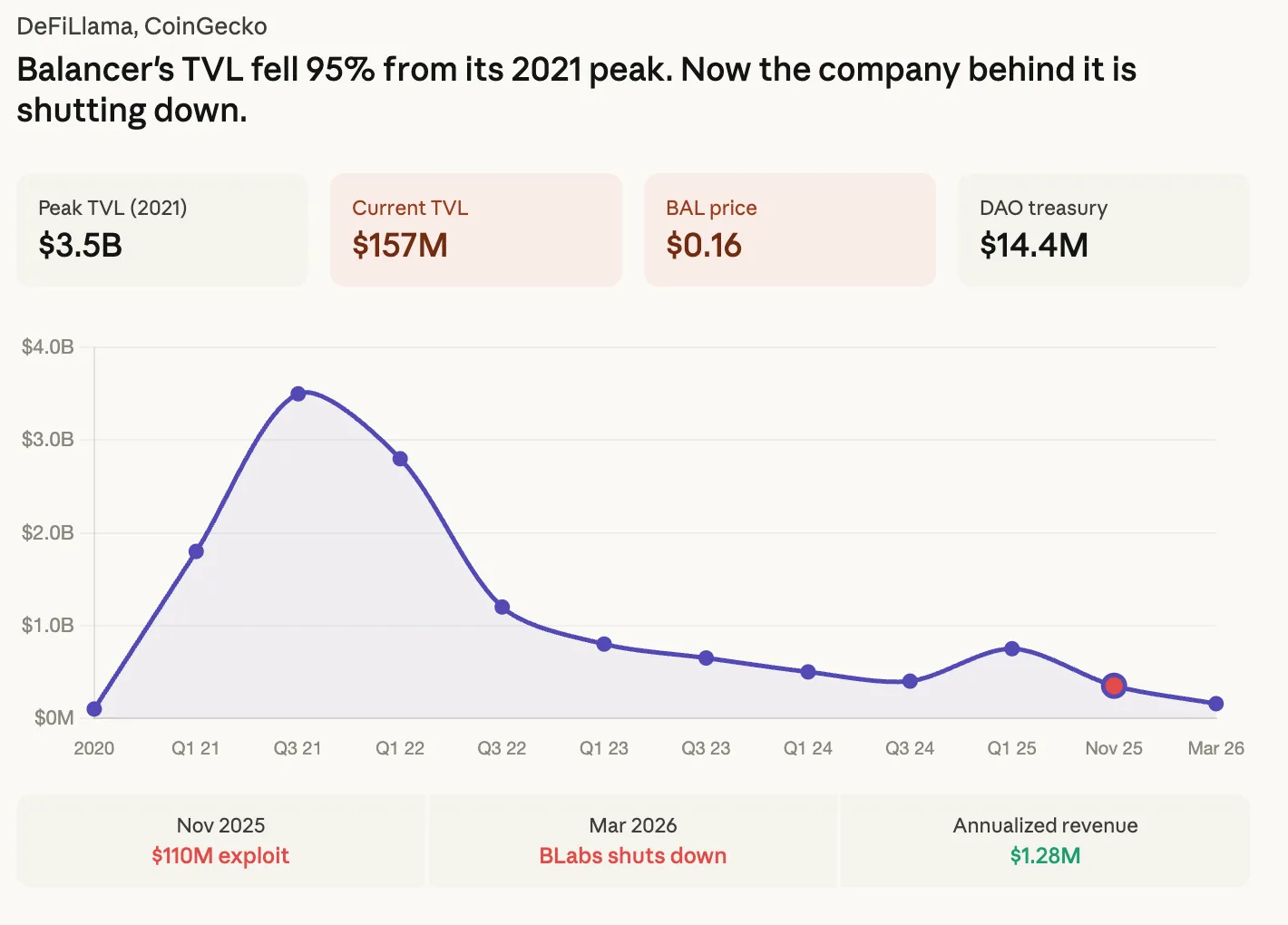
Balancer produced over $1 million in annualized fees over the past three months. That's not enough to sustain the current operation, but it's enough to sustain a much leaner one.
The restructuring plan the remaining team is proposing is aggressive. BAL emissions would be cut to zero, ending what Martinelli described as a “circular bribe economy that costs more than it generates.”
The veBAL governance model, which he said was captured by meta-governance protocols like Aura and bribe markets that made voting “unrepresentative of the actual Balancer front line,” would be wound down.
Protocol fees would be restructured so the DAO treasury captures 100% of revenue instead of the current 17.5%. The v3 protocol share would drop to 25% to attract organic liquidity. And a BAL buyback would offer holders exit liquidity at a fair price.
“If you believe in the restructured Balancer, you stay. If you don't, you get a fair exit,” Martinelli wrote. “That's honest dealing, and it clears the overhang.”
Essential BLabs team members would be absorbed into Balancer OpCo pending a governance vote. Martinelli himself will have no formal relationship with the protocol after the wind-down but offered to serve as an advisor.
The product scope is narrowing to five areas where the team sees differentiation: reCLAMM pools, liquidity bootstrapping pools, stablecoin and liquid staking token pools, weighted pools, and expansion to non-EVM chains. Everything else gets cut.
BAL was trading at $0.72 as of Tuesday morning, down roughly 88% from its all-time high.