







CNBC interview Eswar Prasad, an economics professor at Cornell University. The academic highlighted BTCs “flaws” and how other cryptocurrencies have come up “with more viable options”.
According to Prasad, Bitcoin “harms” the environment. This argument has been used by Elon Musk, Tesla‘s CEO, and is one of BTC’s detractors favorite.
The academic believes BTC transactions and its consensus algorithm, Proof-of-Work (PoW), have a direct impact on the environment. He classified the process of adding transactions, and mining BTC as “energy-intensive”.
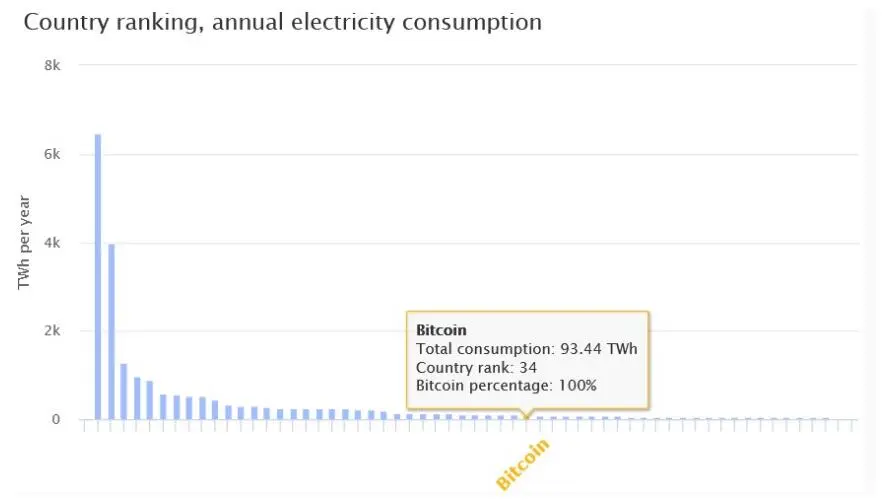
When compared with the energy consumption of countries such as Finland and Switzerland, the academic believes Bitcoin can consume even more energy. Prasad based his arguments on the Cambridge Bitcoin Electricity Consumption Index.
This index records that BTC uses around 93.44 TW/h per year, much more than Israel, Belgium, Greece, and other major countries, as shown in the chart below.
However, data from the Cambridge Centre for Alternative Finance indicates that 39% of Bitcoin mining comes from Renewable Sources. On the contrary, China (12.7%), the United States (8.7), and the entire World (11.4%) dont come close to this metric.
Bitcoin Flaws And Its Biggest Strength?
In addition to its alleged negative environmental impact. The academic argued that BTC is “not so anonymous after all”. Thus, the cryptocurrency “failed” to provide pseudonymity to its users. As an example, to this argument, CNBCs report quotes a U.S. law enforcement operation.
Carried out by the U.S. Department of Justice and Federal authorities, this operation led to the recovery of a ransom paid in Bitcoin to the hackers of the company Colonial Pipeline. As reported by Bitcoinist, the report by the authorities left more questions than answers and many found it contradictory. The academic said:
it turns out that if you use bitcoin a lot, and especially if you use Bitcoin to get any real goods and services, then it becomes possible eventually to link your address or your physical identity to your digital identity.
Finally, Prasad argued that BTC fails to operate as a currency because it‘s “slow and cumbersome”. Thus, he believes people don’t use it to pay for goods and services. Of course, the academic also pointed out that BTC‘s price it’s too volatile to operate as a medium of exchange.
So you could take a bitcoin to a store and one day, get a cup of coffee and another day, with the same bitcoin, be able to treat yourself to a lavish meal. So that doesnt work well for the medium of exchange.
The academic seems to be more inclined to Proof-of-Stake (PoS), and Ethereums migration to this consensus algorithm.
Prasad also published an article in The New Tork Times titled “The Brutal Truth About Bitcoin”. The crypto community was unreceipted of the publication. Many used El Salvador as a strong point to defend BTC.
In this country, Bitcoin can be mine with cheap energy, its used as a fast and cost-efficient way to send remittances without third-party intervention, and has been adopted by a part of the population to buy goods and services.