







Yesterday, the highly anticipated Layer2 project Scroll successfully launched on Binance. According to Rootdata‘s heat index, the project’s popularity has been steadily increasing since its launch. However, the feedback on the project has not been entirely positive. Since its debut, the price of $SCR has dropped by 22%.
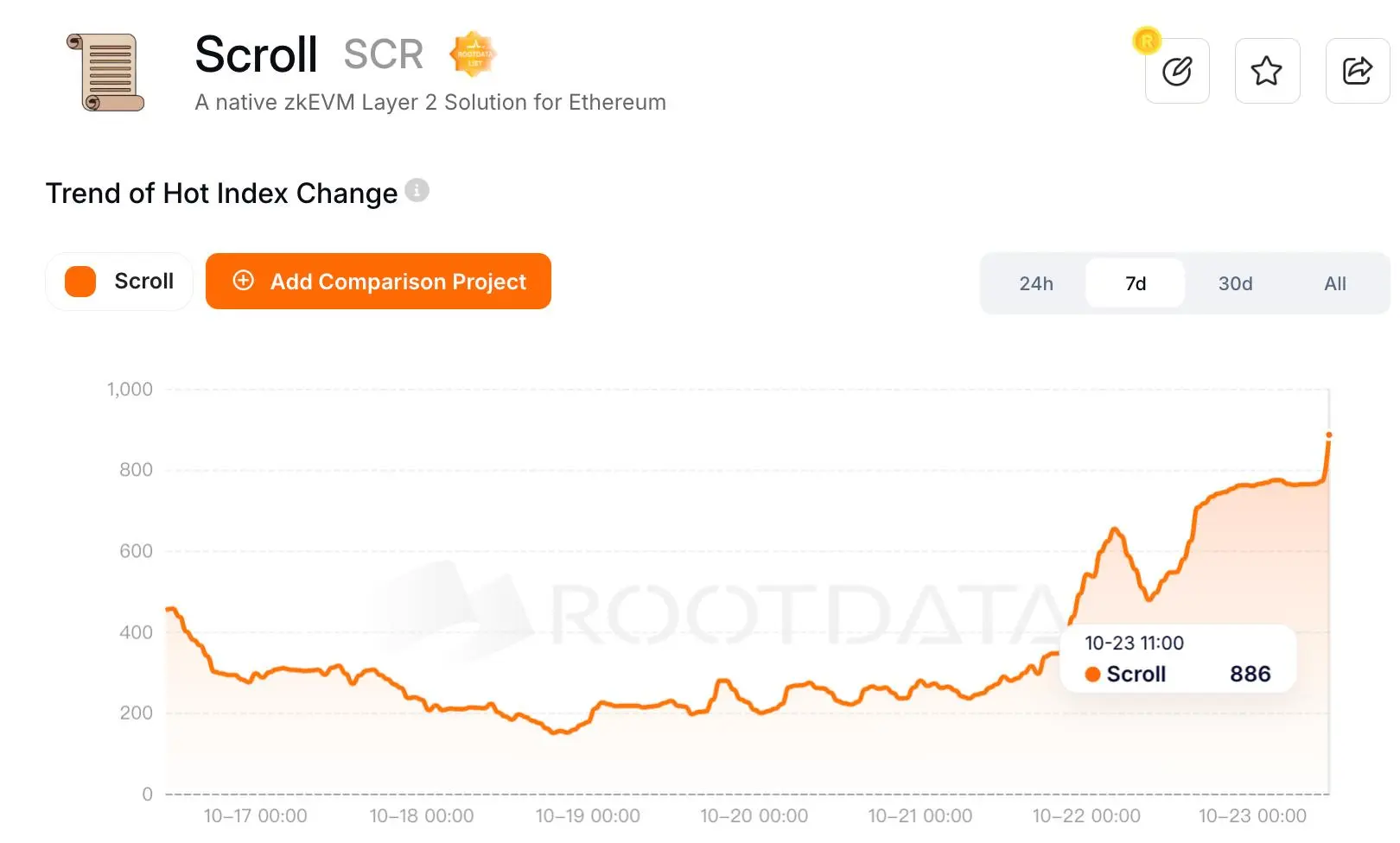
WikiBit has compiled the following key reasons behind this situation:
1. Dissatisfaction among Scroll users regarding the token distribution ratio.
2. The airdrop allocation received by users does not cover the on-chain interaction costs.
3. Suspicions of insider trading by the project team.
The “Dark Forest Theory” in the Airdrop Arena
Public chains, led by Ethereum, have previously fostered ecosystems where multiple DApps leveraged airdrops to create positive externalities for the entire ecosystem. The earliest airdrop, carried out by Uniswap, distributed governance tokens to early users, building community consensus. Since then, many projects have adopted this “proven” method, using airdrops to create community engagement and consensus.
However, as the industry evolved, project teams realized that airdrop expectations help attract users, and users realized they could exploit airdrop rules to obtain excess profits. Airdrops gradually became a battlefield between project teams and airdrop hunters: project teams aimed to acquire real users at the lowest cost, while users sought to maximize airdrop returns with minimal time and expenditure.

The current attitude of both users and project teams toward airdrops can be explained by the “Dark Forest Theory.” Project teams and users are like hunters in a dark forest, where neither trusts the other, and both conceal their true intentions. Project teams fear that users are merely looking for short-term profits, so they set complex rules and conditions to filter out the most valuable participants and protect their limited resources. On the other hand, users, uncertain of a projects long-term development, adopt strategies such as multiple accounts and mass participation to gain an early advantage, secure the airdrop, and exit quickly for a profit. With limited resources and intense competition, both sides proceed cautiously, carefully guarding their interests to avoid being outmaneuvered by others. In this environment, project teams and users both employ hidden strategies, striving to maximize their returns in a landscape fraught with uncertainty.
Airdrops Becoming an Exit Channel for Teams
“Once there is sufficient profit, capital becomes bold; with 10% profit, it is eagerly employed everywhere; with 20% profit, it becomes active; with 50% profit, it dares to take risks; for 100% profit, it tramples on all human laws; for 300% profit, it is willing to commit any crime, even risking the gallows.” – Marx, Capital
Aside from Scroll, which launched yesterday, several billion-dollar projects have been exposed for insider trading, such as EigenLayer and Zksync, which were uncovered by on-chain detectives. The original purpose of airdrops is being distorted, as they are gradually becoming a way for project teams to exit.