






Just 1% of firms drive 80% of AI spending on OpenAI and Anthropic, according to corporate card company Ramp. Growth in that spending has nearly stalled for two months, leaving the boom leaning on a few customers.
Per-employee spending by that top 1% hit $9,568 in September, up 11.7% on the month but 3.1% below Julys peak. Ramp lead economist Ara Kharazian attributes the slowdown mainly to falling prices for top models.
Sponsored

Sponsored
What Happens to AI Spending If Startups Pull Back?
Ramp tracks how American businesses pay for AI. However, it cautions that its top 1% estimate is volatile because few firms sit in that group.
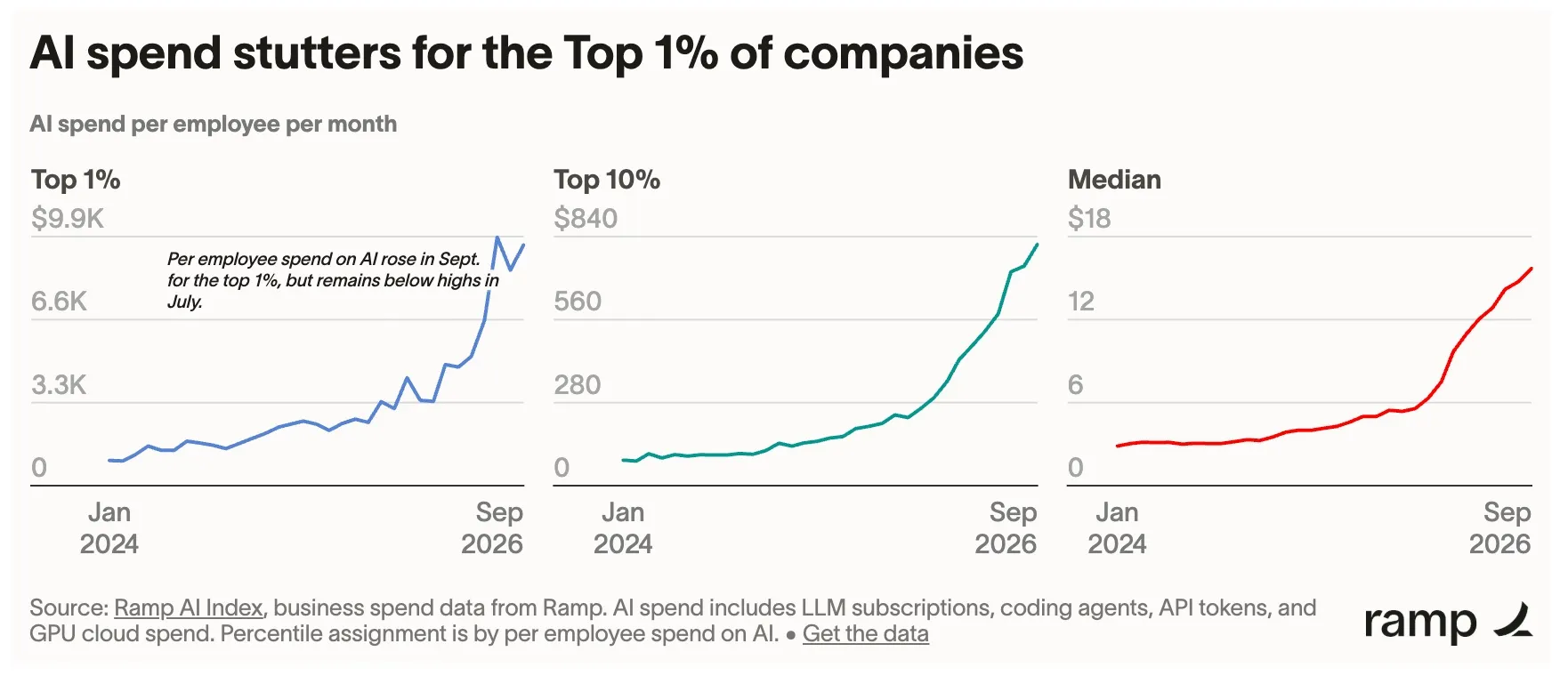
AI Spend rises for the top 1%. Source: Ramp
Economist Brad DeLong adds that Ramps customers skew toward tech, and its data misses free tools.
Tokens, the billing units for AI models, kept rising in volume. Yet spending on them barely grew in August and September, Ramp reports.
CNBC reporter Kate Rooney said roughly 80% of those top spenders are venture-backed.
Sponsored
Sponsored
Rooney said rate pressure or a shut initial public offering (IPO) window would mean less venture funding. In that case, the effects could run from model makers to cloud providers and then to chipmakers.
How Exposed Are Portfolios to a Top-Heavy AI Boom?
Asset manager Apollo has also flagged that AI spending growth has stalled.
Meanwhile, Citadel CEO Ken Griffin issued a chip glut warning. He told Bloomberg that oversupply of graphics processing units (GPUs) could force chip prices down.
The counterargument is that demand has not vanished. Still, paid AI adoption reached 55.9% of Ramp businesses in September, Kharazian wrote. Rooney said the bull case needs that use to spread to grocers and consumer companies.
Goldman Sachs estimates AI capital spending drives about half of S&P 500 earnings growth. It has steered AI-wary clients toward defensive stock picks in health care and consumer staples.
Similarly, concentration shows up in the index. The 15 largest stocks hold a record 46.7% share of the S&P 500, The Kobeissi Letter reported. That compares with 27.2% at the 2000 dot-com peak.