






Bitcoins back-to-back October losses have put its “Uptober” reputation under the microscope as analysts weigh seasonal trends against institutional demand and economic conditions.
Bitcoin fell 7.3% in October 2026, following a roughly 4% decline a year earlier, according to CoinGlass data.
The losses defied October‘s historically bullish reputation, which earned it the nickname “Uptober.” This year, industry figures turned to darker labels, including “Black October” and “Hacktober,” amid a wave of crypto security incidents, including Binance’s record-breaking $6.3 billion hack.
Bitcoins seasonal trends shift as monthly volatility declines
October has historically delivered Bitcoins highest median return at 15.4%, with gains in 10 of 13 years through 2025, according to Andrew Yang, a researcher at crypto analytics firm Kaiko.
Septembers historically bearish reputation has weakened as well. Bitcoin has posted gains every September since 2023, which could reflect traders buying ahead of an expected October rally, Yang told Cointelegraph.
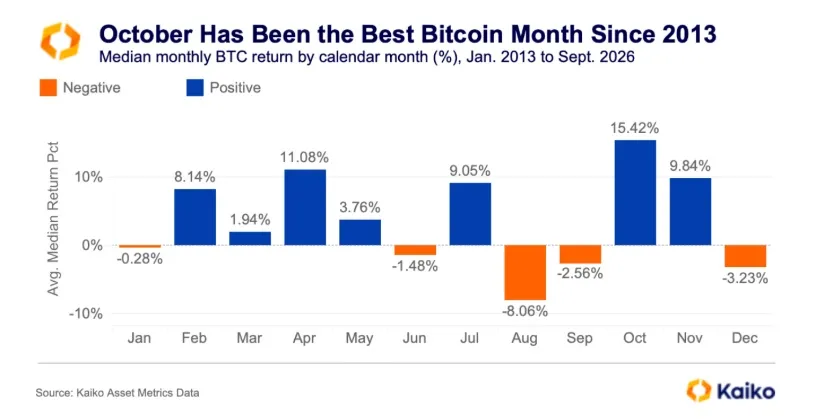
Median monthly Bitcoin return by calendar month since January 2013. Source: Kaiko
Bitcoins narrowing price swings may also be making seasonal trends less pronounced, Yang said. Its typical monthly move has declined from 14% between 2013 and 2016 to 9.6% since 2024, leaving less room for sharp seasonal rallies, he added.
Are institutions rewriting Bitcoins calendar?
Analysts also pointed to institutional investment and broader economic conditions as increasingly important influences on Bitcoins price.
Justin dAnethan, head of research at Arctic Digital, pointed to exchange-traded fund (ETF) flows and corporate Bitcoin buyers, saying their investment decisions are shaped more by liquidity, interest rates and investment mandates than seasonal trading narratives.
Related: Bitcoin ETF flows give mixed read on institutional demand: CoinShares
US spot Bitcoin ETFs recorded $515 million in net outflows in October, while spot Ether ETFs saw a record $1.61 billion in monthly withdrawals.
Yang cautioned that spot Bitcoin ETFs, approved in January 2024, are too recent to assess. Still, Bitcoin “increasingly trades like a macro asset, driven more by economic data and institutional flows than by the calendar,” he said.
Two October losses dont settle the question
Despite two consecutive October losses, analysts cautioned against writing off Uptober entirely.
Julio Moreno, head of research at CryptoQuant, said October has generally performed better during Bitcoin bull markets and worse during bear markets, making the broader market cycle an important factor when comparing returns.
“Price performance depends more on spot demand dynamics than cyclical patterns, and demand doesnt care about the calendar,” Moreno told Cointelegraph.
Related: Bitcoin risks worst October in 12 years as tech sell-off spreads to gold
Markus Levin, co-founder of XYO, said that traders may be anticipating seasonal gains earlier. “When enough people expect a rally in October, the rally gets priced in before the month arrives,” he said.
“Uptober has historical validity but, like other seasonality metrics, it can also fail at times,” said Arctic Digital‘s d’Anethan.
Magazine: Cybersecuritys Black October: How to protect yourself