Recently, two prominent crypto figures on X, @blmario669 and @choc07_, highlighted the same issue: DEXE, once considered a potential 100x gem, plunged from $46.9 to $5.6 within a single day, an 88% drop. (It has since fallen to a low of $1.5, representing a 97% decline.) During the crash, a large investor reportedly suffered losses of nearly $1.7 million, equivalent to more than 10 million RMB.
The sharp decline in DEXE has drawn attention toward market maker DWF Labs, which was accused of using the Ceffu MirrorX mechanism to bypass on-chain monitoring and execute a large-scale sell-off.
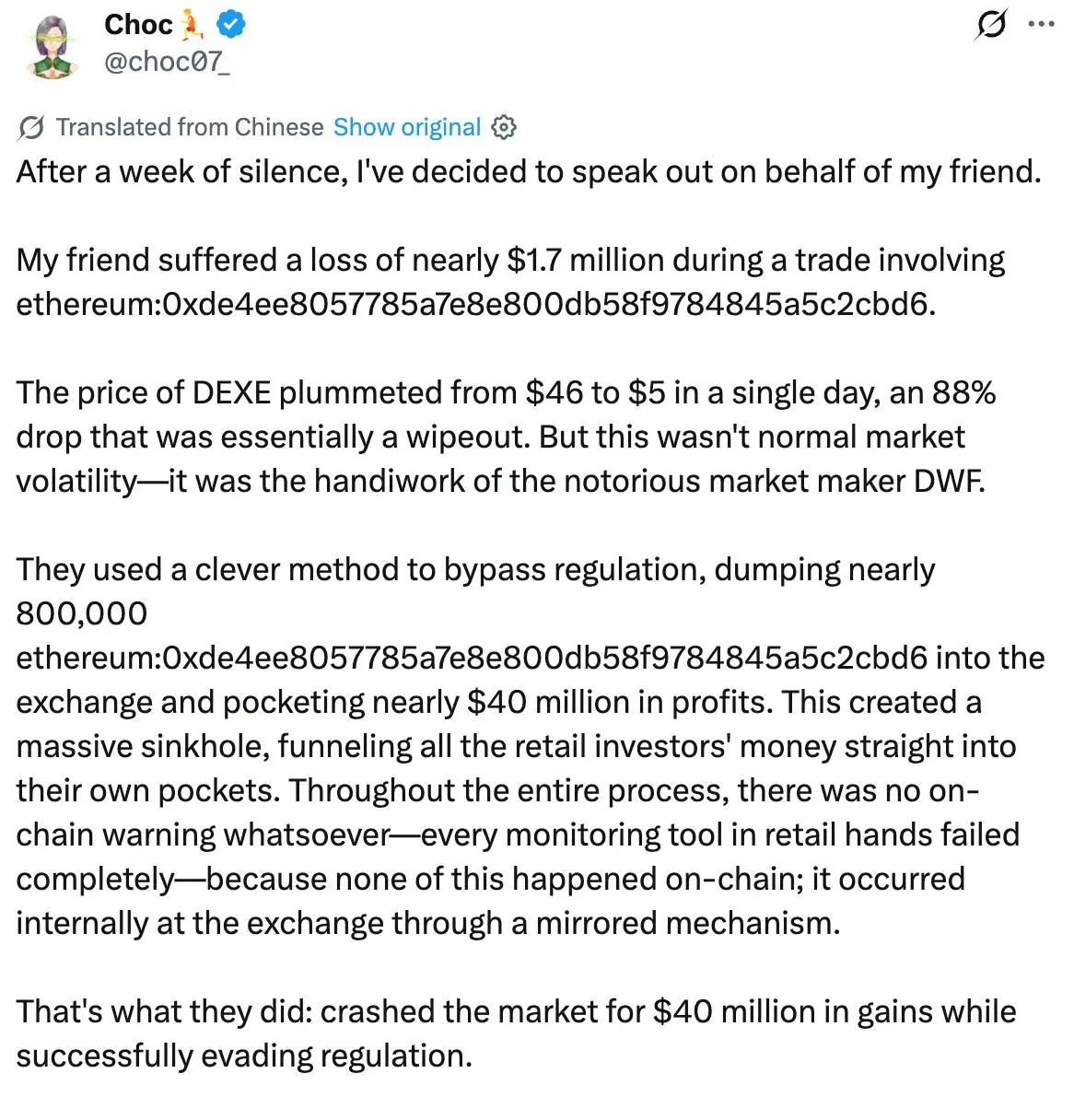
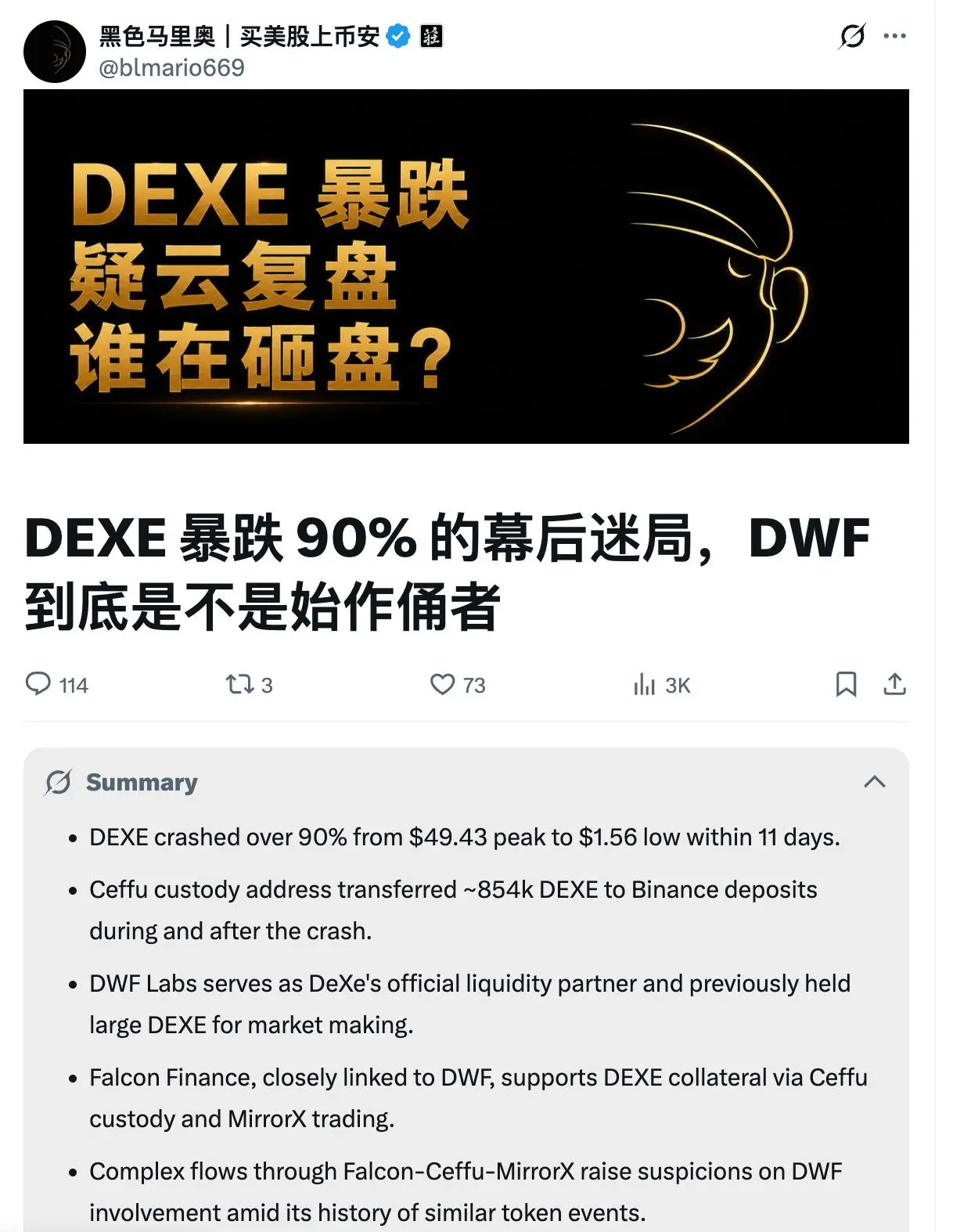
For more detailed information, please refer to: @blmario669 and @choc07_.
DEXE operates in the decentralized social trading and asset management sector. In October last year, it followed the broader market downturn and dropped to a low of $0.136. However, starting in February this year, it went against the market trend and entered a five-month consecutive rally, reaching $49.4 on July 13. The token recorded a peak gain of more than 360x, making it a true “100x coin.” Its market capitalization ranking also surged from outside the top 100 into the top 50.
However, just seven days after reaching its all-time high, on July 21, DEXE suffered an 88% single-day crash, becoming a textbook example of a “Super Mario-style dump”: a step-by-step price pump followed by a “straight-to-the-bottom” collapse.
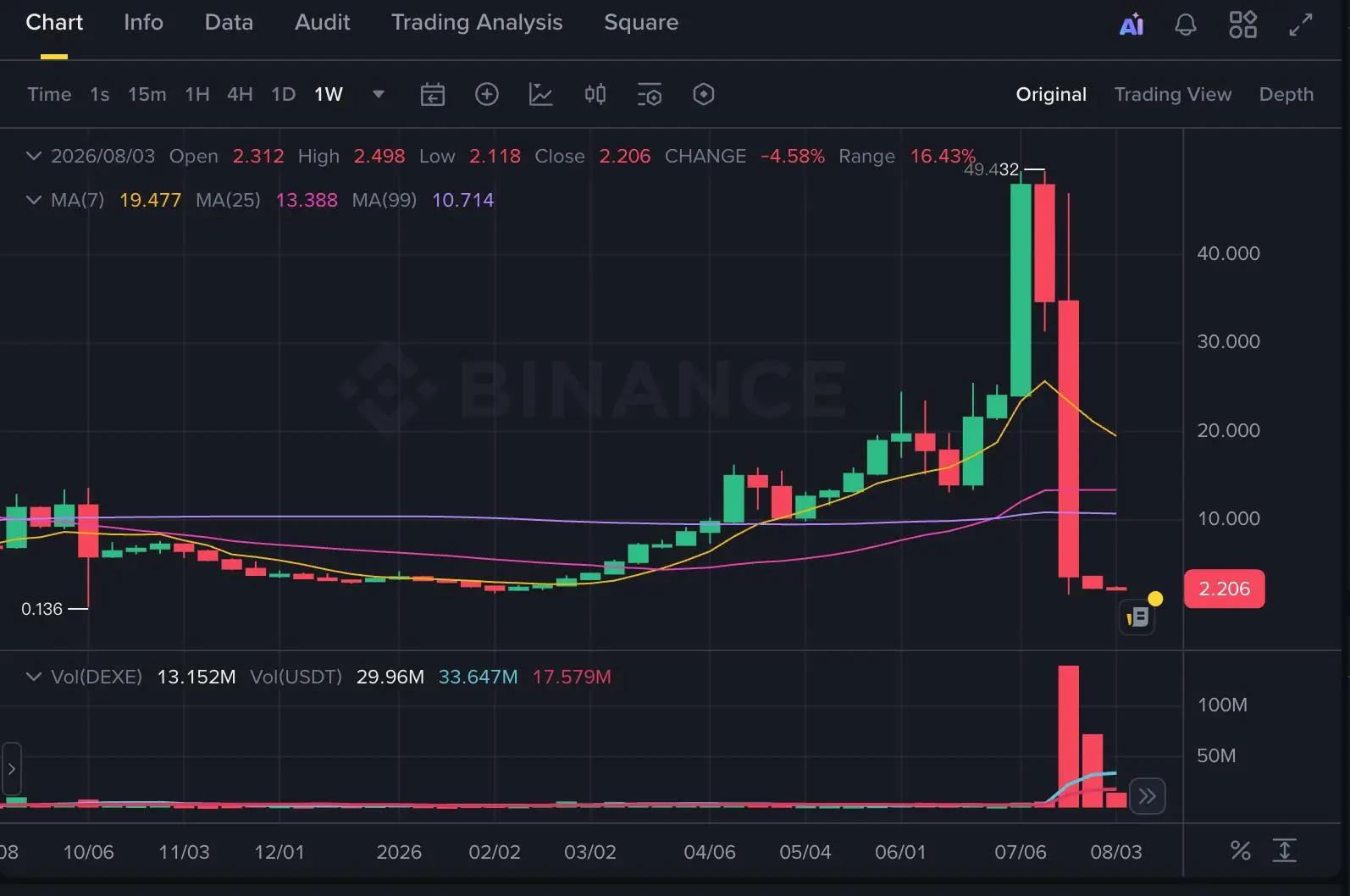
DEXE Weekly Candlestick Chart (Source: Binance)
The suspected culprit behind this crash, DWF Labs, is far from an unknown player. It describes itself as a “leading global cryptocurrency market maker,” claiming to trade more than 800 trading pairs across over 60 platforms. Its market-making portfolio includes once high-profile tokens such as CFX, MASK, ACH, FET, and YGG — many of which have experienced similar “pump-and-dump” price patterns.
Veteran crypto investors may be familiar with this phenomenon: during bear markets, small-cap tokens like DEXE often experience sudden explosive rallies. Some tokens can surge 3x, 5x, or even 10x within just a few days. However, this is not necessarily a positive signal. In many cases, these moves are designed by large players to attract retail investors and create exit liquidity.
The logic is simple: when the entire market is cold and one token suddenly starts rising alone, it creates a narrative that “a bull market is coming,” attracting retail investors to enter. Alternatively, it can be used to revive community activity and create new liquidity for selling. It is like seeing flowers bloom in the middle of the freezing winter — something unusual is probably happening behind the scenes.
Behind DEXEs Crash: Invisible Selling Pressure and How MirrorX Allows Institutions to “Disappear”How did DEXE, a token that gained 100x after a five-month rally, return to its starting point within a single day?
The first question is obvious:
Who was selling?
The amount of DEXE actually available for trading on the open market was extremely limited. The majority of tokens were locked in DAO treasuries, team contracts, and cross-chain bridges. There were only a handful of independent wallets holding more than $1 million worth of DEXE. Retail investors simply could not create selling pressure of this magnitude.
This was not a normal market correction — it appeared to be a carefully orchestrated sell-off.
The most alarming aspect of this crash was that there were no on-chain warning signals.
In traditional large-scale sell-offs, massive token transfers usually occur before the dump, allowing monitoring tools to detect unusual movements. But this time was different — the selling happened inside the exchange, through a “mirroring” mechanism.
Three key players were involved:
DWF Labs is DeXes official liquidity partner. In April 2024, the DeXe DAO approved a proposal to establish a liquidity partnership with DWF Labs. DWF had previously received 300,000 DEXE tokens and placed them into long-term staking.
Finance Falcon Finance is a synthetic dollar protocol that allows users to deposit assets such as DEXE as collateral to mint USDf. Falcon is led by DWF Managing Partner Andrei Grachev and has significant overlap with DWF in terms of key personnel, institutional resources, and trading capabilities.
Ceffu, formerly Binances custody division (Binance Custody), holds a critical tool: the MirrorX mirrored trading mechanism.
The operating logic of MirrorX is as follows:
The actual assets remain locked inside Ceffu custody and do not move on-chain. However, the exchange can create a 1:1 mirrored position that allows the institution to trade, adjust margin, and manage risk. The actual on-chain transfer is only settled later, typically on a T+1 basis.
This means:
Institutions do not need to transfer real tokens from Ceffu to Binance first — they can sell on Binance before the actual on-chain movement occurs.
On-chain data appears to support this timeline:
Starting at 16:20 on July 21, DEXEs price plunged from above $46 to below $10, with estimated selling volume exceeding 240,000 tokens. Meanwhile, the Ceffu wallet did not transfer 719,727 DEXE tokens to Binance until the following day, with the on-chain outflow representing more than 97% of its previous holdings.
Sell first, transfer later.
This time gap rendered retail monitoring tools ineffective.
As one analysis put it:
“Someone used MirrorXs time difference — where trades are executed first on the exchange while on-chain settlement happens on T+1 — to dump the tokens, trap retail investors, and only reveal the on-chain evidence the next day.”
Since February, Ceffu-labeled addresses have transferred a total of 854,149 DEXE tokens to Binance through eight different routes. Under the MirrorX mechanism, if these funds were used for selling near the top, the potential selling value could have reached approximately $39.44 million.
DWF Labs “Track Record”: Not the First ControversyDWF Labs responded to the incident by acknowledging that it held a short position on DEXE and had sold part of its spot holdings. However, it explained that these actions were part of “normal profit-taking, risk hedging, and cash management.”
The market, however, was not convinced — because DWF has faced similar accusations before.
YGG Incident (2023)
DWF Labs served as YGGs market maker. After Andrei Grachev publicly promoted YGG, the token price experienced a noticeable rally. Shortly afterward, on-chain data showed that DWF-related addresses transferred nearly 5 million YGG tokens to Binance in batches near the price peak, after which the token price dropped sharply.
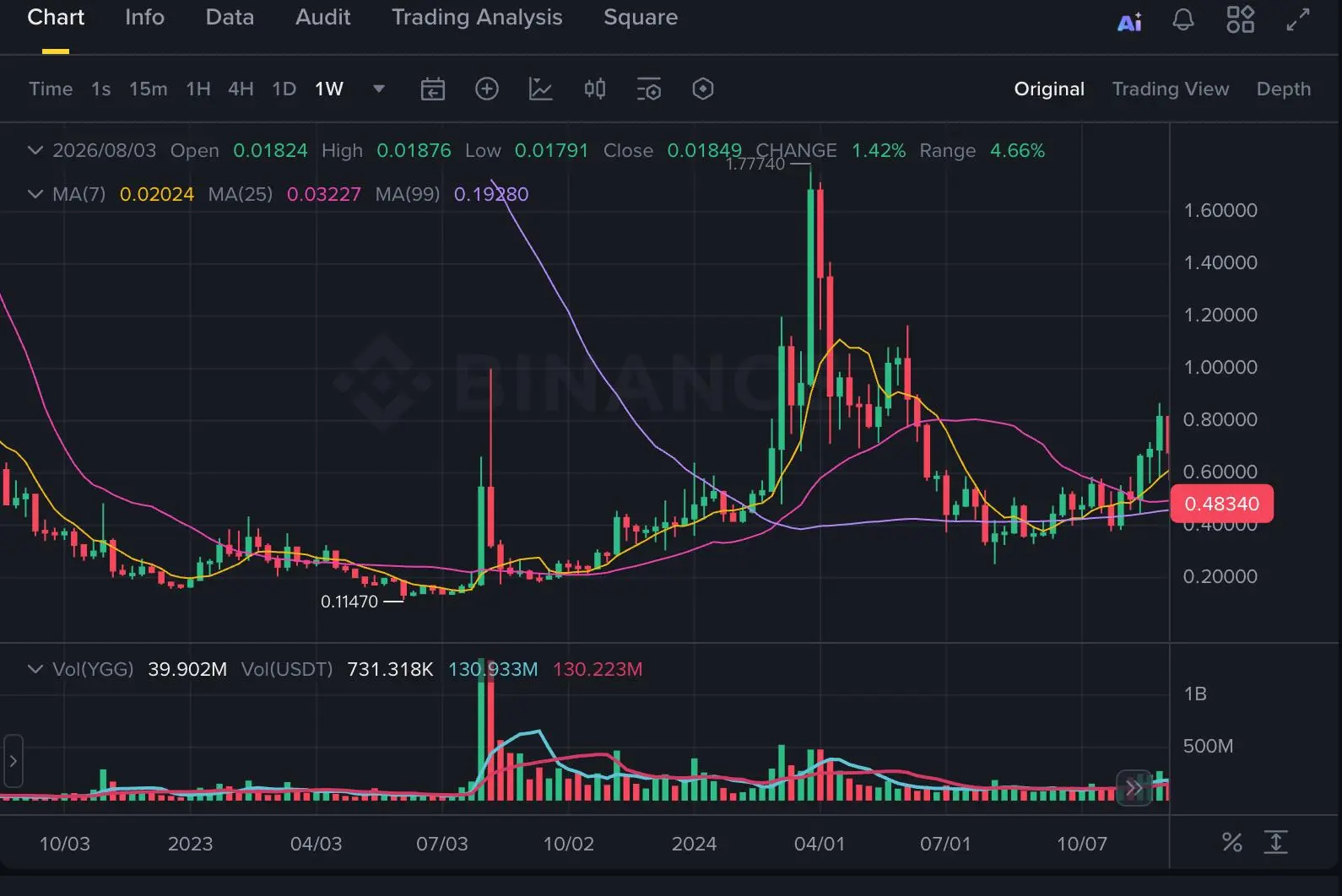
YGG Weekly Candlestick Chart (Source: Binance)
According to The Wall Street Journal, Binances internal market surveillance team previously identified more than $300 million in suspicious wash trading activity allegedly conducted by DWF in 2023 and recommended terminating cooperation with the firm.
ESPORTS Incident (May 2026)
The token suffered a flash crash, plunging 92%. Around five days before the collapse, approximately 19.9 million ESPORTS tokens (worth around $13.9 million) were transferred to a Kraken address linked to DWF.
SIREN Incident (June 2026)
After experiencing a major rally, SIREN suffered two separate crashes of more than 90%. On-chain analysis showed that a single entity at one point controlled approximately 88.5% of SIREN‘s supply, with the related wallet cluster allegedly linked to DWF Labs. SIREN’s market capitalization collapsed from a peak of $2.77 billion to just $40.78 million.
In addition, tokens such as DODO, C98, and CYBER have also experienced highly similar patterns — rapid short-term price increases followed by sharp declines.
After the DEXE crash, some tokens accepted as collateral by DWFs Falcon Finance were identified by the community as potentially carrying similar risks, including:
COTI, GIGGLE, AKE, EPIC, BOME, PUMP, LUMIA, ADA, WIN, CORE, SSV, and ZIL.
The community has summarized a recurring pattern:
Large amounts of tokens are obtained through OTC deals, investments, or market-making agreements; market-making accounts are then used to create trading volume and price momentum; tokens are transferred to exchanges near market highs; and the process eventually ends with a sharp price collapse.
Entering 2026, similar patterns have appeared frequently. Some analysts pointed out:
“Since the beginning of this year, whether a token surged 5x, 10x, 50x, or even 100x, almost without exception, they all eventually ended in a collapse.”
Why Are Small-Cap Coins That Explode During Bear Markets Often Traps?DEXEs dramatic rise and fall is not an isolated case during this bear market cycle.
From June to July 2026, a series of altcoins including LAB, HOME, TAC, GWEI, IN, ESPORTS, EDGEX, GUA, TRIA, M, TAIKO, EVAA, SLX, and SIREN experienced major crashes one after another.
These tokens share one common characteristic:
They achieved astonishing gains within an extremely short period of time, only to suffer even more dramatic losses shortly afterward.
This phenomenon becomes particularly dangerous during bear markets because:
1. Liquidity dries up
During the 2026 bear market, liquidity for small- and mid-cap tokens has severely deteriorated. Around 95% of altcoins fell below their 200-day moving averages, while 38%-40% of altcoins hovered near historical lows.
Spot trading volume for altcoins dropped from a peak of nearly $50 billion in October 2025 to approximately $7.7 billion in March 2026, representing a decline of more than 80%.
In a market lacking liquidity, any large sell order can trigger a chain reaction and cause a market collapse.
2. The dual role of market makers
Institutions represented by DWF often serve multiple roles simultaneously: they act as market makers providing liquidity for projects, while also being investors in collateral platforms and potential beneficiaries of liquidations.
This multi-layered identity creates significant conflicts of interest:
They can potentially switch between supporting price increases and selling pressure, while retail investors have no way to clearly distinguish what is happening behind the scenes.
3. Extreme information asymmetry
Mechanisms like MirrorX allow institutions to execute transactions off-chain, while on-chain records appear only later.
Retail investors on-chain monitoring tools become ineffective. By the time transfer records become visible, the price may have already collapsed.
4. The high FDV, low circulating supply trap
Many newly launched tokens have extremely low initial circulating supply but very high fully diluted valuation (FDV).
Project teams and early investors can unlock and sell tokens at elevated prices, while retail investors end up buying assets that are significantly overvalued.
Since January 2024, almost all major blockchain tokens launched after TGE have suffered severe losses, with some tokens falling as much as 99.8% from their initial valuations.
Bear Market Survival Guide: Control Your Hands, Stay AliveThe crypto market has now entered a deep bear market, with nearly two years remaining until the fifth Bitcoin halving expected in April 2028.
Meanwhile, the Federal Reserves interest rates remain elevated, market liquidity remains weak, and capital is limited. Under these conditions, a sustained market-wide rally is unlikely.
Remembering this basic premise can help investors avoid most “get-rich-quick” traps.
Here are several principles to survive this bear market:
Do not chase sudden pumps during a bear market
Small-cap tokens that surge rapidly during bear markets are often a prelude to a “pump-and-dump” event.
DEXEs journey from $2 to $49, followed by its collapse from $49 to $1.5, shows how late buyers ultimately become exit liquidity for early holders.
Experienced investors often summarize it this way:
“For any small-cap altcoin, once you make profits, take out your initial investment first — otherwise, stay away.”
Be cautious with projects announcing market maker partnerships
When a project announces cooperation with a well-known market maker, do not automatically treat it as a bullish signal.
Market makers are not charities. Their goal is to generate profits, and one common way to do so is to sell into strong price rallies.
The list of projects involving DWF as a market maker continues to grow, and so does the number of controversial collapses associated with them.
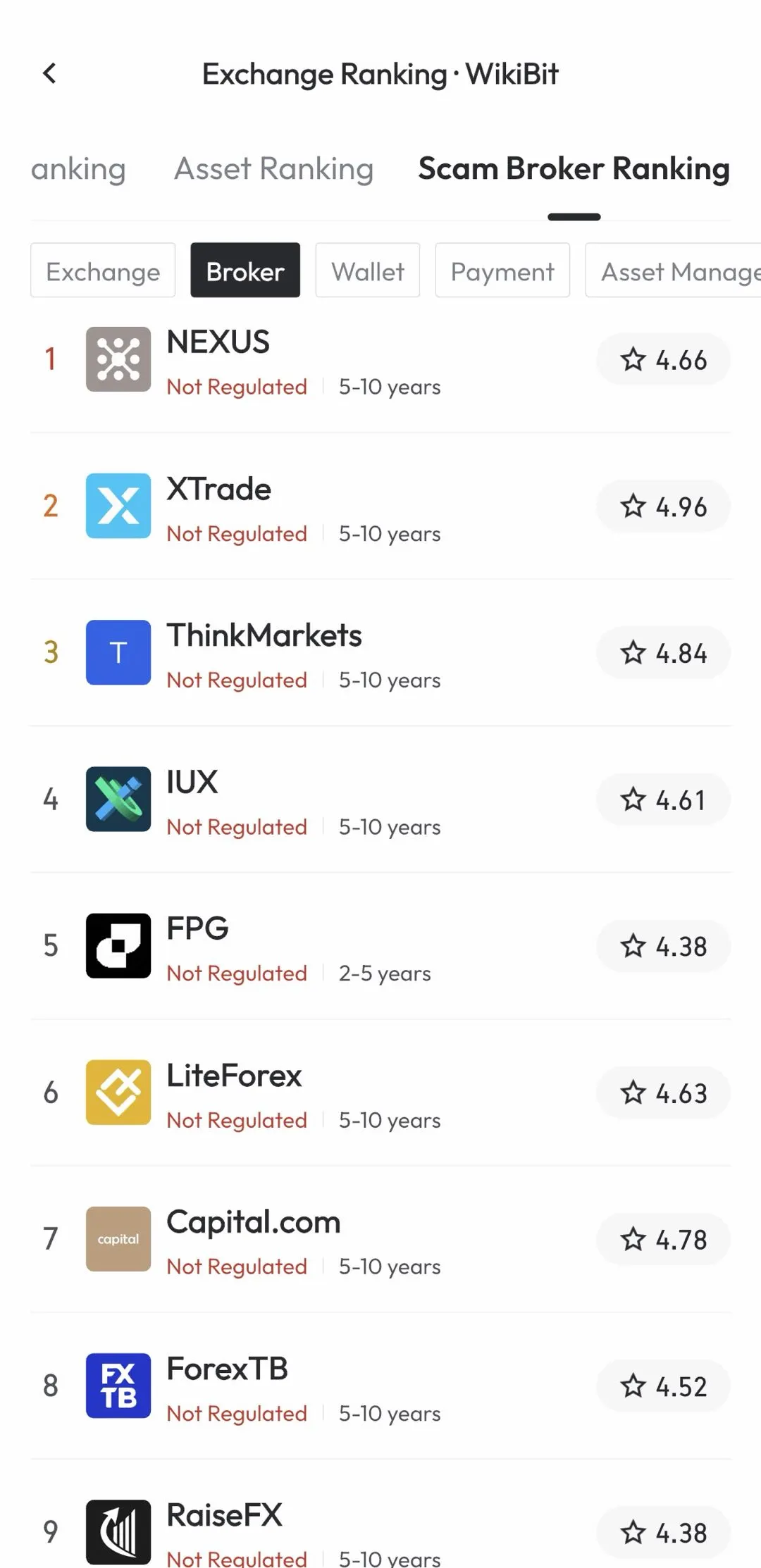
Broker Risk Ranking (Source: WikiBit)
Understanding exactly what you are buying is crucial.
Before purchasing a small-cap token, ask yourself a few questions:
- What is its actual circulating supply?
- What is its fully diluted valuation (FDV)?
- What is the token unlock schedule?
- Who controls the majority of the supply?
If you cannot answer these questions, what you are buying is not an investment — it is a lottery ticket.
Stay Away from the Breeding Ground of “Mirror Trading” and Custody-Based Sell-Offs
The Ceffu MirrorX mechanism has exposed a harsh reality:
On-chain transparency is only transparent for ordinary users — institutions may still operate with limited visibility.
When you see a token suddenly collapse on Binance while there is no obvious on-chain activity, mirror trading mechanisms may be one possible explanation.
For trading platforms and custodians with unclear mechanisms and insufficient transparency, maintaining distance is a wise choice.
Protecting Your Principal Matters More Than Anything
During a bear market, cash is king.
Do not FOMO into a token simply because you see someone else making a 10x profit.
What you see is the moment they made money.
What you do not see is:
- the moment they suffered losses;
- the moment early holders exited;
- the moment market makers sold into retail liquidity.
Remember one sentence:
99.9% of altcoins eventually go to zero.
Against this probability, any “100x coin” narrative becomes extremely fragile.
ConclusionThe story of DEXE tells us one thing:
When a small-cap token suddenly explodes during a bear market, it is more likely to be a trap than an opportunity.
Behind those seemingly “smart” price pumps, there is often an even smarter exit strategy.
In a battlefield where information, tools, and rules are not equal, the only thing retail investors can do is refuse to participate in a game designed against them.
If you really feel the urge to trade, consider using dollar-cost averaging strategies for major cryptocurrencies such as BTC, ETH, and BNB. For spot investments outside the top 20 by market capitalization, it is better to stay away unless you have a deep understanding of the project — or unless you are closely connected to the insiders.
You can also allocate a portion of your capital for short positions or hedging strategies. If you can survive until the end of the bear market, you will already outperform the majority of market participants.
The worst moment may not have arrived yet.
Bitcoin could potentially revisit the bottom range of this bear market cycle around October, possibly around the $35,000 level.
If a potential global financial crisis occurs at the same time, the impact could become even more severe.
Protect your principal. Stay patient.
The crypto market follows a simple pattern:
90% of the time is boredom, frustration, and accumulation.10% of the time is an explosive bull market.
Your goal is not to trade every day.
Your goal is to survive long enough to capture that critical 10%.