




Bitcoin carry trades could regain their edge over US Treasury bills in 2027 as demand for leverage recovers, according to digital asset bank Sygnum.
In its 2027 Sygnal Outlook report, Sygnum forecasts that the annualized premium on three-month Bitcoin (BTC) futures at the Chicago Mercantile Exchange would average more than 2% above three-month US Treasury bill yields next year.
A crypto carry trade involves buying Bitcoin while betting against its price through futures contracts. This helps limit exposure to Bitcoins price swings while also allowing traders to collect funding payments or futures premiums.
Fabian Dori, chief investment officer at Sygnum, told Cointelegraph that returns could recover as investors become more willing to take risks and fewer hedge funds compete for the same profits.
“The basis trade had become very crowded, with many hedge funds running it through spot ETFs [exchange-traded funds] against short CME futures,” Dori said. “Positioning data indicates that those funds have now unwound much of their CME short positions, so there is less capital competing for the same premium.”
Why Bitcoin carry returns fell
Sygnum cited a 67-day stretch of negative Bitcoin funding rates in 2026. It also comes as crypto tech and infrastructure company Talos recently published research showing how much returns have fallen.
In its latest report, Talos said Bitcoin funding rates and futures premiums, which reached peak annualized levels of 20%-40% in early 2024, dropped to just 3%-5% this year. The current three-month US Treasury bill yield is around 4.25%, which means traders can earn about the same return from government debt without taking on the extra risks of crypto trading.
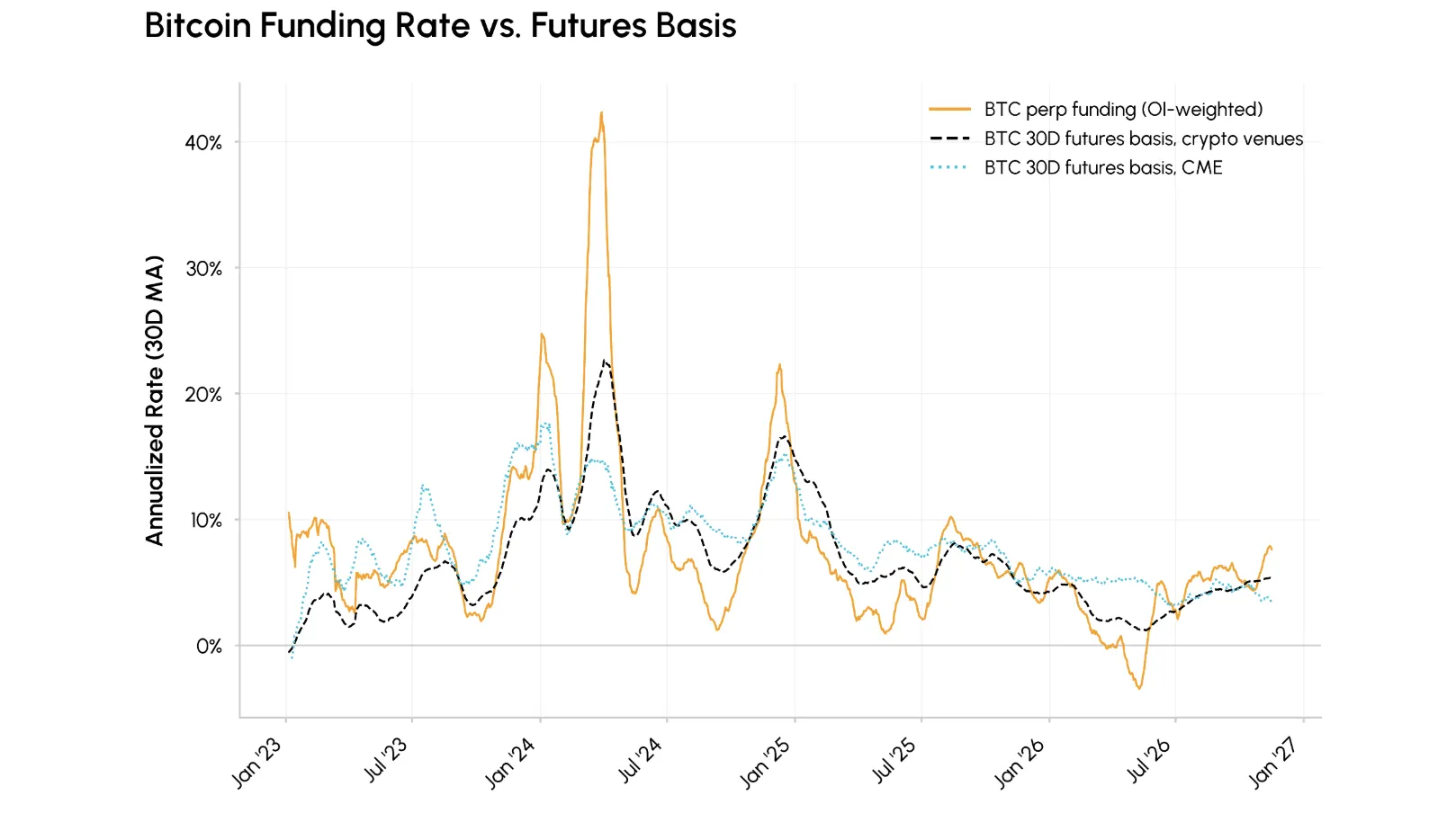
Bitcoin perpetual funding rates and the 30-day futures basis, annualized, 2024-2026. Source: Talos CM Market Data Pro
Sygnum‘s forecast now raises the question of whether Bitcoin carry trades can make enough money to justify the risks, such as sudden drops in returns and higher trading costs. And while returns have started to improve, it’s unclear whether that will continue into 2027.
Bitcoin carry trades became popular after the launch of US spot Bitcoin ETFs in 2024, which gave larger investors an easier way to use the strategy. But as more investors entered the market, the returns available from these trades began to fall.
“A more mature market pays less for the same trade,” Dori said. “But it also attracts additional investors, which may increase the demand for leverage.”
According to Talos, Bitcoin funding rates turned negative briefly in the second quarter of the year. This meant that traders betting against Bitcoin through perpetual futures had to pay traders betting on higher prices — as opposed to collecting payments.
Related: Bitcoin ETF inflows leave institutional demand unclear: CoinShares
Bitcoin funding shows tentative recovery
Still, there have been signs of a recovery: Talos found that crypto funding rates have started to rise again since August, potentially supporting Sygnums prediction. Coinbase also said in a Nov. 2 report that Bitcoin funding rates rose from around 4% annualized at the start of October to an average of 8.9% annualized in the last week of the month.
Coinbase questioned whether the increase reflected meaningful demand for leveraged Bitcoin trades; it cited weaker buying activity in the spot market.
“It‘s less clear to us that the late rise in BTC leverage reflects conviction, given how little support it had from spot holders or the options market,” Coinbase’s report reads.
Sygnum expects wider institutional adoption to support demand for leveraged Bitcoin exposure in 2027. It pointed to factors such as growing institutional investment in Bitcoin, the growth of tokenization and rising demand for AI.
However, Dori warned that a sharp market downturn, a shortage of liquidity, or interest rates staying higher for longer could prevent carry trade returns from recovering. He also pointed to risks that come with increased leveraged trading. Even a hedged position can face margin calls, requiring traders to post more collateral or close their futures position.
“Carry can pay steadily for long periods and then turn quickly,” he said. “When positioning gets crowded and funding reverses, the unwind is typically fast, because the same leverage that pays the carry forces the exit.”