Preface: An industry giant with “a perfect ledger but a breached front line”
In the previous 52 issues, we dug into a series of exchanges from HashKey to Bitget. Today, in issue 53, we come to a name no one in crypto can avoid—Binance.
On “paper metrics,” this player is the ceiling of the crypto industry: customer assets of about $129.4 billion; total PoR reserves of about $135.8 billion; BTC reserve ratio of 100.35%, USDT 103.88%, and USDC 108.26%; derivatives trading volume of $4.90 trillion in Q1 2026, accounting for 34.9% of the Top 10; and custodial assets of $152.9 billion, accounting for 73.5% of the top ten exchanges. By any static financial indicator, Binance is the “too big to fail” existence.
But on the other side, just today—October 30, 2026—on-chain data shows that Binances hot wallets had about $6.0 billion to $6.28 billion in assets transferred out across 8 to 9 chains, with more than $6 billion flowing out within 55 minutes. Issuers such as Tether and Circle urgently froze about $2.8 billion, but about $3.27 billion (mainly native assets such as BTC and ETH) was still moving freely on-chain.
An exchange with a “PoR reserve ratio above 100%” had billions of dollars emptied from its hot wallets. Proof of Reserves tells you “the platform has money,” but it does not tell you whether that money could “disappear” from hot wallets at any moment. Today well peel this back layer by layer.
1. Regulatory compliance: After the $4.3 billion settlement, the compliance test has only just begun
Binances “compliance assets”: settlement and dropped lawsuits
Binance has not been without regulatory “stop-the-bleeding moves.” In November 2023, Binance reached a $4.3 billion settlement with the U.S. Department of Justice, FinCEN, OFAC, and other agencies, pleaded guilty, and agreed to accept independent monitoring for five years. In early 2026, the SEC withdrew its lawsuit against Binance and acknowledged in court filings that its prior enforcement had “defects.”
On paper, this looks like a story of “compliance repair.”
But the U.S. Treasury says: your compliance “gaps” remain
In May 2026, the U.S. Treasury formally required Binance to arrange executive interviews and produce data to verify whether it was complying with the $4.3 billion settlement agreement. The third-party monitor appointed by Treasury approached this from three directions: requiring current co-CEO Richard Teng, the compliance head, and former executives (including CZ) to appear and verify compliance details; focusing on obtaining transaction data related to sanctioned jurisdictions such as Iran, North Korea, and Syria from 2024 to 2026; and Treasury believes Binance has “compliance gaps” in about $2 billion of Iran-related fund flows and U.S. user controls, and required it to upgrade monitoring systems and expand the scope of KYC.
In plain terms: it paid a $4.3 billion penalty, pleaded guilty, and accepted five years of monitoring—yet in 2026 regulators still believe your compliance has “gaps,” and the gaps involve sanction-related fund flows. This is not a “legacy issue”; this is an ongoing compliance review.
EU: MiCA license gone, surviving on a “reverse solicitation” exemption
In June 2026, Binance withdrew its Greek MiCA application, closing off its main path to obtaining unified EU authorization. Since the end of the MiCA transition period on July 1, 2026, Binance has been operating in the EU without a MiCA CASP license.
What is its “legal cover”? It is the “reverse solicitation exemption” under Article 61 of MiCA—allowing EU clients to actively seek services, but prohibiting the platform from actively marketing. EU regulators have already questioned the use of this exemption and required Binance to provide relevant information. Binances local licenses in France, Spain, Poland, and other countries have also become invalid under the MiCA framework, and some EU clients have been migrated to its Abu Dhabi entity.
The world‘s largest exchange, under the EU’s largest unified regulatory framework, is maintaining operations through an “exemption” rather than a “license.”
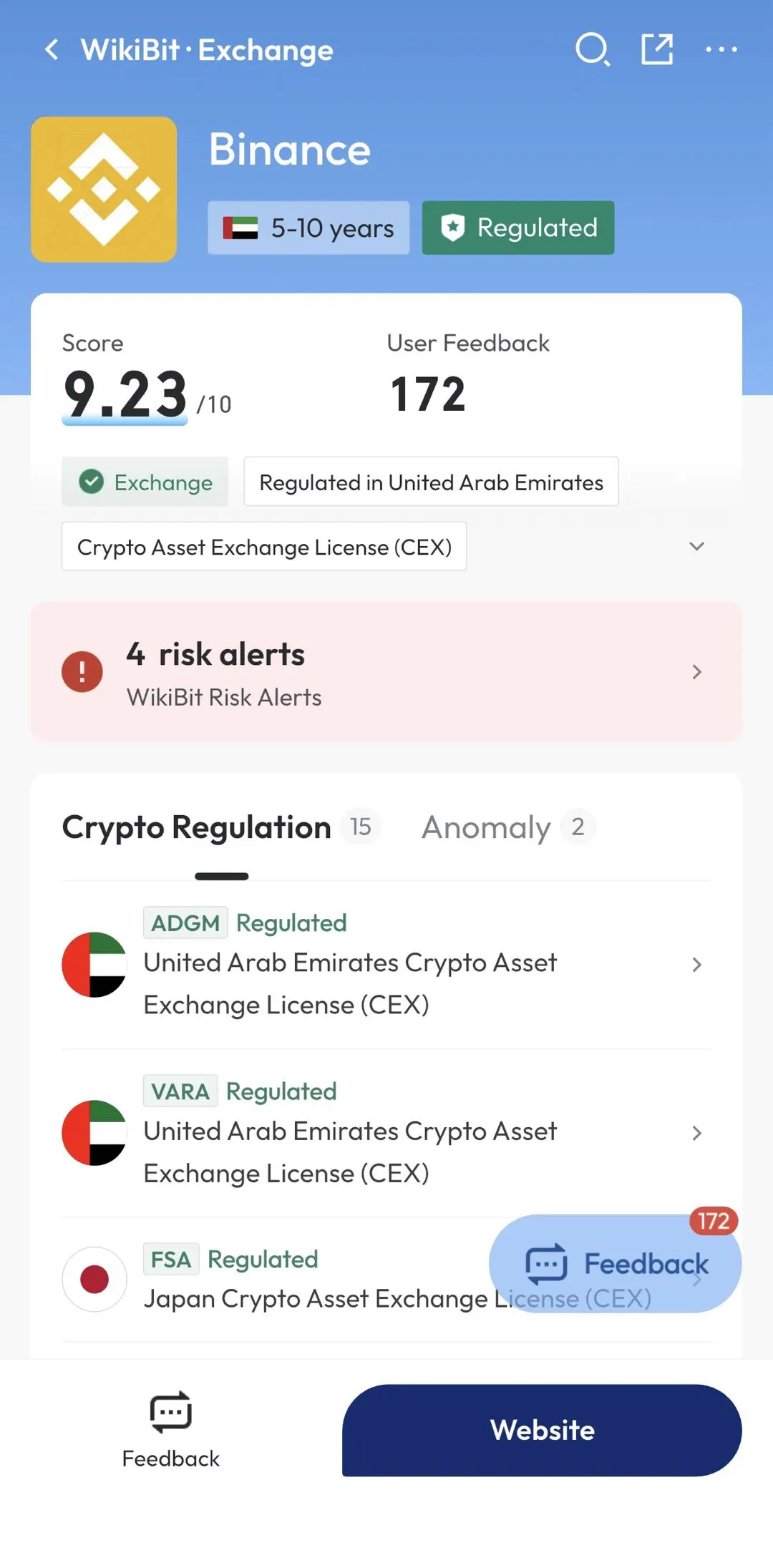
WikiBit score 9.23/10, with notes: France AMF (regulatory number: E2022-037) regulatory status abnormal; the regulator‘s published status is revoked; Spain BDE (regulatory number: D661) regulatory status abnormal; the regulator’s published status is revoked; please be aware of the risk!
Risk Rating: Medium Risk (Regulatory Compliance)
Binance is not operating without regulatory authorization across the board. Rather, its regulatory position can be characterized as one involving settlements, regulatory oversight, and compliance gaps that are still being investigated by authorities.
The $4.3 billion settlement and the SEC's withdrawal of its lawsuit were genuine steps toward containing its regulatory problems. However, the U.S. Treasury's compliance review in May 2026 and Binance's lack of a MiCA license in the EU demonstrate that its regulatory rehabilitation remains far from complete.
2. Account Security and Withdrawals: Today's $6.28 Billion Incident and the Everyday Reality of Withdrawals Frozen Over a $4 Transaction
October 30, 2026: Eight to Nine Blockchains, More Than $6 Billion, and Just 55 Minutes
This is one of the largest hot wallet security incidents in Binance's history and in the history of the entire cryptocurrency industry.
Attack method:
On the previous day, between October 28 and 29, the attacker funded a newly created address with approximately 0.1 ETH in gas fees through Tornado Cash.
The attacker then exploited an EIP-7702 authorization mechanism, an Ethereum feature that allows ordinary wallets to execute smart contract code, to take control of a hot wallet labeled “Binance 14.”
From submitting the authorization to draining the wallet, the entire process took approximately four minutes.
The attacker subsequently carried out repeated sweeps across multiple wallets, with the overall operation lasting more than two hours.
Estimated losses based on on-chain data, as of approximately 8:00 AM Beijing time on October 30:
| Blockchain / Asset | Estimated Amount |
| Ethereum (ETH/USDT/USDC, etc.) | $3.74 billion |
| Bitcoin | 18,270.2 BTC, approximately $1.47 billion |
| Tron (TRX/USDT) | Approximately $628 million |
| XRP | Approximately $297 million |
| Solana | Approximately $96.1 million |
| Others (Arbitrum, Avalanche, Optimism, etc.) | Approximately $60 million combined |
| Total | Approximately $6.28 billion |
Freezing progress:
Tether froze 1.567 billion USDT, while Circle froze 800 million USDC. Ripple, Paxos, and World Liberty Financial also participated in the freezing efforts.
So far, approximately $2.8 billion has been frozen. However, around $3.27 billion remains freely transferable on-chain, primarily consisting of native assets such as BTC and ETH that cannot be frozen by stablecoin issuers.
Official response:
In the early stages of the incident, Binance issued a statement saying that it was aware of a potential security issue, that user funds remained safe, and that withdrawals had been temporarily suspended.
CZ subsequently posted on X that “it does look like Binance was hacked,” while thanking Tether and Circle for their rapid response in freezing assets.
Binance officially stated that it would cover all losses.
According to Binance's preliminary investigation, as outlined on its support page, the incident may have originated from a compromised laptop belonging to a DevOps engineer. The attacker allegedly gained access to service containers and submitted unauthorized withdrawal transactions. No evidence of private key leakage had been identified at that stage.
Everyday Withdrawal Freezes: A $4 Transaction Leaves $3,500 Locked for a Month
If today's hacking incident represents a security breakdown at the platform level, everyday account freezes represent the friction users experience at the individual level.
In August 2026, a Binance user described their experience on Reddit.
After a $4 payment on BNB Smart Chain was rejected, the user's withdrawal privileges were disabled for 24 hours. The account was subsequently referred for a “compliance review,” with an estimated completion date of September 18 — more than a month after the original $4 transaction.
Approximately $3,500 in the account became inaccessible.
The user emphasized that the account had been open for nearly five years, with hundreds of transactions completed and no previous issues.
Other users described similar experiences in the comments:
A $100 withdrawal was followed by more than $4,000 in account funds becoming inaccessible.
A transfer of 45 USDT reportedly triggered an extended compliance review.
Binance has not publicly explained the specific triggers behind these individual cases.
However, from the perspective of exchange risk controls, the destination address, counterparty, or historical transaction patterns associated with a small payment may be the actual triggers, rather than the transaction amount itself.
Risk Rating: Extreme Risk (Account Security and Withdrawal Access)
Today's $6.28 billion hacking incident and the everyday experience of having withdrawals frozen over a $4 transaction are not two unrelated problems. They are two sides of the same coin.
A platform managing approximately $129.4 billion in customer assets saw its hot wallet taken over through an EIP-7702 authorization mechanism and drained within minutes. Meanwhile, an ordinary user's small transaction could trigger a compliance review lasting an entire month, without a clear explanation.
The former represents a failure in platform-level security controls. The latter highlights a lack of transparency in risk management and compliance procedures.
For users, whether their money disappears because of a hacker or becomes inaccessible due to a “compliance review,” the practical result is the same: they cannot access their own assets.
3. Proof of Reserves Transparency: The Better the Balance Sheet Looks, the More Striking the Hot Wallet Breach Becomes
PoR Data: Reserve Ratios Above 100% — Apparently Flawless
As of October 1, 2026, Binance's Proof of Reserves (PoR) data showed the following reserve ratios:
| Asset | Reserve Ratio |
|---|---|
| BTC | 100.35% |
| ETH | 100.00% |
| USDT | 103.88% |
| USDC | 108.26% |
| BNB | 100.47% |
| SOL | 100.00% |
| XRP | 100.77% |
For BTC, Binance reported a net customer balance of 688,572.68 BTC, compared with on-chain wallet holdings of 691,003.593 BTC.
Based on prevailing market prices, the combined net customer balances amounted to approximately $133.6 billion, while total on-chain wallet holdings reached approximately $135.8 billion.
From a PoR perspective, none of Binance's reported asset reserve ratios fell below 100%.
But there is one question PoR cannot answer:
How could a hot wallet be drained in the first place?
PoR demonstrates that the assets held by a platform are greater than or equal to its total customer liabilities.
It does not establish how those assets are distributed across different wallets, nor does it prove that the access controls protecting those wallets are sufficiently secure.
Today's incident exposed precisely this limitation.
PoR tells users that Binance has sufficient assets to cover customer balances. It does not tell them that billions of dollars may be concentrated in a handful of hot wallets, or that the authorization mechanisms controlling those wallets could potentially be compromised through an EIP-7702 exploit originating from an address funded via Tornado Cash — in just four minutes.
Adequate reserves and hot wallet security are two entirely different things.
An exchange with 100% reserves can still lose billions of dollars if its hot wallet access controls are compromised. The difference is that it may actually have enough money to cover the losses.
PoR is a financial health check, not a security audit.
It can tell you whether the balance sheet is healthy. It cannot tell you whether the vault door can be opened with a forged authorization.
Risk Rating: Medium Risk (Proof of Reserves Transparency)
Binance's PoR transparency is genuine, and its reserve data is continuously disclosed. This deserves objective recognition.
However, today's incident draws a clear distinction between two concepts: PoR can demonstrate that an exchange has the financial capacity to compensate users, but it cannot prove that those assets will not be stolen.
For users, “the platform can afford to reimburse me” and “my assets will not be stolen” represent two fundamentally different forms of security.
4. Financial Strength and Trading Depth: Too Big to Fail, but the Bigger the Exchange, the Greater the Potential Risk
Let's start with the numbers: Binance's position as the industry leader is no exaggeration.
In Q1 2026, Binance recorded $4.9 trillion in derivatives trading volume, accounting for 34.9% of the combined volume of the top 10 exchanges. To put that into perspective, Binance alone processed more derivatives trading volume than OKX and Bybit combined.
Its spot market performance was equally impressive. Spot trading volume reached approximately $639.9 billion in Q1, averaging around $7.19 billion per day and representing 34.3% of the top 10 exchanges' combined market share.
Now let's look at its asset base:
Assets under custody: $152.9 billion, accounting for 73.5% of the total held by the top 10 exchanges. By comparison, OKX, ranked second, held just $15.9 billion.
Stablecoin reserves: As of July 2026, Binance held approximately $53 billion in stablecoins, representing 57% of the $93 billion in stablecoin reserves held by exchanges worldwide. That's about $42 billion more than the second-largest exchange.
Customer assets displayed in real time: Approximately $129.4 billion.
These figures show that Binance isn't just leading in trading volume. It also dominates in asset size, market share, and liquidity.
But here's the big question: Does being the biggest automatically make an exchange the safest?
Not necessarily.
Binance's enormous scale certainly gives it greater financial resources to absorb losses. But it also creates another problem: when its security defenses fail, the potential damage can be enormous.
Think about it this way. With $152.9 billion in assets under custody, even a single compromised hot wallet could involve an amount larger than the entire asset base of many smaller exchanges.
The reported $6.28 billion incident is a good example. If something similar happened to a mid-tier exchange, it could face a serious liquidity crisis, become unable to meet its obligations, or even collapse. Binance, on the other hand, has the financial resources to absorb a loss of that scale.
But there's one thing we shouldn't overlook: Being able to afford the losses doesn't mean the same thing won't happen again.
The real concern isn't whether Binance has enough money to cover the damage. It's why a single failure in internal access controls could potentially allow billions of dollars to leave the platform within such a short period.
So yes, Binance deserves credit for its financial strength. But that only demonstrates its ability to withstand financial shocks. It doesn't prove that its security systems are free of vulnerabilities.
Risk Rating: Low Risk (Financial Strength)
Binance is undoubtedly among the industry's strongest players in terms of assets, trading depth, and market position. There's little room for debate on that point. However, we need to distinguish between two very different questions: Can the exchange afford to compensate users after an incident? And can it prevent another incident from happening in the first place? Binance has a clear advantage on the first question. The second still needs to be proven through action.
5. Internal Operations and Management: CZ Has Stepped Down, but He Hasn't Completely Left the Picture
Let's look at Binance's management first. The exchange is no longer run by CZ alone.
After CZ stepped down as CEO in November 2023, Binance gradually moved toward a new management structure. Day-to-day operations are now jointly overseen by Richard Teng and Yi He.
Their responsibilities are relatively clearly divided:
Richard Teng: With a regulatory background, he previously served as CEO of the Financial Services Regulatory Authority at Abu Dhabi Global Market (ADGM). His main responsibilities include regulatory relations, compliance, and licensing.
Yi He: With a stronger background in the market and user operations, she focuses primarily on user growth, product services, and community operations.
Binance also currently has a seven-member board, including three independent directors and one independent chair.
At first glance, this structure looks reasonably well organized. At least the exchange is no longer relying on its founder to handle everything.
But here's the interesting part: although CZ has stepped down as CEO, he hasn't completely withdrawn from Binance's decision-making process.
In February 2026, Richard Teng told Bloomberg Television that CZ, as a major shareholder, still had a say in Binance's major decisions.
In April 2026, Yi He also said that CZ had stepped away from day-to-day management but remained involved in major decisions.
In other words, CZ is no longer responsible for running the business on a daily basis, but he still has considerable influence over important decisions.
The real question is: When something goes wrong with security, who takes ultimate responsibility?
The $6.28 billion incident raises an issue that goes beyond the financial losses themselves: Who is ultimately responsible for Binance's internal security and access-control systems?
According to Binance's preliminary investigation, the attackers compromised a DevOps engineer's laptop. They then used the compromised device to access service containers and submit unauthorized withdrawal transactions.
Pay attention to the key detail here: the attack may not have involved the traditional scenario of private keys being stolen. Instead, it appears to have started with an employee's device being compromised, allowing the attackers to exploit internal system access.
This is more than just a conventional hacking incident. It raises questions about employee device security, internal permissions, and operational security as a whole.
Put simply:
If there's a problem with regulatory licensing, it's relatively clear who should handle it.
If user growth falls short, there are already designated people responsible.
But if an employee's computer gets hacked and attackers can exploit internal permissions to move billions of dollars, who is ultimately responsible for protecting that security barrier?
This is precisely the area of Binance's management structure that needs further clarification.
Richard Teng specializes in regulation and compliance, while Yi He is more familiar with the market and user operations. There's nothing inherently wrong with this division of responsibilities. However, the exchange's core security infrastructure, internal access controls, and employee device protection also need clearly designated owners, strict authorization procedures, and fully traceable accountability.
Risk Rating: Medium Risk (Management and Governance)
To be fair, Binance's current management structure is more mature than that of many exchanges that rely heavily on a single founder to make all the decisions. Its regulatory relations and day-to-day operations also have relatively clear divisions of responsibility.
However, this incident is a reminder that we shouldn't judge an exchange's management simply by looking at who founded it, who serves as CEO, or how many licenses it holds. We also need to examine whether its internal security systems are genuinely reliable.
After all, when users deposit their money on an exchange, they don't really care who is responsible for growth or who handles regulatory compliance. What they care about is whether their assets can be deposited safely and, more importantly, withdrawn safely.
The key question Binance needs to answer is this: What concrete measures will it take to ensure that similar internal access-control vulnerabilities never happen again?
Clarify the $6.28 billion incident wordingSeparate reserves from assets under custody
6. Real Community Feedback: The Bigger the Exchange, the More Complaints It Attracts — But What Matters Is Where Those Complaints Are Concentrated
For large exchanges, complaint volumes cannot be directly compared with those of smaller platforms.
Binance has an enormous user base, so a high absolute number of complaints is hardly surprising. What matters more is the nature of those complaints and the problems they reveal.
Trustpilot Data: Rating Unavailable, with a High Proportion of Negative Reviews
Binance's Trustpilot page shows approximately 6,188 reviews, including around 595 submitted over the past 12 months.
The displayed review distribution is approximately:
1-star reviews: 82%
5-star reviews: 6%
However, an important qualification is necessary.
Trustpilot explicitly states that Binance's rating is unavailable due to violations of the platform's guidelines.
Therefore, the star distribution above reflects the review structure displayed on the page at the time of observation. It should not be treated as Trustpilot's official overall rating of Binance, nor as a representative measure of satisfaction among all Binance users.
What Are Users Actually Complaining About?
Based on user reviews and discussions across WikiBit, Trustpilot, and other platforms, the main areas of dispute include:
Accounts restricted due to questions about the source of funds or transactions involving external wallet addresses.
Extended withdrawal review periods.
Customer support responses that rely heavily on standardized templates and provide no clear resolution timeline.
Users struggling to understand KYC, Enhanced Due Diligence (EDD), and source-of-funds documentation requirements.
Disputes over refund amounts following failed bank transfers.
These complaints share a common characteristic: users are often not completely prevented from trading, but they cannot freely withdraw or transfer their account assets.
For exchanges, anti-money laundering checks and source-of-funds reviews are necessary compliance measures.
However, when a platform fails to provide clear documentation requirements, review progress updates, and an effective appeal process, users can end up experiencing prolonged restrictions on their funds.
7. Comprehensive Exchange Exit Risk Assessment
| Assessment Dimension | Risk Level | Key Findings |
| Regulatory Compliance | Medium | $4.3 billion settlement and SEC lawsuit withdrawal. However, the U.S. Treasury was still investigating compliance gaps in May 2026. No EU MiCA license; operations rely on the reverse solicitation exemption. |
| Account Security / Withdrawals | Extreme | On October 30, 2026, approximately $6.28 billion was drained from hot wallets through an EIP-7702 authorization exploit. Everyday users have also reported month-long freezes triggered by transactions as small as $4. |
| Proof of Reserves Transparency | Medium | PoR ratios remain above 100%, with continuous disclosures. However, PoR does not establish the security of hot wallet access controls. |
| Asset Strength | Low | $152.9 billion in assets under custody, representing 73.5% of the top 10 exchanges. A 34.9% share of derivatives trading volume and genuine financial capacity to absorb major losses. |
| Management and Operations | Medium | Clear division of responsibilities between the two co-CEOs: Teng oversees regulatory matters, while Yi He focuses on users. However, ultimate accountability for internal access controls and OpSec remains unclear. |
| Product Experience | Low | Industry-leading liquidity, market depth, and cryptocurrency coverage. The core trading functionality is not the primary source of concern. |
| Community Feedback | High | Approximately 82% of displayed Trustpilot reviews are 1-star. Complaints include prolonged freezes triggered by small transactions, highlighting the tension between being “too big to fail” and an individual user still being unable to access their funds. |
Overall Rating: Medium-High Risk (Prominent Security and Operational Risks, Rather Than Traditional Exchange Exit Risk)
Binance's traditional exchange exit risk is among the lowest in this series.
It has real assets, substantial reserves, genuine financial capacity to compensate users, and a documented history of regulatory settlements.
It is unlikely to simply disappear with customer funds in the manner associated with exchanges such as UZX or Azbit.
In today's $6.28 billion incident, Binance has also explicitly stated that it will cover all losses.
But not running away does not mean being safe.
Binance's major risks are not primarily about whether it will suddenly shut down and disappear. They lie in two areas: systemic security incidents and individual account restrictions.
1. Today's incident proves that 100% PoR does not mean hot wallets are secure.
The EIP-7702 authorization mechanism, the compromised laptop of a DevOps engineer, and the draining of “Binance 14” in just four minutes all point to failures in access control and internal permission governance, rather than insufficient reserves.
Even a platform with enough money to compensate users can lose billions of dollars overnight.
2. Everyday withdrawal freezes demonstrate that risk-control transparency falls far behind PoR transparency.
PoR allows Binance to disclose reserve ratios to two decimal places. Yet when an individual user's account is frozen, the explanation may amount to just four words: “compliance review,” accompanied by a vague estimated timeline.
Reserve transparency is designed for the market. Risk-control transparency is designed for users.
On Binance, the latter falls far short of the former.
3. Being “too big to fail” is a double-edged sword.
With $152.9 billion in assets under custody, Binance has sufficient financial resources to absorb today's losses.
But the same scale also means that a single hot wallet compromise can result in losses that most exchanges simply could not withstand.
System security depends on the weakest link in the chain, not on the size of the platform's total assets.
8. Recommendations for New and Existing Users
For New Users
1. Do not confuse “too big to fail” with “my money is absolutely safe.”
Binance may be able to afford $6.28 billion in losses, but that does not guarantee that your account will never be subjected to a month-long compliance review because of a small transaction.
The reported cases on Trustpilot involving a $4 transaction triggering a freeze on $3,500 in funds illustrate this concern.
2. If you are in the EU, first confirm which Binance entity holds your account.
Binance does not currently have a MiCA CASP license, and some EU customers have reportedly been transferred to its Abu Dhabi entity.
Which legal framework protects you and which regulator you should approach in the event of a dispute depend on the specific entity serving your account, not simply on the Binance brand name.
3. If you decide to use Binance, test withdrawals with a small amount first.
Start by depositing an amount you can afford to lose and complete the entire process:
Deposit → Trade → Withdraw.
If the withdrawal goes through smoothly, you can consider increasing your exposure. If your account is flagged for review, at least the amount at risk will be relatively small.
4. Consider self-custody for substantial holdings.
Today's incident demonstrates that even the world's largest cryptocurrency exchange can suffer a compromise of its hot wallet access controls.
For substantial long-term holdings, consider using a hardware wallet. Do not treat an exchange's PoR as sufficient proof of your personal asset security.
For Existing Users
1. Reassess your “hot exposure.”
How much of your capital on Binance is kept there for immediate trading?
Following today's incident, it is worth reviewing that allocation.
Trading capital and long-term investment holdings should be managed separately.
2. Monitor the restoration of withdrawal services.
Binance has suspended all deposits and withdrawals.
Until withdrawal services are fully restored and you have successfully tested a withdrawal yourself, avoid depositing additional assets into Binance.
3. Keep all relevant records.
If your account becomes restricted or you encounter withdrawal problems, preserve all emails, customer support conversations, transaction receipts, and device login records.
Following a security incident of this scale, Binance's customer support resources may come under additional pressure.
A complete record of your interactions and transactions will be essential if you need to file an appeal or pursue a public complaint later.
4. Do not relax your personal OpSec standards simply because the platform can afford to compensate users.
Today's attack reportedly originated from the device of an internal DevOps engineer.
Your own device security, API key management, and two-factor authentication (2FA) settings remain your first line of defense in protecting your assets, regardless of how large the exchange may be.
Final Verdict: Who Is Binance Suitable For?
Who is Binance suitable for?
Active traders who need industry-leading liquidity, market depth, and a wide range of cryptocurrencies, as well as users who recognize its financial capacity to absorb losses and its progress toward regulatory compliance, while being willing to accept the risks of security incidents and compliance-related withdrawal friction.
Who should think twice before using Binance?
Users who treat Binance as an absolutely secure savings vault. Today's $6.28 billion incident demonstrates that hot wallets can be drained within minutes.
EU users who have not verified their account entity, applicable legal protections, and regulatory jurisdiction, particularly given the absence of a MiCA license.
Anyone who cannot tolerate having withdrawals subjected to reviews lasting several weeks. Binance's risk-control transparency remains far below its PoR transparency.
Binance represents one of the most extreme examples of a paradox in the crypto industry: too big to fail, yet still too big to feel completely safe.
Its PoR tells you that it has enough assets to cover customer balances.
Its market share tells you that it is a critical piece of the industry's infrastructure.
Its compensation commitment tells you that it can withstand today's $6.28 billion loss.
But early this morning, an address funded with gas through Tornado Cash used a single EIP-7702 authorization mechanism to drain enough assets from its hot wallets in just four minutes to potentially buy an entire mid-sized cryptocurrency exchange.
Meanwhile, somewhere on the platform, an ordinary user's $3,500 may still be sitting in a compliance review, waiting for a vaguely defined resolution date because of a $4 transaction.
A balance sheet can prove that a platform has money. It cannot prove that your money will not be taken away through another means.
Coming Next: WikiBit Exchange Exit Risk Rankings #54 — OKX. Stay tuned!
Risk Disclaimer: This article represents the author's independent analysis and opinions only and does not constitute investment advice. Cryptocurrency investments involve significant risks. Please exercise caution and conduct your own research before investing.
Information in this article is updated as of October 30, 2026. Please cross-check and verify the latest developments through multiple sources.
Separate exit risk from security riskMake the risk table internally consistent
WikiBit is an exchange regulatory information platform used and supported by over 1 billion crypto investors. Explore real-time regulatory information on cryptocurrency exchanges anytime. Download WikiBit here:https://wikibit.onelink.me/wgfF/1b1dn69b