Introduction: A Major African Crypto Gateway with Extensive Licensing, Yet Withdrawal Problems Persist
In our previous 67 issues, we examined a wide range of cryptocurrency exchanges, from HashKey to Bitbank. For Issue No. 68, we're turning our attention to a particularly representative player in emerging-market regulatory compliance: Luno.
When it comes to regulatory coverage, Luno is one of the more widely licensed platforms in our series. Founded in South Africa in 2013 and now headquartered in London, Luno is part of Digital Currency Group (DCG), the parent company of Grayscale. It has more than 14 million users worldwide and serves as one of the most important fiat-to-crypto gateways in Africa, Southeast Asia, and the UK.
Its regulatory credentials include:
UK Financial Conduct Authority (FCA) cryptoasset registration.
South Africa's Financial Sector Conduct Authority (FSCA) Crypto Asset Service Provider (CASP) authorization.
Recognized Market Operator (RMO) status from Malaysia's Securities Commission.
Digital Financial Asset Trader licensing from Indonesia's Financial Services Authority (OJK).
Registration with Australia's AUSTRAC.
Luno also publishes monthly Proof of Reserves (PoR) attestations conducted by independent auditing firm Moore Johannesburg. Using Merkle Tree technology, the platform allows users to independently verify whether their balances are included in the relevant monthly snapshot. This makes Luno one of the few exchanges in our series to have implemented both regular third-party attestations and user self-verification.
Judging by three key indicators — regulatory coverage, audit frequency, and user base — Luno is clearly different from platforms such as UZX and CrypFine, which have questionable licensing claims or rely heavily on regulatory appearances without substantial authorization. Luno holds genuine, verifiable regulatory approvals in multiple emerging markets and has made monthly PoR reporting a regular practice.
However, there is another side to the story.
Luno has an overall Trustpilot rating of 4/5, classified as “Great.” Yet reviews over the past 12 months repeatedly mention account freezes, withdrawal difficulties, and customer support that relies heavily on AI-generated responses.
Some users have complained that even three days after completing address verification, they still could not access or withdraw their funds. Customer support reportedly responded only with automated messages.
WikiBit gives Luno a score of 7.82/10, while flagging an abnormal regulatory status associated with France's AMF (registration number: E2022-045). The regulator's published records indicate that the status has been revoked. Users should exercise caution.
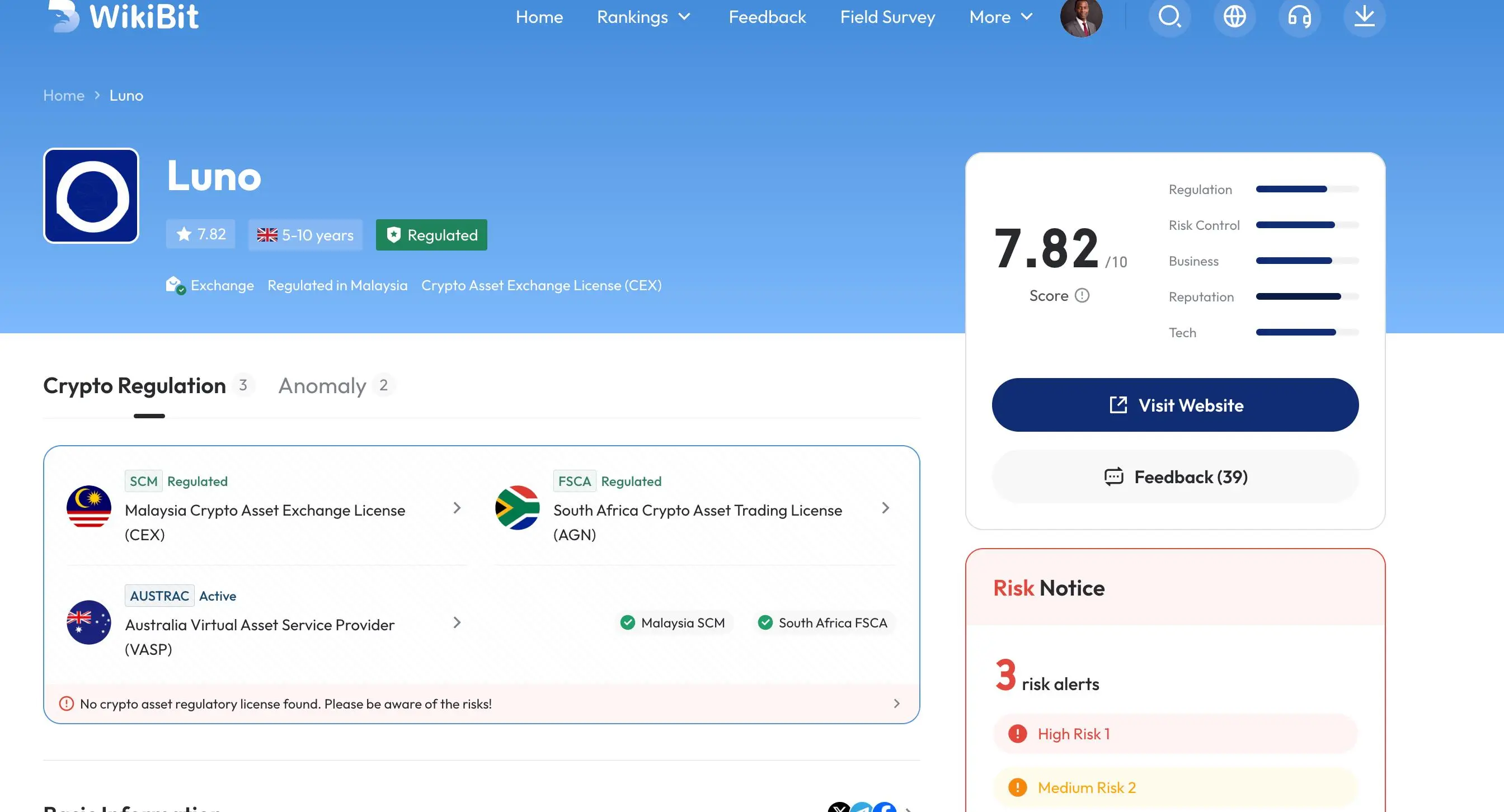
Furthermore, WikiBit has received 21 investor complaints and exposure reports concerning Luno in the past three months, with issues involving security, customer service, and withdrawals.
In July 2026, Luno announced plans to cut approximately 20% of its workforce. This was its second major round of layoffs following a 35% reduction in January 2023. Although the company stated that customer support and operations would not be affected, the restructuring reflects the underlying pressure on its retail business.
So, why does a veteran African exchange with licenses in multiple countries, monthly Moore PoR attestations, and 14 million users still face complaints about users being unable to withdraw funds after completing verification?
Why has it conducted two major rounds of layoffs within two and a half years, while shifting its focus from retail customers toward institutional business?
1. Regulatory Compliance: Five Countries, Genuine Licenses — But Each License Only Protects Specific Entities and Users
Luno's Regulatory Framework: Among the Most Comprehensive in Emerging Markets
Luno's regulatory status can be cross-checked through multiple sources. According to BanksForCrypto, CryptoSlate, Revain, and Luno's official legal pages, its regulatory credentials include:
United Kingdom: FCA cryptoasset registration under the anti-money laundering regulatory framework.
South Africa: Authorized by the FSCA as a Crypto Asset Service Provider (CASP), with FSP number 53314.
Malaysia: Became the first exchange to receive full approval from Malaysia's Securities Commission in 2019, holding Recognized Market Operator (RMO) status.
Indonesia: PT Luno Indonesia holds a Digital Financial Asset Trader license issued by OJK (KEP-17/D.07/2026).
Australia: Registered with AUSTRAC as a digital currency exchange provider.
Bermuda: Registered with the Bermuda Monetary Authority (BMA).
This combination of licenses is relatively rare in emerging markets.
Malaysia's full regulatory approval and South Africa's FSCA CASP authorization both involve substantive requirements concerning capital, corporate governance, and anti-money laundering controls.
Luno is not simply an offshore entity relying on an MSB registration as a regulatory marketing tool.
The Limitations of Its Licenses: Local Entities and Local Users, Not Everyone on the Global Luno Platform
However, there are several important limitations worth understanding.
First, FCA registration in the UK is an AML registration, not full financial services authorization.
The LSE Directory describes Luno as:
“Registered, though not fully authorised, with the UK Financial Conduct Authority under its cryptoasset anti-money laundering regime.”
This means UK users receive regulatory protection within the scope of the anti-money laundering framework, rather than the broader protections associated with fully authorized financial services providers.
In particular, this registration does not automatically provide coverage under the UK's Financial Services Compensation Scheme (FSCS).
Second, Luno does not hold a MiCA authorization or a US Tier-1 regulatory license.
Its compliance strategy is primarily built around deep regulatory coverage in emerging markets, combined with UK AML registration.
It does not have substantive authorization under the EU's unified MiCA framework or the US regulatory system.
Consequently, users accessing Luno from jurisdictions outside its main regulatory coverage may not enjoy the same clearly defined protections available to users in South Africa or Malaysia.
Third, there is a discrepancy in publicly available information regarding its Indonesian OJK license.
Records published by truebroker.net indicate that the Indonesian OJK license was confirmed through an announcement by a licensed exchange rather than directly through OJK's official registry.
This does not directly disprove the license's authenticity. However, it highlights differences in the quality of publicly verifiable regulatory evidence across jurisdictions.
South African and Malaysian authorizations are supported by clearly identifiable regulatory registers, while confirmation of the Indonesian license appears to rely on a relatively indirect source.
Low Risk
Risk Assessment: Regulatory Compliance
Compared with most exchanges covered in this series, Luno has one of the strongest regulatory frameworks.
That deserves objective recognition.
However, having a license and having your specific account, product, and jurisdiction protected by that license are two different things. Users should verify the exact legal entity serving them and the regulatory protections applicable to their accounts, particularly as Luno continues shifting its business from retail toward institutional clients.
2. Account Security and Withdrawals: Completing Verification Does Not Automatically Unlock Withdrawals
A 4/5 Trustpilot Rating Does Not Eliminate a Recurring Operational Problem
Luno currently has an overall Trustpilot rating of 4/5, classified as “Great,” based on 7,463 reviews.
The platform has responded to 77% of negative reviews, typically within 48 hours. It also actively invites customers to leave reviews, whether positive or negative.
Looking at the overall review distribution and the platform's engagement with customer feedback, these are relatively healthy signals compared with many other exchanges in this series.
However, recent complaints point to a specific pattern of operational friction.
One user described their experience as follows:
“Three days after completing my address verification, I still couldn't access or withdraw my funds... Customer support only sent an automated response from its AI assistant, Toshi, saying my request had been forwarded to the support team. Then I was left waiting for a real human response... The Help Center kept getting stuck on the security verification page, and I couldn't get through for hours.”
The key issue here is not that the user failed to complete verification.
It is that verification was completed, but withdrawal access was not restored.
Users may complete every step required by the platform and still find themselves unable to access their own funds, while communication channels are effectively blocked by automated responses and malfunctioning security verification pages.
Regional Payment Disruptions and Temporary Withdrawal Restrictions
Luno has also experienced several operational issues in specific markets.
Nigeria and Kenya: Fiat withdrawal delays have occurred repeatedly, with the company attributing them to disruptions involving local payment channels. Subsequent platform announcements marked these incidents as resolved.
Third-party custody infrastructure: Temporary disruptions involving external custody providers have also caused delays in cryptocurrency transfers.
Withdrawal restrictions during its EEA exit: Luno proactively restricted users from transferring crypto assets externally during its withdrawal from the European Economic Area (EEA). This was a platform policy adjustment rather than evidence of a sudden exit scam or an unexpected asset freeze.
Two Different Types of Complaints Must Be Distinguished
When evaluating Luno's reputation, it is important to separate genuine platform complaints from fraudulent impersonation schemes.
1. Complaints involving the legitimate Luno platform
Reports on Trustpilot, WikiBit, and regional forums generally involve:
Additional KYC requirements triggered by large withdrawals.
Temporary account restrictions resulting from source-of-funds reviews.
Slow customer support responses.
Long waiting times caused by local fiat payment channels.
2. Fraud complaints involving fake “Luno Global” platforms
A significant number of complaints mentioning “Luno Global” actually concern impersonation websites and fraudulent platforms.
These scams often demand additional payments, supposedly for taxes or security deposits, before allowing victims to withdraw their funds.
Such cases should not automatically be attributed to the legitimate Luno exchange.
Users should always verify the official website domain before registering, depositing funds, or communicating with customer support.
Overall Security Assessment
Luno's security infrastructure appears to be above the industry average. There is no widespread evidence of a coordinated asset-locking incident or an exchange exit scam.
However, several genuine operational risks have already materialized:
Centralized risk-control systems can temporarily freeze accounts.
Regional payment service disruptions can delay fiat withdrawals.
Third-party custody issues can interrupt cryptocurrency transfers.
Business restructuring or market exits can result in withdrawal restrictions.
Medium-High Risk
Risk Assessment: Account Security and Withdrawals
The main concern is not evidence of an imminent disappearance of customer assets, but rather the possibility that users may encounter account restrictions, delayed withdrawals, and inadequate customer support when attempting to access their funds.
3. Proof of Reserves Transparency: Luno Implements Monthly Third-Party Attestations and User Self-Verification
Monthly Moore Johannesburg Attestations + Merkle Tree + User Verification Widget
Luno's PoR framework ranks among the stronger examples of institutionalized transparency in our entire series.
According to Luno's official Proof of Reserves guide, all stored customer assets undergo monthly independent attestation by Moore, conducted by Moore Johannesburg.
The process uses Merkle Tree technology and includes more than ten attestation procedures designed to confirm that customer assets exist and that Luno maintains sufficient reserves to cover its customer obligations.
Users can also independently verify whether their account balances are included in a specific monthly PoR snapshot through Luno's PoR web application:
Crypto Economy has also confirmed that Luno's PoR covers customer liabilities, with the latest report available for September 2026. The monthly attestations are conducted by Moore Johannesburg using Merkle Tree technology and include a user self-verification component.
Luno's official Google Play description also explicitly states that the platform holds all cryptocurrencies on a 1:1 basis and regularly publishes independently audited Proof of Reserves reports.
However, There Is an Important Distinction Between an Attestation and a Full Financial Audit
There is one critical limitation that users should understand.
Luno explicitly clarifies this point in its official PoR guide:
“This engagement focuses on customer liabilities and reserves and is intended to complement, not replace, a full financial audit.”
The Malay-language version of the guide makes the limitation equally clear: the process covers only Luno customers' cryptocurrency holdings, should not be defined as a full audit, and does not mean that customers' investments are “guaranteed” or otherwise fully secured.
In simple terms, Luno's PoR is a specific attestation of customer cryptocurrency assets and liabilities, not a comprehensive audit of the exchange's entire financial position.
It helps answer one important question:
Are customers' cryptocurrency balances backed by sufficient reserves on a 1:1 basis?
However, it does not necessarily cover:
Fiat currency liabilities.
Operational liabilities.
Other financial obligations.
Off-balance-sheet risks.
These limitations matter because an exchange's overall financial health involves much more than the cryptocurrency reserves it holds.
The Key Advantage: Users Can Independently Verify Their Own Balances
What makes Luno's PoR particularly noteworthy is its user self-verification mechanism.
Users can access a dedicated verification page and check whether their individual account balances are included in the relevant monthly audit snapshot.
This is fundamentally different from platforms such as Bitbank, where users may only have access to reserve ratios without publicly available wallet addresses or an independent self-verification tool.
Within our series, relatively few exchanges have implemented the combination of monthly independent attestations and user-level verification.
Low Risk
Risk Assessment: Proof of Reserve Transparency
Luno's PoR is not simply a self-published reserve snapshot.
It combines monthly attestations by an independent auditing firm, user self-verification, and an explicit disclosure of the scope and limitations of the process.
The fact that its PoR does not replace a comprehensive financial audit is a genuine limitation. Nevertheless, its transparency framework remains one of the more robust implementations among the exchanges examined in this series.
4. Financial Strength: 14 Million Users and a Leading African Crypto Gateway, but Limited Trading Volume
User Base and Market Position: A Major Crypto Gateway in Emerging Markets
Luno's core strength is not its position in global trading-volume rankings, but its role as a major fiat-to-crypto gateway in Africa and Southeast Asia.
The platform has a particularly strong presence in the UK, South Africa, Nigeria, Malaysia, and Indonesia. It supports free deposits in GBP, EUR, ZAR, and IDR, giving it a first-mover brand advantage in several African markets.
With 14 million users worldwide, Luno has established a genuine network effect for a platform primarily targeting retail customers in emerging markets.
Trading Volume: $46.51 Million in Adjusted 7-Day Volume on CoinPaprika, and Approximately $10.8 Million in 24-Hour Volume on Coinfolytics
In terms of absolute trading volume, Luno is a relatively small but stable platform rather than a major liquidity hub.
According to CoinPaprika:
Adjusted 7-day trading volume was approximately $46.51 million (November 12–18, 2026).
Adjusted 24-hour trading volume was approximately $5.2862 million.
Adjusted daily spot trading volume totaled approximately $166 million over the period from October 18 to November 16, 2026.
Coinfolytics reported 24-hour trading volume of approximately 146.51 BTC (around $10.8 million), ranking Luno 102nd among centralized exchanges (CEXs) and accounting for just 0.01% of the total trading volume tracked across CEXs.
What does this mean?
Luno's market depth and liquidity are insufficient for large-volume transactions or high-frequency trading.
Its real value lies in providing fiat on-ramps and cryptocurrency custody, rather than deep trading liquidity.
For emerging-market users whose primary objective is to buy and hold cryptocurrencies, this may be perfectly acceptable. However, traders who need to move large amounts of capital in and out of the platform or execute frequent trades may find Luno unsuitable.
Parent Company DCG: A Complicated Background, but Luno Is Not Genesis
Luno is owned by Digital Currency Group (DCG), which also owns Grayscale and Foundry.
DCG experienced a major crisis in 2023 when its Genesis lending subsidiary collapsed. Since then, the group has been working to stabilize its investment portfolio.
Luno and Genesis are separate entities. Luno's regulatory licenses and PoR attestations belong to Luno itself.
Nevertheless, DCG's troubled history inevitably casts a reputational shadow that may influence how users perceive Luno's parent-company background.
Medium Risk
Risk Assessment: Financial Strength
Luno's user base and fiat gateway position represent genuine business strengths. However, its relatively limited trading volume and DCG's historical connection to the Genesis crisis are factors that investors should take into account.
5. Internal Operations and Management: Identifiable Founders, a CEO Transition, and Two Major Layoff Rounds
Founders and CEO: From Marcus Swanepoel to James Lanigan
Luno's founding team is publicly identifiable, verifiable, and has a well-documented corporate history.
The founding team includes:
Marcus Swanepoel: South African entrepreneur who founded Luno in 2013 and served as CEO for approximately ten years.
Timothy Stranex: Co-founder and CTO.
Carel van Wyk and Francois Paul: Other members of the founding team.
In March 2023, James Lanigan, previously Luno's COO who joined the company in 2018, took over as CEO, while Swanepoel transitioned to the role of Executive Chairman.
In an industry where anonymous founders are still relatively common, Luno's publicly identifiable founding team, long leadership tenures, and clearly documented succession arrangements represent genuine positives in terms of corporate governance transparency.
However, Two Major Rounds of Layoffs Within Three Years Reflect Pressure on Its Retail Business
In January 2023, Luno laid off approximately 35% of its workforce.
In July 2026, the company announced another round of layoffs, affecting approximately 20% of its employees.
CEO James Lanigan explicitly stated that the restructuring was intended to shift the company's focus away from retail trading and toward institutional customers and B2B services.
The reasoning was straightforward: retail trading volumes had not recovered quickly enough, while the greater business opportunities were increasingly concentrated in B2B services.
Luno stated that customer support and operations would not be affected by the layoffs.
However, for a platform historically built around retail customers, two major rounds of workforce reductions and an explicitly stated strategic shift toward institutional clients suggest that the priority assigned to its retail business is being reassessed.
Medium Risk
Risk Assessment: Management and Corporate Governance
Luno scores positively in terms of identifiable founders, verifiable management backgrounds, and an orderly CEO succession.
However, its strategic shift from retail toward institutional business, combined with two major rounds of layoffs, suggests potential structural pressure on the resources and service quality available to retail customers.
6. Product Experience and Trading Depth: Fiat On-Ramps Are a Genuine Advantage, but Withdrawal Problems Remain a Weakness
Product Positioning: Fiat Access and Simplicity Are Luno's Core Competitive Advantages
Luno has a clearly defined product strategy built around four main services:
Fiat-to-crypto gateway.
Custodial cryptocurrency wallet.
Simple cryptocurrency buying and selling.
Savings products.
Free deposits in GBP, EUR, ZAR, and IDR provide a genuine convenience advantage.
Its support for approximately 20 cryptocurrencies is sufficient for users whose primary objective is to buy and hold digital assets.
The app's ease of use has also earned a positive reputation among retail customers in emerging markets.
However, The Gap Between Different User Experiences Is Real
For users who do not trigger additional compliance reviews, Luno's buying, selling, and deposit experience can be relatively smooth.
But users who do trigger additional checks may encounter a very different experience:
Even after completing verification, they may remain unable to withdraw their funds for three days, receive nothing but automated AI responses from customer support, and find themselves unable to access the Help Center because its security verification process is stuck.
This gap in user experience is a significant weakness.
Limited Trading Depth: Not Designed for High-Frequency or Large-Volume Traders
With 24-hour trading volume generally at the tens-of-millions-of-dollars level, large orders may encounter significant slippage.
Luno is not primarily designed for high-frequency trading or large-volume transactions.
Its product strengths are centered on providing convenient market access and long-term cryptocurrency holding services, rather than supporting sophisticated trading strategies or deep liquidity requirements.
Medium Risk
Risk Assessment: Product Experience
Luno offers a relatively straightforward and convenient experience for ordinary retail users, particularly those entering the cryptocurrency market through local fiat currencies.
However, limited trading depth and inconsistent experiences during account reviews and withdrawals remain important weaknesses.
7. Comprehensive Exit-Scam Risk Assessment
| Category | Risk Level | Assessment |
| Regulatory Compliance | Low | FCA (UK AML registration) + FSCA (South African CASP, FSP 53314) + full Malaysian SC approval (first exchange in 2019) + OJK (Indonesia) + AUSTRAC (Australia). However, Luno has no MiCA or US Tier-1 authorization, and the Indonesian license is supported by a less authoritative verification source. |
| Account Security / Withdrawals | Medium-High | Trustpilot's overall 4/5 rating is relatively healthy, but individual cases of users remaining unable to withdraw funds three days after completing verification, with only AI customer support available, have been reported. |
| Proof of Reserves Transparency | Low | Monthly independent attestations by Moore Johannesburg + Merkle Tree technology + user self-verification widget + explicit disclosure that PoR is not a comprehensive financial audit. One of the strongest transparency frameworks in this series. |
| Financial Strength | Medium | 14 million users, a leading fiat gateway position in Africa, and free fiat deposits. However, adjusted 24-hour trading volume is only in the millions of dollars, with a CEX ranking of approximately 102. DCG's Genesis history is also a relevant background factor. |
| Management and Operations | Medium | Founders and CEO are publicly identifiable, with an orderly succession. However, Luno laid off 35% of its workforce in 2023 and approximately 20% in 2026, while explicitly shifting from retail toward institutional business, creating structural pressure on resources allocated to retail services. |
| Product Experience | Medium | Fiat access and simplicity are genuine advantages. However, trading depth is limited, and the inability to withdraw funds after completing verification remains a specific weakness when accounts trigger additional reviews. |
| Community Feedback | Medium | Trustpilot rating of 4/5 (“Great”), with 77% of negative reviews receiving responses. However, recent negative reviews are concentrated around AI customer support and the disconnect between verification completion and withdrawal access. |
Overall Rating: Medium-Low Exit-Scam Risk
The probability of Luno disappearing with customer funds is extremely low. However, friction between verification and withdrawals, along with impersonation-related brand confusion, represents genuine risk.
Luno is one of the exchanges in this series with the strongest institutional security framework. At the same time, it is also one of the platforms facing a particularly concrete risk of brand impersonation.
Its risk profile can be summarized in one sentence:
“The licenses are genuine, PoR is independently attested monthly and can be verified by users themselves, but there may still be three days of AI customer support between completing verification and unlocking withdrawals.”
1. Regulatory Compliance and Transparency Are Among the Strongest in This Series
Luno's substantive regulatory licenses across five countries — South Africa's FSCA, Malaysia's SC, Indonesia's OJK, the UK's FCA, and Australia's AUSTRAC — combined with monthly Moore Johannesburg PoR attestations and user self-verification tools, create a regulatory framework that is more accountable and transparent than that of most offshore exchanges.
Luno is not the kind of platform that is likely to “disappear with customer funds” or deceive users through regulatory theater, as seen in cases such as UZX, Azbit, or CrypFine.
2. Cases of “Verification Completed but Withdrawals Still Blocked” Represent Genuine Operational Friction
The Trustpilot complaint describing a user who completed address verification but remained unable to withdraw funds three days later, received only AI assistant Toshi responses, and encountered a Help Center stuck on security verification, points to weaknesses in process coordination and human customer support responsiveness.
On a platform with an overall rating of 4/5, such an isolated case does not indicate that the exchange is preparing to exit.
However, it does demonstrate that when a withdrawal triggers additional reviews, the actual user experience may fall significantly below what the phrase “regulated platform” might suggest.
3. Luno Impersonation Is a Concrete Manifestation of Brand Risk
The WikiFX complaint involving 55,434 USDT and an alleged “tax payment to unlock withdrawals” most likely concerns impersonation domains such as lunomte.xyz rather than the legitimate Luno.com.
However, users who cannot distinguish between legitimate and fake Luno platforms may still blame the Luno brand after being scammed.
This is not evidence of wrongdoing by Luno itself, but it is the first layer of risk users must confront when searching for “Luno.”
4. The Shift from Retail to Institutional Business Is a Long-Term Structural Change
Two major rounds of layoffs within three years — 35% in 2023 and approximately 20% in 2026 — combined with an explicit shift toward B2B and institutional clients, represent a structural change in Luno's business strategy.
This does not change the validity of its current licenses or PoR framework.
However, it means that the resources and product priorities allocated to retail customers may face sustained pressure in the future.
8. Recommendations for New and Existing Users
Recommendations for New Users
1. Verify that you are accessing luno.com, not an impersonation domain.
The “tax payment to unlock withdrawals” cases reported on WikiFX involve domains such as lunomte.xyz and lunomte.cc, which are not Luno.com.
Only use the official website and download the app from official app stores. Avoid clicking Luno-related links shared through social media groups, communities, or unsolicited emails.
2. If you are in South Africa, Malaysia, Indonesia, or the UK, understand the scope of Luno's local regulatory protection.
Luno's local licenses are genuine, making it one of the more compliant fiat-to-crypto gateways in these markets.
However, be prepared for potentially slow verification procedures and delays in customer support when additional reviews are triggered.
Do not assume that having a license means every withdrawal will arrive instantly.
3. If you need to execute large trades or trade frequently, consider the limitations of Luno's liquidity.
Luno's trading depth is limited, with adjusted 24-hour trading volume generally in the millions of dollars.
Large orders may encounter significant slippage.
Luno is better suited to buying and holding cryptocurrencies and serving as a fiat gateway than acting as a primary venue for deep-liquidity trading.
4. Do not let monthly PoR reporting make you complacent about withdrawal timelines.
PoR demonstrates asset coverage, not instant withdrawal settlement.
Consider distributing large holdings across multiple storage locations, and avoid relying entirely on the withdrawal review process of a single centralized platform for your liquidity needs.
Recommendations for Existing Users
1. If your account triggers verification or a withdrawal review, preserve all records.
The Trustpilot user who remained unable to withdraw funds three days after completing verification was able to describe the timeline and specific problems because they retained their submission records and customer support conversations.
Archive everything, including:
Screenshots of submitted verification documents and confirmation messages.
Customer support conversations.
Screenshots showing the Help Center stuck during security verification.
Withdrawal requests and transaction records.
2. If you need funds within a specific timeframe, initiate withdrawals early rather than waiting until the last minute.
Cases demonstrating that “verification completed does not equal withdrawal access restored” show that users do not control the review timeline.
Always allow sufficient time for potential delays.
3. Monitor how layoffs and strategic restructuring affect customer support.
Luno has stated that customer support and operations will not be affected.
However, two major rounds of layoffs within three years, combined with a strategic shift from retail toward institutional clients, mean that the level of resources allocated to retail customer support remains a variable worth monitoring.
4. Distinguish between risks associated with Luno.com and those associated with fake Luno platforms.
If you encounter requests on social media or in community groups to “pay taxes to unlock withdrawals” or “deposit additional funds before withdrawing,” first verify whether you are actually using luno.com.
The risks associated with impersonation platforms are far greater than the operational friction associated with the legitimate Luno platform itself.
Final Recommendations
Who is Luno suitable for?
Luno is suitable for users in supported markets such as South Africa, Malaysia, Indonesia, and the UK who value:
Substantive regulatory licenses.
Monthly Moore-attested Proof of Reserves.
User self-verification tools.
Free fiat deposits.
A straightforward cryptocurrency buying and holding experience.
It is particularly suitable for users whose primary objective is to buy and hold cryptocurrencies, who can accept the possibility of slower withdrawal reviews, and who are willing to plan their liquidity needs in advance.
Who is Luno not suitable for?
Large-volume or high-frequency traders who require deep liquidity.
Users who consider instant withdrawals immediately after verification a strict requirement. The Trustpilot cases discussed above are genuine examples of operational friction.
Users who frequently access platforms through unofficial channels and may struggle to distinguish between legitimate and fake Luno websites.
The Bottom Line
Luno's situation reflects a gap between the depth of its institutional transparency and the friction users may encounter in individual operations.
It has five-country regulatory coverage, monthly Moore-attested PoR, user self-verification tools, 14 million users, and a leading position as a fiat-to-crypto gateway in Africa.
These are genuine, verifiable institutional strengths that place Luno among the stronger platforms in this series.
However, an individual user may still find themselves unable to withdraw their funds three days after completing verification, facing AI customer support and a Help Center that refuses to load.
Meanwhile, someone searching for “Luno” may encounter an impersonation website and a fraudulent “tax payment to unlock withdrawals” scheme.
Luno is not among the exchanges with the highest exit-scam risk.
Instead, it is a platform where the books are visible, the licenses can be verified, and the actual withdrawal experience may depend on how its review process operates at a particular moment.
For users depositing funds into the platform, that final factor is precisely the one that deserves the most serious attention.
Coming Next: WikiBit Exchange Exit-Scam Risk Rankings – Issue No. 69: Backpack Exchange. Stay tuned!
Risk Disclaimer: This article represents an individual analytical opinion and does not constitute investment advice. Cryptocurrency investments involve risks. Please exercise caution before entering the market.
Information Updated: November 27, 2026. Please cross-check and verify the latest information through multiple sources.
WikiBit is a regulatory and risk intelligence platform built specifically for cryptocurrency investors. It provides real-time access to global exchange regulatory licenses, credit ratings, risk alerts, industry news, and genuine user reviews, helping investors identify potential risks, stay away from problematic platforms, and make more informed trading decisions.
Before investing in crypto, check WikiBit first!
Download the WikiBit App now and add an extra layer of protection to your crypto assets:
https://wikibit.onelink.me/wgfF/1b1dn69b