At 4:30 a.m. on August 7, 2026, beneath the Jade Park apartment building in Asunción, Paraguay, the body of a naked man was found lying quietly on the ground, covered with a black plastic bag. He had fallen from the 30th floor. The apartment door on the 30th floor was left open, and the interior was found in complete disarray.
The 29-year-old Brazilian girlfriend, who lived on the 27th floor, told police officers who arrived to collect evidence:
“I don't know anything.”

The deceased was Harry Chun Tak Yeh, whose Chinese name was Ye Junde. He was an early Bitcoin OG who entered the market in 2013, when Bitcoin was still around $60. He was the founder of Quantum Fintech Group and the operator behind Tomb Finance. He once claimed to manage $2.4 billion in assets and pushed Tomb Finance to a peak market capitalization of $1.6 billion.
Then, the project went to zero — and so did the man.
This was not the first case, and it certainly will not be the last.
Today, we take a look at the “spectacular deaths” of major figures in the crypto industry over the past decade. We rank them based on levels of mystery, personal wrongdoing, and impact. Prepare yourself mentally, because in these stories, the “actors” are truly gone.
S-Tier (Legendary Mystery): Harry Yeh — Naked, Plastic Bag, 30th Floor
【Mystery Level】★★★★★
【Wrongdoing Level】★★★★★
【Impact Level】★★★★★
The way this crypto figure died can be called the ultimate case in the history of crypto-related deaths — even Netflix screenwriters might hesitate to write a plot like this.
Naked body, plastic bag, 30th floor, a girlfriend who claimed to know nothing, a chaotic apartment, an open door…
Police are investigating three possibilities simultaneously: accident, suicide, and homicide. Put simply: even investigators do not know what happened.
What makes it even more disturbing is the timeline. Just two days before his death, Chainalysis released a report stating that in the first half of 2026, there were 46 confirmed “wrench attacks” targeting cryptocurrency holders worldwide — violent attacks designed to force victims to hand over their private keys. More than $30 million was stolen through such attacks in just six months.
Was Harry Yeh a victim of a “wrench attack”? If so, was the attacker after his private keys — or was the goal to silence him? Why was he naked? Who covered him with the plastic bag? Did his girlfriend really “know nothing”?
No one knows the answers, and perhaps no one ever will.
As for the wrongdoing factor, the algorithmic stablecoin project Tomb Finance was pushed from a $2.5 million TVL to a $1.6 billion peak valuation within four months through leverage and aggressive hype — before collapsing to zero.
Who lost the money? The retail investors who chased the rally.
While he was showing off private jets and luxury yachts on Instagram, he may never have imagined that one day he would end up hitting the ground naked.

A+ Tier (Super Mystery): Nikolai Mushegian — CIA Assassination Claims and Beach Drowning
【Mystery Level】★★★★★
【Wrongdoing Level】★★
【Impact Level】★★★★
Co-founder of MakerDAO, 29 years old, and one of the early security architects of DeFi. On October 28, 2022, he drowned on a beach in Puerto Rico.
Just hours before his death, he posted on Twitter:
“I am being targeted by the CIA and Israeli intelligence agencies.”
Then he died.
His family immediately came forward to “clarify” that it had nothing to do with conspiracy theories and that he had mental health issues.
Which version do you believe?
The crypto community is still debating this case today. One side argues: this was a classic case of paranoid schizophrenia, with the extreme pressure of working in crypto pushing him over the edge. The other side argues: if the CIA wanted to kill someone, and then had the family say the victim was mentally unstable, isnt that a familiar playbook?
Even more intriguing is that, in the months before his death, Mushegian had repeatedly warned about security risks in the DeFi industry. He understood the underlying vulnerabilities of the system better than most. Was someone trying to stop him from speaking out?
We will never know.
But like Harry Yehs death, his case left behind an eternal mystery. A 29-year-old young man “drowned” on a beach — could he swim? Were the waves in Puerto Rico unusually strong? These details were all brushed aside with the simple explanation that he was “mentally unstable.”
A Tier (Power, Wealth, and Death): Vyacheslav Taran — Helicopter Crash and the “Month of Death”
【Mystery Level】★★★★
【Wrongdoing Level】★★★
【Impact Level】★★★★★
In November 2022, Russian billionaire and founder of cryptocurrency brokerage company Libertex, Vyacheslav Taran, died when the helicopter he was traveling in crashed near the border between France and Italy. The pilot and Taran were both killed.
In the same month, three major figures from the crypto world died in three different ways:
- Mushegian — drowned
- Taran — helicopter crash
- Tiantian Kullander — died in his sleep (30 years old, co-founder of Amber Group)
Three deaths in one month caused widespread media attention, with some calling it the “crypto curse month.”
Tarans helicopter crash was the most controversial. Against the backdrop of the Russia-Ukraine war, a Russian billionaire dying unexpectedly in Europe — how many times have we seen a similar script over the past decade?
Was it simply a mechanical failure? Or did someone not want him to continue living?
Libertex managed billions of dollars in client assets. After Tarans death, who took control of those assets? Few people asked, because everyone was focused on “mourning.”
As for Kullander, “died in his sleep” — simply put, the cause of death remained unclear. At just 30 years old, his company had reached a valuation of more than $3 billion, and then he was suddenly gone. His family requested privacy, and the media respected it. But everyone knows that in the crypto world, “privacy” often means “cannot be disclosed” or “does not want to be disclosed.”
B+ Tier (Blood and Violence): Fernando Pérez Algaba — Body Parts Inside a Red Suitcase
【Mystery Level】★★★★
【Wrongdoing Level】★★★★
【Impact Level】★★★
In July 2023, 41-year-old Argentine cryptocurrency millionaire Fernando Pérez Algaba disappeared for five days. His body was later found near a stream in Buenos Aires — inside a red suitcase, dismembered.
The killers were people he owed money to. To avoid repaying debts of tens of thousands of dollars, they murdered him, dismembered his body, and dumped it in a suitcase.
This was one of the most brutal, direct, and unapologetically violent deaths in crypto history.
Algaba himself was not exactly an innocent figure. He had a gambling problem and had financial dealings with local criminal groups. Cryptocurrency was only one source of his wealth — more accurately, it was a tool that allowed him to borrow more money, gamble bigger, and accumulate larger debts.
The crypto connection in this case was actually limited. It was more like a gang-related murder case involving someone who happened to be a crypto millionaire.
But it delivered a simple lesson:
Making money in crypto does not automatically make you part of the “upper class.” The people coming after you for debts may be holding an account book — or they may be holding a knife.
B Tier (Mental Collapse): Konstantin Galich — The Bullet Inside a Lamborghini
【Mystery Level】★★★
【Wrongdoing Level】★
【Impact Level】★★★
In October 2025, 32-year-old Ukrainian crypto trader and online influencer Konstantin Galich was found dead inside his own Lamborghini after a market crash. He had suffered a gunshot wound to the head, and a firearm registered in his name was found at the scene. Before his death, he reportedly sent farewell messages to his family, saying he was suffering from depression due to financial difficulties.
That day, the global cryptocurrency market liquidated more than $19 billion, wiping out over 1.6 million traders.
This is a story about mental health.
Crypto wealth can come quickly — and disappear just as quickly. One day you may be a billionaire; the next day you may have nothing. This kind of extreme financial roller coaster can have a devastating impact on mental well-being.
Galich was not the first person pushed to the edge by the market, and he will not be the last.
But the fact that he died inside a Lamborghini carries a powerful symbolism. The car was purchased during the bull market, a symbol of his “success.” In the end, that symbol of achievement became the place where he died — his success turned into his coffin.
B- Tier (Regulatory Execution): Faruk Fatih Özer — The Turkish Exchange Founder Who “Committed Suicide” in Prison
【Mystery Level】★★★
【Wrongdoing Level】★★★★★
【Impact Level】★★★
In 2025, Faruk Fatih Özer, founder of the collapsed Turkish cryptocurrency exchange Thodex, died while serving time in prison. His lawyer stated that Özer had recently isolated himself, refused visits from family members, and that the preliminary assessment indicated a possible suicide.
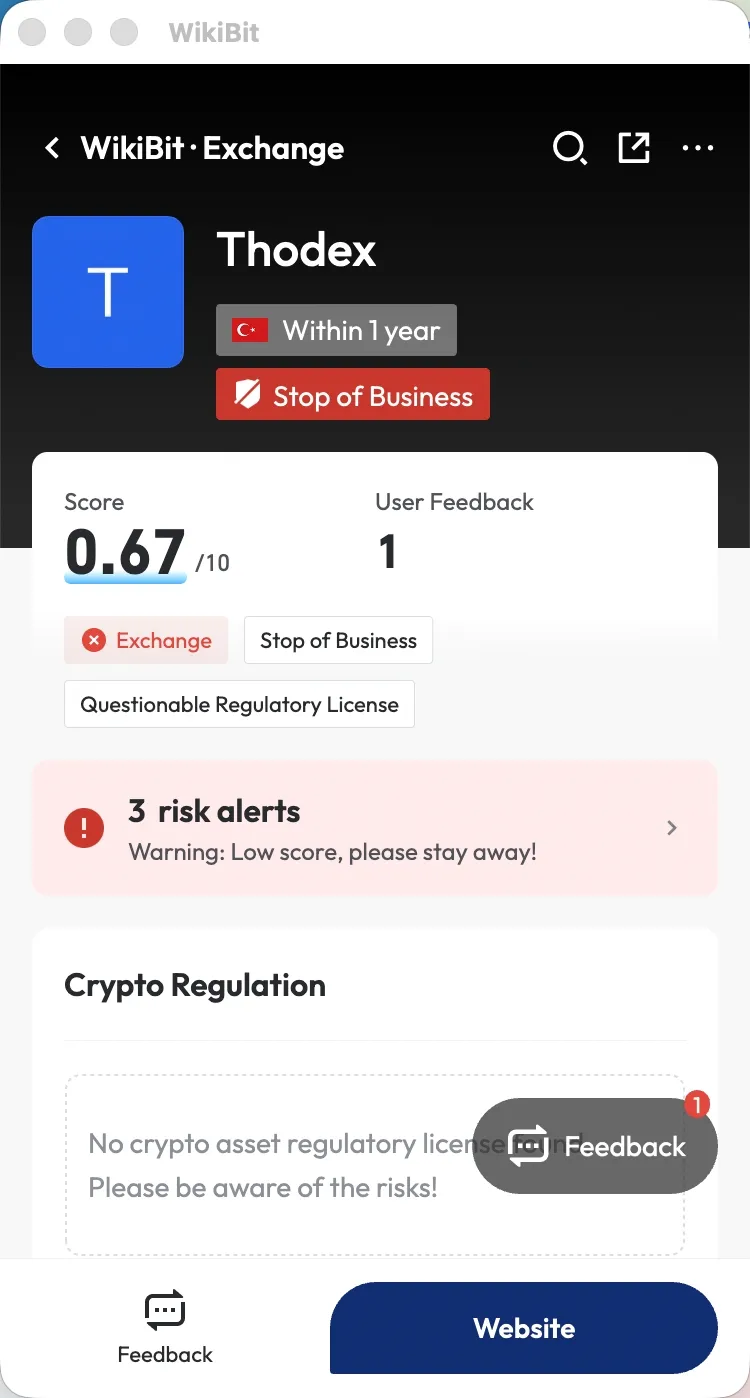
Thodex Risk Data (Source: WikiBit)
But do you know what Thodex actually was?
In 2021, Thodex suddenly shut down. Founder Faruk Fatih Özer allegedly fled with user funds, involving approximately $2 billion in losses and affecting more than 400,000 users. Özer escaped to Albania and was extradited back to Turkey in 2022, where he was sentenced to prison.
Then, he “committed suicide” in prison.
For users who lost their life savings, was Özers death a form of justice finally being served — or did he escape the punishment he truly deserved?
Even more ironically, after Özers death, recovering the frozen assets became even more difficult. Because the “main perpetrator was dead,” legal proceedings became more complicated. Victims not only failed to recover their money, but even the question of “who should be held responsible” became unclear.
A Guide to Crypto Tycoon Deaths: Four “Ways to Die,” One Final Outcome
Looking back at the unnatural deaths of major crypto figures over the past decade, almost all cases can be categorized into four types:
Type 1: Mysterious Deaths (Harry Yeh, Mushegian, Taran)
The most chilling category.
You never know whether it was an accident, suicide, or murder.
Family members either say “I know nothing” or “he had mental problems.” Police either investigate multiple possibilities simultaneously or issue statements saying the preliminary assessment points toward suicide.
The most terrifying part of this type of death is the lack of answers.
You may never know the truth — and this very uncertainty creates fertile ground for conspiracy theories.
In crypto, information opacity does not only exist in trading markets; it can also exist at the scene of death itself.
Type 2: Violent Robbery (Algaba and Potential “Wrench Attack” Victims)
Chainalysis data is alarming: violent crypto crimes resulted in approximately $58 million forcibly stolen in 2025, and losses have already exceeded $30 million in 2026 so far. Home invasions accounted for 37% of all wrench attacks, reaching a historic high.
The strongest encryption cannot stop a $5 wrench.
This is a cold reality, and it has nothing to do with technology.
In the face of physical violence, private keys, cold wallets, and multi-signature security — all become useless.
Type 3: Mental Collapse (Galich)
The crypto industry is a massive psychological stress test.
Your wealth can double within 24 hours — or disappear completely within 24 hours.
Such extreme financial volatility can be devastating to mental health.
Galich was not the first, and he will not be the last.
When you place your entire fortune into an extremely volatile market, you are not only betting your money — you may also be betting your life.
Type 4: “Death” as a Strategy (Özer and Those Who Faked Their Deaths)
The most ironic category:
In some cases, “death” itself becomes a business strategy.
Özer “committed suicide” in prison — was he truly unwilling to continue living, or was his “death” a way to escape creditors and victims?
In 2025, Jeffy Yu, co-founder of AI agent project Zerebro, was reported to have “committed suicide” during a livestream. It was later revealed to be fake — he was alive, and his token price surged afterward.
The founder of QuadrigaCX, Gerald Cotten, reportedly died of Crohns disease in India in 2018, but some people still suspect that he faked his death to escape with the funds.
In crypto, even death cannot always be trusted.
Why Are Unnatural Deaths So Common in Crypto?
The question is: why does the cryptocurrency industry repeatedly produce these unusual deaths?
1. Private Keys Mean Life, Private Keys Mean Death
In traditional finance, your money is stored in a bank. Even if someone kills you, they cannot simply access your funds — passwords, verification procedures, and banking operations are still required.
But cryptocurrency is different:
Whoever controls the private key controls the assets.
A single cold wallet and a string of seed phrases could represent hundreds of millions of dollars.
Criminals do not need to break the blockchain.
They only need to break you.
2. The Culture of Showing Off Wealth = A Death Invitation
Crypto elites share a common trait: they are highly visible.
They attend industry conferences, appear in media interviews, and post photos of private jets and luxury yachts on social media.
Criminals do not need to be elite hackers. They only need to know:
Who has money?
Where do they live?
Traditional billionaires also display wealth, but they usually have security teams and mature wealth-management systems.
In crypto, many wealthy figures failed to establish even basic physical security measures.
3. Wild Growth Without Regulation
A lack of regulation means:
Project founders can manipulate markets freely.
Those who lose money have nowhere to seek justice.
Those who make money often lack legal protection.
Eventually, some disputes may be resolved through physical violence.
Algabas dismemberment represents an extreme example of this logic.
4. The Black Hole of Mental Health
Going from billionaire status to having nothing may take only one bear market.
Galichs Lamborghini is the perfect symbol of this reality.
The industry has created countless stories of “overnight wealth,” but it has provided almost no psychological support system for those who experience “overnight poverty.”
5. The Economic Value of “Death”
In crypto, one persons death can affect not only their family, but also:
the price of their token,
the future of their project,
and even market sentiment.
Some people use this to short a token.
Some use it to pump prices.
Some use it as a way to escape.
In the traditional world, death is the end.
In crypto, death may only be the beginning of another game.
Epilogue: Who Will Be Next?
Harry Yehs body remains in a forensic morgue in Paraguay awaiting further examination.
His girlfriend says she “knows nothing.”
His project token has nearly collapsed to zero.
The photos of private jets and luxury yachts on his Instagram have become his final images.
The crypto industry has made significant progress in asset security over the past few years — cold wallets, multi-signature systems, and hardware devices have all become increasingly sophisticated.
But personal safety has become the new weak point.
The strongest encryption cannot stop a $5 wrench.
The greatest wealth cannot buy back a life.
The most ironic thing is this:
In crypto, even death cannot always be trusted.
It could be an accident.
It could be murder.
It could be suicide.
Or it could simply be a carefully planned exit performance.
This article is compiled from publicly available reports. Some cases remain under investigation, and final conclusions should be based on official statements.