






Net redemptions across the 11 stablecoins tracked by crypto research firm Kaiko reached about $12 billion in the 30 days to Nov. 13, echoing a pattern analysts saw during the 2022 bear market.
Tether‘s USDt (USDT) and Circle’s USDC (USDC), the two largest stablecoins, each ended the period with about 4% fewer tokens in circulation. Since Nov. 13, total stablecoin supply has fallen just 0.4%, while USDC supply has edged higher.
“The contraction looks like capital leaving crypto rather than rotating within it,” Kaiko analyst Andrew Yang told Cointelegraph.
Yang said that the redemptions left traders with fewer stablecoins on hand to buy crypto.
The cash-out coincided with outflows from US spot Bitcoin exchange-traded funds and a shift in expectations toward tighter Federal Reserve policy.
USDT trading slows while onchain transfers hold up
Daily trading volume in USDT pairs was about half its 2025 average over the past month, according to Kaiko. Bitcoin (BTC) market makers continued to post orders close to the market price.
The dollar value of orders to buy or sell Bitcoin within 1% of its market price fell about 15% over the past month. Measured in Bitcoin, those orders were 9% larger in aggregate, Yang said.
Related: Stablecoin supply falls $14.2B in biggest 30-day drop since June 2022
Nearly 90% of the 30-day decline in stablecoin supply came from Ethereum, a major hub for exchanges and decentralized finance. On Tron, a network more commonly used for payments, stablecoin supply fell just 1.4%, according to Kaiko.
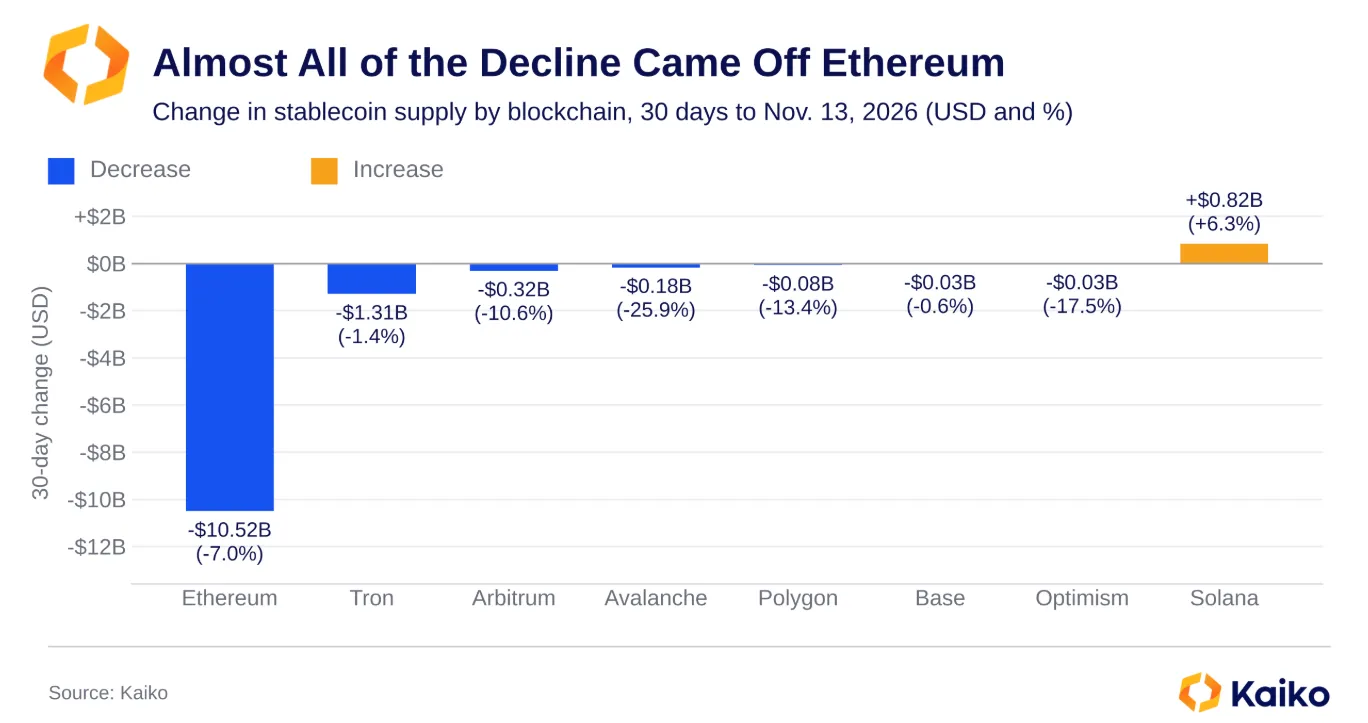
Source: Kaiko
Onchain transfers of USDT and USDC have averaged about $157 billion a day so far this quarter. Thats above the 2025 daily average of $130 billion, though below the pace in the fourth quarter of last year, Kaiko said.
How the cash-out compares with 2022
During the 2022–2023 bear market, rising interest rates and falling crypto prices drove months of redemptions from fiat-backed stablecoins, Yang said. He described the current pullback as much smaller and pointed to a more recent comparison. Stablecoin supply fell from mid-May into June this year before stabilizing in August.
For USDT, the latest decline is the largest since 2022, said Julio Moreno, head of research at blockchain analytics firm CryptoQuant. Its market capitalization has fallen $9 billion over the past 60 days, a drop Moreno linked to a broader retreat from risk assets, including stocks and commodities.

Moreno tracks USDT supply as a measure of the funds available for trading. Exchanges hold 51% of the USDT circulating on Ethereum, he told Cointelegraph.
USDT supply was also shrinking when Bitcoin bottomed in November 2022, Moreno said.
He said stablecoin supply would have to grow again “in order for liquidity to improve and the market to recover.”