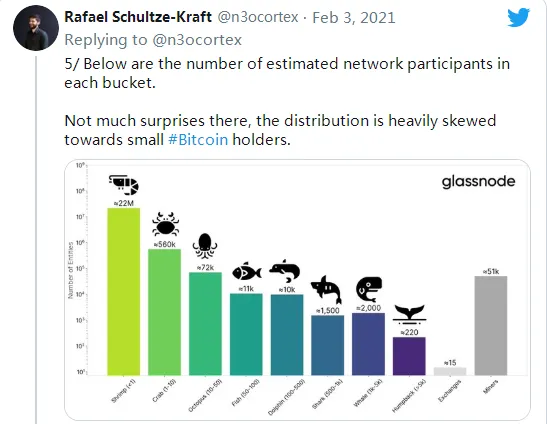
Earlier this week, Rafael Schultze-Kraft, CTO at blockchain data and intelligence provider Glassnode, did an analysis of “the distribution of Bitcoin across network participants”.
In a blog post published on Tuesday (February 2), the Glassnode CTO referred to a Bloomberg report (from last November) titled “Bitcoin Whales Ownership Concentration Is Rising During Rally.” He said that problem with such reports is that “that analyze the distribution of BTC across network addresses. This leads to misleading statistics, which result in false narratives around BTC ownership among stakeholders.”
He then pointed out two problems with this approach:
“Not all Bitcoin addresses should be treated equal.” (e.g. an address belonging to a crypto exchange can hold funds for millions of individuals)
A Bitcoin address is not an “account.” (e.g. one person can own/control multiple addresses)
Here are the results of Glassnodes analysis:
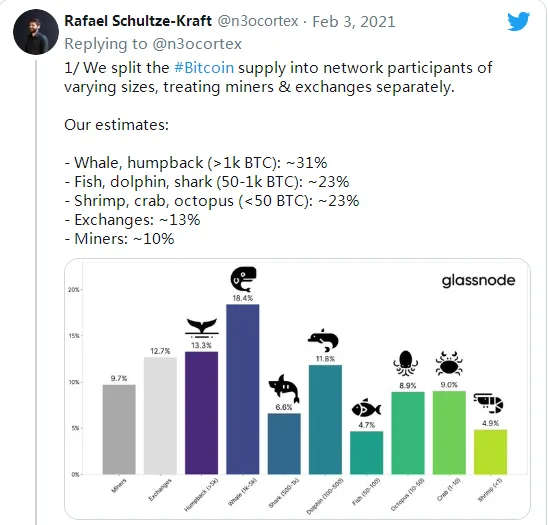
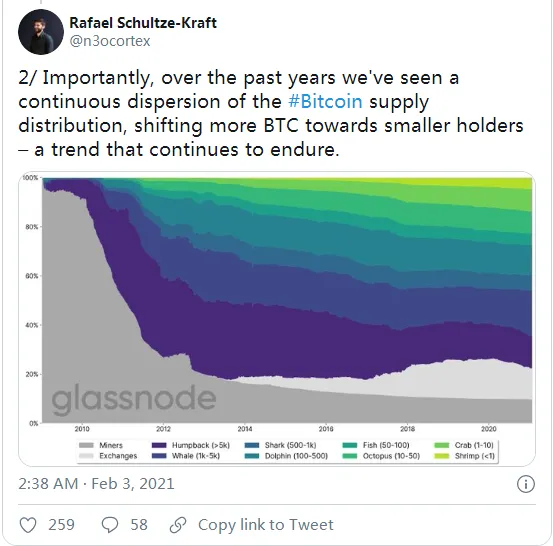
The Bitcoin supply held by the smallest participants (shrimps and crabs) has increased by 130% since 2017, and the second smallest (i.e. octopuses and fish) has increased by 14%.
As for the larger entities, i.e. “dolphins + sharks” and “whales + humpbacks”, they have decreased their Bitcoin holdings by -3% and -7% respectively.
Glassnode goes on to say that they found “on a more short-term time window” a significant increase in the number of Bitcoin whales (and their supply) since 2020, which “suggests that institutional investors, funds, family offices, and other HNWI have been entering the space.”
Glassnodes estimated number of network participants in each bucket and the amount of BTC supply they hold led them to the conclusion that “that around 2% of network entities control 71.5% of all Bitcoin.” Furthermore, Glassnode points out that these numbers are “an estimate for an upper bound of the true distribution of Bitcoin ownership” and that they “expect the actual distribution to be more evenly distributed across entity sizes.”