Introduction: An Exchange Surrounded by Both Licenses and Warnings
In our first 49 installments, we examined a range of exchanges, from HashKey to KuCoin. For Episode 50, we turn to one of the most complicated compliance stories in the industry: Gate (Gate.io).
On paper, Gate has an impressive track record. Originally launched as Bter.com in 2013, it now claims more than 63 million users worldwide and lists over 5,500 crypto assets. Its 24-hour spot trading volume has ranked as high as second globally. The platform reports total reserves of $8.688 billion, a reserve ratio of 118.49%, and multiple regulatory registrations and licenses, including Malta's MiCA authorization, Dubai's VARA license, Cyprus's CySEC license, and Australia's AUSTRAC registration.
But there is another side to the story.
In 2025, the Cayman Islands Monetary Authority (CIMA) issued a public notice explicitly stating that Gate.io and Gate Global Corp had “never been licensed or authorized to conduct business in or from within the Cayman Islands”—the jurisdiction Gate has long identified as its place of registration. Taiwan's Financial Supervisory Commission (FSC) has stated that Gate had not completed the required anti-money laundering registration and was therefore prohibited from providing virtual asset services locally. In July 2026, a longtime Gate user claimed that approximately $1.7 million had been stolen from their account, with Gate and the user offering conflicting accounts of what happened. Gate has a Trustpilot rating of just 1.5/5, with 78% of reviews giving it one star. Complaints largely concern frozen withdrawals and unresponsive customer support.
WikiBit gives Gate a score of 8.93/10, yet the platform has received 27 user complaints over the past three months.
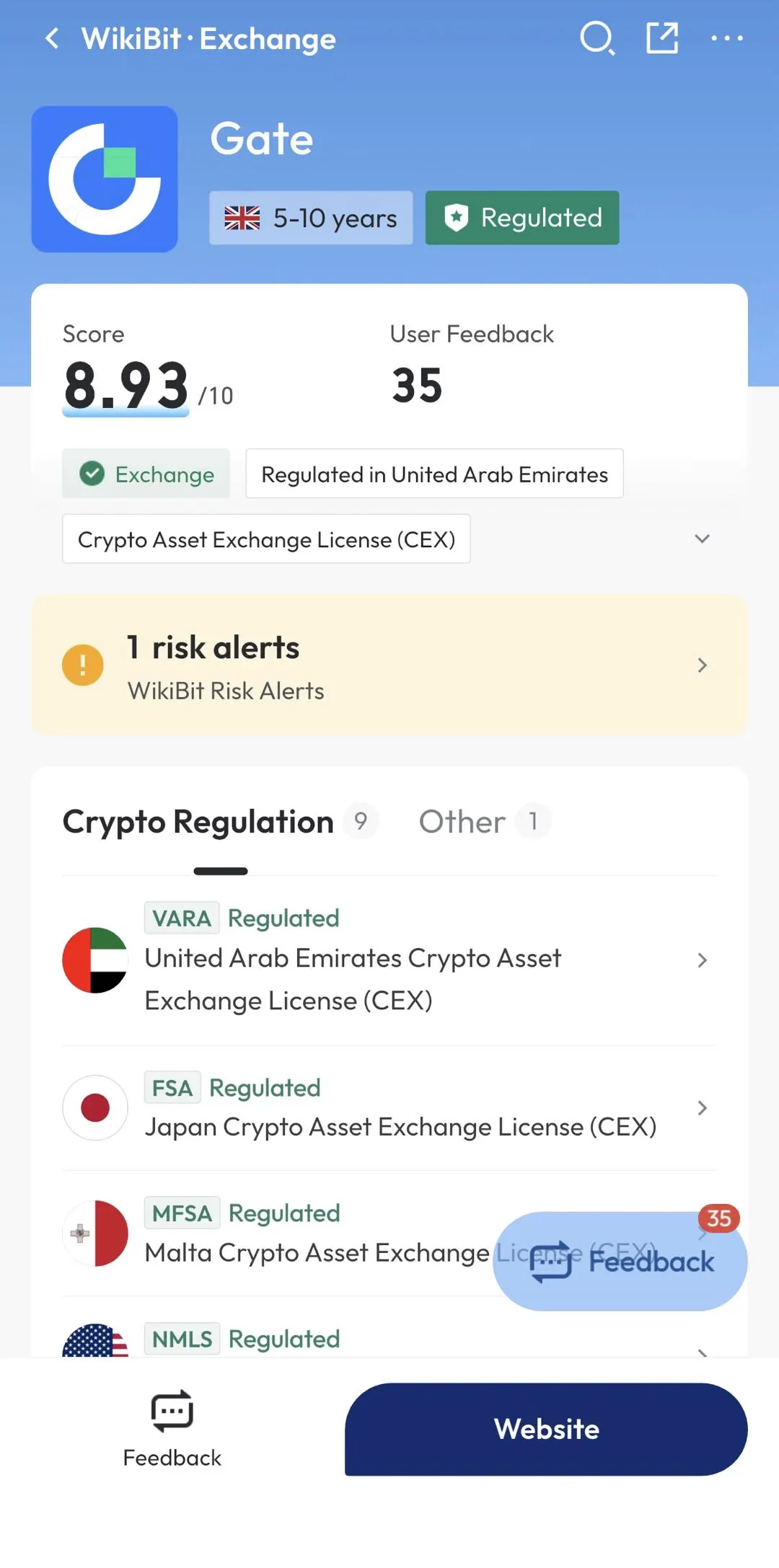
Why would an exchange holding MiCA and VARA licenses face a public statement from its purported registration jurisdiction saying it has never been licensed there? Why would a platform reporting a reserve ratio of 118% have users claiming they cannot withdraw their money?
Today, we will investigate these questions layer by layer.
1. Regulatory Compliance: The Licenses Are Real, but the Claimed Home Jurisdiction Says Otherwise
Legitimate regulatory credentials: Malta's MiCA framework, Dubai's VARA, and Cyprus's CySEC
Gate is not without meaningful regulatory achievements. According to a review by the third-party research organization avoid.net, Gate holds a MiCA authorization in Malta, a VARA license in Dubai, a CySEC license in Cyprus, and registration with Australia's AUSTRAC.
At its 13th-anniversary event, Gate also outlined its goal of securing three additional compliance milestones within the year: licenses or authorizations in Hong Kong, Singapore, and the European Union under MiCA.
U.S. users are served by a separate entity, Gate US, which has reportedly obtained Money Transmitter Licenses (MTLs) in 36 states and completed registration with FinCEN.
These credentials are not merely decorative badges. Malta's MiCA framework and Dubai's VARA regime are substantive regulatory frameworks with meaningful supervisory and enforcement powers.
However, holding licenses in certain jurisdictions does not mean that every Gate entity, product, or user worldwide is covered by those authorizations.
CIMA's message: Gate has never been licensed here
This is the most serious contradiction in Gate's compliance narrative.
Gate has long identified the Cayman Islands as its place of registration. However, in a public notice issued in 2025, the Cayman Islands Monetary Authority (CIMA) explicitly stated that Gate.io and Gate Global Corp had “never been licensed or authorized to conduct business in or from within the Cayman Islands.”
In plain English, Gate has identified the Cayman Islands as its registration jurisdiction, while the territory's financial regulator says the two named entities have never been authorized to operate there.
This does not necessarily mean that the companies were never incorporated in the Cayman Islands. Corporate registration and financial-services authorization are two different things. Rather, the regulator's statement means that the named entities cannot claim CIMA authorization to conduct the relevant business in or from the Cayman Islands.
An exchange can hold licenses in Malta and Dubai while having no financial-services authorization in the jurisdiction it identifies as its corporate home. This separation between corporate registration and regulatory authorization creates a significant transparency concern.
Taiwan's FSC: Required AML registration has not been completed
Taiwan's Financial Supervisory Commission has stated that Gate had not completed the required anti-money laundering registration. As a result, Gate was not permitted to provide virtual asset services in Taiwan or solicit Taiwanese residents through advertising, and the regulator advised the public against using the platform.
This is a separate issue from whether Gate holds a MiCA authorization. MiCA governs the applicable regulatory framework in the EU; it does not exempt an exchange from Taiwan's local compliance requirements.
34 restricted jurisdictions: VPN access may trigger account restrictions
Gate restricts access from 34 countries and territories, including mainland China, South Korea, and North Korea. U.S. users are directed to the separate Gate US entity.
Gate has explicitly warned that accessing the platform through a VPN from a restricted jurisdiction may result in account suspension, frozen funds, or forced account closure.
For users, the key question is not simply whether Gate holds a license somewhere. It is whether the specific entity serving them is authorized to provide the relevant services in their jurisdiction—and what legal protections apply to their accounts and assets.
Risk rating: High Risk (Regulatory Compliance)
Gate holds genuine regulatory credentials, but its compliance structure has a significant transparency gap. The Cayman Islands regulator says the named entities have never been authorized to operate there, while regulators in other markets, including Taiwan, have raised concerns about local registration requirements.
Malta's MiCA framework and Dubai's VARA regime cover specific entities, activities, and customers; they do not automatically extend to every user of Gate's global platform.
When trading on Gate, which license protects a particular user, and which laws govern their account? The answer depends on the user's location and the legal entity providing the service. For ordinary users, identifying that entity and understanding the applicable protections can be difficult.
2. Account Security and Withdrawals: The $1.7 Million Dispute and a Trustpilot Score of 1.5/5
July 2026: A $1.7 million account-drain dispute, with both sides telling different stories
This has been one of Gate's most closely watched security controversies in recent years.
On July 8, 2026, a Gate user known as “第一美少女” (@jheioff) posted on X, claiming that their Gate account had been compromised and approximately $1.7 million in assets drained. The reported assets included 49.96 ETH, 746,475 HSK, and 1,565,982 USDT.
The user emphasized that their account had phone verification, Google Authenticator, and email verification enabled. According to their account, they received no verification codes on their phone during the incident and had never provided a video, a video of themselves holding their ID, or a screen recording of a login session.
Gate's response pointed in a different direction.
In an official statement, Gate said that the person requesting the security-setting changes had supplied the account's email address and phone number, real-name identity information, platform trading records, screen-recording materials involving Alipay transactions, and “corroborating records of matching transactions.”
Gate's security team argued that the Alipay screen recordings could only have been made by the customer or someone with access to the customer's Alipay account.
Gate also described its security-change procedure as involving “advance notifications through multiple channels, initial automated risk screening, multiple layers of manual review, and a security waiting period.” According to the platform, an application would be processed only after a two-day notification period without objections. Following a security-setting change, withdrawals would be restricted for another 24 hours.
The user subsequently released surveillance footage, claiming that at the time Gate identified as the facial-recognition event, they had not picked up their phone for facial recognition and had not initiated any security-setting reset.
Gate later acknowledged that its initial external communication had not been handled appropriately and apologized to the user and the public. It also said it had established a dedicated team to help the user report the incident to the police and coordinate with Tether on efforts to freeze the relevant assets.
The dispute has not produced a conclusion accepted by both parties.
Gate's position is that the user's device or Alipay account may have been compromised or controlled by someone else. The user's position is that they performed no such actions and that Gate's security procedures had vulnerabilities.
For outside observers, the most important point is not deciding who is right without sufficient evidence. It is recognizing the seriousness of the allegation: a longtime user who says multiple verification methods were enabled and no verification codes were received claims that approximately $1.7 million was withdrawn without authorization.
Whatever the eventual explanation, this is a deeply concerning security signal. The public information described above does not, by itself, establish whether the incident resulted from an account compromise, a flaw in the platform's security procedures, or another cause.
Trustpilot: 1.5/5, with 78% of reviews giving one star
Gate has a Trustpilot rating of 1.5/5, categorized as “Bad.” Approximately 78% of its reviews give it one star, and the platform reportedly responds to only 39% of negative reviews.
The complaints repeatedly highlight several themes.
Frozen withdrawals: Users report repeated rejection of security codes and describe customer support as slow, repetitive, and unable to resolve their problems.
P2P transaction disputes: Some users claim that after making payments through P2P transactions, the counterparties did not receive the funds. In one reported case, Gate allegedly promised a refund within three to seven days, but the issue remained unresolved after 24 days.
Repeated EDD checks: Some users say their deposits were held for days during Enhanced Due Diligence (EDD) reviews, only for subsequent transactions to trigger the same process again after the initial review was completed.
Repeatedly changing support timelines: Users report being told that their accounts would be restored on Sunday, only to hear that restoration might happen later that day or the following day, followed by another promise of Sunday. One recurring complaint is that support provided repeatedly conflicting timelines without a clear resolution.
These are user-reported experiences, not independently verified findings about every case. Nevertheless, the consistency of the complaint themes raises questions about the platform's handling of account reviews, withdrawal restrictions, and customer communication.
A different picture on G2: 4.4/5
In sharp contrast to Trustpilot, Gate reportedly holds a G2 rating of 4.4/5 based on 227 reviews.
Feedback on G2 tends to focus more on the platform's features: its broad asset coverage, extensive trading tools, and overall functionality.
An analysis published by securities.io captures this divide: Gate's trading platform is widely viewed as capable and feature-rich, but customer satisfaction can deteriorate significantly when users need support or account intervention.
The contrast suggests that users may have very different experiences depending on whether they are trading normally or dealing with a security review, a withdrawal restriction, or a disputed account action.
Risk rating: High Risk (Withdrawals and Customer Support)
“Smooth trading when everything works, but nowhere to turn when something goes wrong”—this is the central pattern emerging from Gate's user feedback.
Users who never encounter problems may appreciate its extensive token listings and trading features. But when risk controls, EDD reviews, or withdrawal checks are triggered, some report facing a support system characterized by low response rates, inconsistent timelines, and limited procedural transparency.
Regardless of how the $1.7 million dispute is ultimately resolved, it highlights a real and serious problem: when a large amount of money is at stake, information asymmetry and a breakdown of trust between the platform and the user can become critical risks.
3. Proof of Reserves: In This Area, Gate Genuinely Ranks Among the Industry's Leaders
PoR Data: Consistent Reporting, Transparency, and a Robust Technical Framework
Gate's proof-of-reserves (PoR) performance is a rare bright spot among the high-risk exchanges examined in this series.
As of October 18, 2026, Gate reported total reserves of $8.688 billion and net customer assets of $7.332 billion, representing an overall reserve coverage ratio of 118.49%, up from 117.26% in the previous report.
Earlier reports showed a total reserve ratio of 122% and a BTC reserve ratio of 147% in March 2026. Gate's September 2026 PoR report listed total reserves of $8.215 billion and an overall reserve ratio of approximately 117%, with reserve ratios of 120.31% for BTC, 123.59% for ETH, and 114.25% for USDT.
Gate's technical framework combines Merkle Trees with zk-SNARKs. Users can verify through the official website, using their account IDs, whether their assets are included in the verification set. The system is designed to demonstrate full reserve coverage without requiring users to disclose specific reserve data. The verification process is conducted by a qualified third-party firm.
But the Limitations of PoR Must Be Clearly Understood
First, PoR demonstrates that assets cover liabilities; it does not guarantee smooth withdrawals.
A platform can report a reserve ratio of 118% and still have users who cannot withdraw their money—if withdrawals are restricted or other obstacles prevent access to funds.
In the $1.7 million account-drain dispute, the affected user's account balance could theoretically have been included in a reserve report showing 118% coverage. That would not, by itself, resolve the dispute over whether the account was compromised or whether the security procedures worked properly.
Second, PoR covers a limited range of assets.
Gate lists more than 5,500 assets, but its PoR reports primarily cover major assets such as BTC, ETH, USDT, USDC, DOGE, and SOL. The reserve status of many smaller, long-tail assets remains less transparent.
Third, PoR is a strong score in one category of financial transparency, not an overall score for platform security.
Adequate reserves and a disputed $1.7 million account incident can coexist. There is no contradiction between the two: one concerns reported asset coverage, while the other concerns account security, withdrawal access, and operational controls.
Risk Rating: Low Risk (PoR Transparency Only)
Gate performs well in this specific area: regular monthly reporting, zk-SNARKs technology, Hacken verification, and a reserve ratio above 118%.
These are genuine strengths that should be acknowledged objectively, even in an assessment of a high-risk exchange.
But the limits of PoR are equally clear. It can help demonstrate that the platform holds sufficient assets to cover reported liabilities. It does not guarantee that users can withdraw their funds whenever they want, nor does it guarantee that customer support will respond effectively when problems arise.
4. Financial Strength and Trading Depth: The World's Second-Largest Spot Trading Volume—and the Other Side of Listing Almost Everything
The Impressive Numbers
Founded: 2013, originally operating as Bter.com
Global users: More than 63 million
Listed assets: More than 5,500
24-hour spot trading volume: Ranked as high as second globally, according to Gate's disclosures
Spot trading fees: Starting at 0.1% for both makers and takers at the VIP 0 tier
Core products: Spot trading, futures, margin trading, copy trading, trading bots, and structured products
But Listing Almost Every Coin Is a Double-Edged Sword
Gate's broad asset coverage is one of its main selling points. However, more than 5,500 listed assets also means exposure to a large number of long-tail tokens, meme coins, and early-stage projects.
A review by securities.io notes that Gate's strategy resembles KuCoin's, emphasizing early token listings and long-tail assets. This gives Gate a significant coverage advantage in segments where projects may be filtered out by exchanges with stricter or more selective listing standards.
For users, the trade-off is straightforward: Gate may offer access to tokens unavailable on many other exchanges, but those assets can carry substantially greater liquidity risks, project-quality concerns, and price volatility than major cryptocurrencies.
An exchange that lists almost everything inherently exposes its users to a broader range of project-specific risks than a platform that lists only a carefully selected set of assets.
Risk Rating: Medium Risk (Financial Strength and Trading Depth)
Gate's reported base of more than 63 million users and its claim of having ranked second globally in spot trading volume are significant indicators of its market presence. Its coverage of more than 5,500 assets is also a major competitive advantage.
However, trading volume and the number of listed assets do not guarantee that every user's funds are safe.
A platform can offer powerful trading tools and extensive asset coverage, yet still leave users poorly served if its customer support and risk-control procedures fail to keep pace with its product capabilities.
In other words, strong product functionality is most valuable when nothing goes wrong. The real test comes when users encounter account restrictions, withdrawal reviews, or security incidents.
5. Internal Operations and Leadership: Han Lin Is Publicly Identifiable—a Meaningful Advantage Over Anonymous Exchanges
Founder: Han Lin (Dr. Han)
Gate's founder is publicly identified, and his background can be independently researched.
Dr. Han Lin founded Bter.com, the predecessor to Gate, in April 2013 and currently serves as Gate's founder and CEO. He holds a doctoral degree and was invited to speak at the Oxford Union in 2026.
Gate's official narrative emphasizes long-term development. In his 13th-anniversary speech, Han presented the theme of “Resilient Growth: Thirteen Years Across Market Cycles” and identified regulatory compliance—including initiatives involving Hong Kong, Singapore, and MiCA—as a core strategic priority.
But a Publicly Identifiable Founder Does Not Automatically Mean Transparent Governance
Han's public identity, academic background, and media appearances place Gate above many poorly documented exchanges in terms of leadership visibility. This is a positive factor compared with platforms where the founders' identities or professional backgrounds are difficult to verify.
However, a publicly identifiable founder cannot automatically resolve operational problems such as inefficient customer support, opaque withdrawal reviews, or the information asymmetry highlighted by the $1.7 million account dispute.
A founder's strategic vision and the platform's day-to-day execution are two different things.
Risk Rating: Medium Risk (Leadership and Team Transparency)
A publicly identified founder with a documented professional background, public speeches, and media coverage deserves credit.
But knowing who is in charge does not necessarily tell us how effectively the organization is managed.
6. Community Feedback: An Extreme Example of Polarized User Experiences
A Divided Reputation
Gate's community feedback presents a striking contrast between user-review platforms.
Trustpilot: Overall rating of 1.5/5, with 1,428 reviews; 78% are one-star reviews. Gate reportedly responds to 39% of negative reviews. Recurring complaints include frozen withdrawals, repeated EDD checks, contradictory customer-support timelines, and P2P disputes.
G2: Rating of 4.4/5 based on 227 reviews, with positive feedback emphasizing broad asset coverage, extensive trading tools, and strong functionality.
Withdrawal Delays and Restrictions on Funds
In October 2026, a user reportedly claimed that a USDC withdrawal had remained pending for 15 days and that withdrawals from the account had been restricted during that period.
This case does not, by itself, establish that the funds were permanently lost. However, a prolonged withdrawal delay combined with account restrictions is a legitimate concern that warrants investigation and a clear explanation from the platform.
Repeated Reviews and Documentation Requests
Some users complain that EDD reviews repeatedly require additional documents, ask them to resubmit previously supplied materials, or leave them waiting for deposit verification to be completed.
Enhanced due diligence can be a legitimate compliance requirement. The concern arises when the process lacks clear communication, reasonable timelines, or a transparent explanation of what remains outstanding.
Fiat Payment and Refund Disputes
In September 2026, one user reportedly claimed to have paid 61.29 USDT through Gate.io, but the recipient's Alipay account did not receive the funds. The user also said the refund took longer than the originally communicated processing window of three to seven days.
Gate's response reportedly stated that the relevant refund needed to be initiated by the merchant.
This case illustrates how disputes involving third-party payment channels can become complicated when users are unclear about which party is responsible for initiating a refund and how long the process should take.
P2P Trading Disputes
User feedback also includes disputes over payment methods, whether funds were received, and the outcomes of order arbitration.
Such cases require separate examination of transaction records, payment evidence, and the platform's adjudication process. Responsibility cannot be established solely from one party's account of events.
Gate's negative reviews deserve serious attention, particularly those involving account restrictions, withdrawal delays, and complaints that are difficult to resolve across different platform entities.
However, concluding that Gate faces a systemic financial-security crisis would require more direct evidence from financial disclosures, regulatory findings, or on-chain investigations.
The summary published by securities.io captures the divide particularly well: Gate's trading platform is widely regarded as capable and feature-rich, but user satisfaction can fall sharply when support or account intervention becomes necessary.
Risk Rating: High Risk (Community Feedback)
7. Comprehensive Exchange Exit Risk Assessment
| Assessment Dimension | Risk Level | Summary |
| Regulatory Compliance | High | Holds genuine MiCA, VARA, and CySEC authorizations, but CIMA states that the named entities have never been licensed in the Cayman Islands; Taiwan AML registration concerns; 34 restricted jurisdictions. |
| Account Security / Withdrawals | High | The $1.7 million dispute remains contested by both sides; Trustpilot rating of 1.5/5; repeated EDD checks and contradictory timelines; reportedly responds to only 39% of negative reviews. |
| Proof-of-Reserves Transparency | Low | Merkle Tree + zk-SNARKs; Hacken verification; total reserve ratio above 118%; regular monthly reporting. |
| Financial Strength | Medium | More than 63 million users and spot trading volume that has ranked second globally; over 5,500 listed assets, but elevated risks among long-tail tokens. |
| Leadership and Operations | Medium | Founder Han Lin is publicly identifiable and has spoken at the Oxford Union, but customer support and risk-control execution remain significant concerns. |
| Product Experience | Medium | Powerful trading tools and extensive token coverage, but user experience can deteriorate sharply when problems arise. |
| Community Feedback | High | Trustpilot 1.5/5 versus G2 4.4/5; the polarized feedback reflects a recurring pattern: smooth trading when everything works, but limited recourse when something goes wrong. |
Overall Rating: Medium-High Exchange Exit Risk
Gate is one of the most contradictory cases in this series: an extreme divide between a “PoR top performer” and a “customer-support underperformer,” compounded by a regulatory transparency gap involving the jurisdiction it identifies as its corporate home.
Its risk profile has five defining characteristics.
1. Gate genuinely performs well in PoR transparency.
A reserve ratio above 118%, zk-SNARKs technology, Hacken verification, and regular monthly reporting put Gate among the stronger performers in this specific area. This is a genuine strength that must be acknowledged objectively.
2. But the regulator in its claimed registration jurisdiction says the named entities have never been licensed there.
CIMA has explicitly stated that Gate.io and Gate Global Corp have never been licensed or authorized to conduct business in or from within the Cayman Islands.
This is more than a general question about regulatory uncertainty: the regulator itself has publicly clarified the entities' authorization status. Gate's Malta MiCA and Dubai VARA credentials are genuine, but they do not cover every user of its global platform.
3. The $1.7 million dispute is a serious illustration of withdrawal and account-security risks.
Whether the eventual explanation involves a compromised user device or vulnerabilities in the platform's security procedures, the allegation is alarming: a longtime user who says multiple verification methods were enabled claims that approximately $1.7 million was withdrawn without receiving any verification codes.
The dispute has not established a definitive cause, but it is serious enough to prompt every Gate user to review their security settings and withdrawal procedures.
4. “Smooth trading, but nowhere to turn when things go wrong” is the central pattern in its reputation.
The contrast between Trustpilot's 1.5/5 and G2's 4.4/5 does not necessarily mean one group is lying. The platforms may reflect different aspects of the user experience.
Gate's trading functionality can be strong, while satisfaction falls sharply when users need customer support, account intervention, or help resolving withdrawal restrictions.
5. A publicly identifiable founder is a positive factor, but it cannot offset operational shortcomings.
Han Lin has a doctoral degree, has spoken at the Oxford Union, and has articulated a clear compliance strategy. Gate therefore performs relatively well in leadership visibility compared with some other exchanges examined in this series.
However, knowing who is in charge does not automatically establish how effectively the organization handles customer complaints, risk reviews, or account-security incidents.
The central issue is not simply that Gate has a high probability of abruptly shutting down. It is that Gate combines substantial PoR transparency and genuine regulatory credentials in certain jurisdictions with a disputed authorization status in its claimed corporate home, alongside a customer-support system that some users describe as leaving them without effective recourse when problems arise.
8. Recommendations for New and Existing Users
For New Users
1. Approach with caution.
Gate is not a platform whose legitimacy can be dismissed at first glance. It has MiCA and VARA credentials, a reported reserve ratio of 118%, more than 63 million users, and a publicly identifiable founder.
However, CIMA's statement regarding authorization in the Cayman Islands, Gate's 1.5/5 Trustpilot rating, and the disputed $1.7 million incident raise three separate concerns.
Before depositing funds, ask yourself whether the platform's advantages justify these uncertainties.
2. If you decide to try it, test the entire process with a small amount first: deposit → trade → withdraw.
Pay particular attention to withdrawals. Start with a small test withdrawal and confirm that security verification, any applicable EDD procedures, and the withdrawal channel work as expected before considering larger deposits.
A successful test does not guarantee that future withdrawals will be trouble-free, but it can help identify immediate issues.
3. If you are in a restricted jurisdiction, do not use a VPN to bypass Gate's restrictions.
Gate explicitly restricts access from 34 countries and territories. Accessing the platform through a VPN from a restricted jurisdiction may result in account suspension, frozen funds, or forced account closure.
Do not rely on a VPN to circumvent these restrictions or use the platform to store assets if you are not eligible to access the relevant services.
4. Enable security protections, but do not assume they eliminate all risks.
The user involved in the $1.7 million dispute said phone verification, Google Authenticator, and email verification were enabled. Security settings are essential, but they cannot guarantee that an account will never be compromised or that every security process will work perfectly.
For substantial long-term holdings, consider self-custody using a hardware wallet, provided you understand how to secure your private keys and recovery phrases.
For Existing Users
1. Review your exposure.
If more than 20% of your total assets are held on Gate, consider gradually reducing that concentration or diversifying across independent custody arrangements.
This is not a prediction that Gate will encounter problems tomorrow. Rather, the reported difficulties with customer support and risk-control procedures mean that if your account triggers an EDD review or withdrawal restriction, you could face inconsistent timelines, limited responses, and an opaque resolution process.
The 20% figure is a suggested risk-management threshold, not a universally optimal allocation. Your appropriate exposure depends on your financial circumstances, trading needs, and risk tolerance.
2. Preserve all relevant evidence.
The user involved in the $1.7 million dispute was able to make their case publicly in part by retaining communications, surveillance footage, and a timeline of events.
If you encounter withdrawal or risk-control problems, preserve relevant emails, chat logs, KYC submission records, transaction receipts, and device-login histories. Keep copies outside the exchange in case you later lose access to your account.
3. Monitor PoR, but do not treat it as a guarantee.
Gate's PoR reporting is a genuine strength: it is recurring, technically sophisticated, and supported by third-party verification.
But PoR demonstrates reported asset coverage; it does not guarantee that your funds will always be immediately accessible. Even an exchange reporting a reserve ratio of 118% can delay withdrawals for weeks if an account is subject to EDD or other risk-control reviews.
4. Diversify your assets rather than treating Gate as your only financial home.
Gate's extensive token coverage and trading tools are among its strongest competitive advantages. But powerful trading functionality and secure asset custody are two different things.
Consider self-custody for substantial long-term holdings, and keep exchange trading balances within an amount you can financially tolerate having temporarily inaccessible if a withdrawal is delayed.
The Bottom Line: Who Is Gate Suitable For?
Gate may suit:
Active traders seeking broad access to long-tail tokens and a wide range of trading tools.
Users who value its PoR transparency and understand the associated regulatory, operational, and customer-support uncertainties.
Gate may be unsuitable for:
Users who want to keep substantial long-term holdings on a centralized exchange, particularly without an independent custody arrangement.
Users who require consistently responsive customer support and predictable withdrawal resolution.
Users located in restricted jurisdictions, especially those considering VPN access that could trigger account restrictions.
Gate's position is deeply divided.
When it comes to demonstrating that it holds assets, Gate performs well: a reported reserve ratio above 118%, zk-SNARKs technology, and regular monthly reporting.
When it comes to demonstrating its regulatory standing, there is a significant gap: CIMA says the named entities have never been licensed in the Cayman Islands. The Malta and Dubai credentials are genuine, but they do not automatically cover all users worldwide.
When it comes to trading functionality, Gate is highly competitive: more than 5,500 listed assets and spot trading volume that has ranked second globally.
But when it comes to the experience after something goes wrong, some users describe a very different reality: smooth trading when everything works, but nowhere to turn when a serious problem arises.
Imagine a huge shopping mall with an enormous selection of products and exceptionally transparent accounting. But when you lose something inside, you ask security to review the surveillance footage. They tell you to wait two days. Two days later, they ask you to wait another 24 hours. After that, they tell you to come back next Sunday.
No matter how impressive the accounting records look, they cannot replace the peace of mind you need at that moment.
Coming Next: WikiBit Exchange Exit Risk Rankings #51 — Bitget. Stay tuned!
Risk Disclaimer: This article reflects the author's analysis and does not constitute investment advice. Cryptocurrency investments involve substantial risks. Please exercise caution before investing.
Information updated as of October 28, 2026. Please cross-check the latest information against multiple reliable sources before making any decisions.
WikiBit, a regulatory app co-building protection with over 1 billion crypto investors. More crypto exchange real-time regulation info, please feel free check and download WikiBit App athttps://www.wikibit.com/
Apple Store: https://apps.apple.com/sg/app/wikibit-crypto-reg-check/id1541570520
Google Play: https://play.google.com/store/apps/details?id=com.wikifx.wikibitglobal