Introduction: An Exchange with One of the Lowest Runaway Risks, Yet Some of the Most Real-World Friction for Users
The first 54 episodes examined a series of exchanges, from HashKey to OKX. For Episode 55, we're turning our attention to one of the most distinctive players in the entire series when it comes to regulatory compliance: Coinbase.
When it comes to institutional security, Coinbase is arguably at the top of the crypto industry. It is a Nasdaq-listed company (COIN), a publicly traded entity subject to SEC oversight, and its quarterly 10-Q and annual 10-K financial reports are audited by Deloitte in accordance with PCAOB standards.
The platform holds $377 billion in assets, representing 12.5% of the global cryptocurrency market capitalization. In Q3 2026, it reported net income of $719 million, maintained positive adjusted EBITDA for 15 consecutive quarters, and saw its trading volume market share reach 10.7%, marking its fourth consecutive quarterly increase.
From the perspective of whether an exchange might disappear with customers' funds, Coinbase is arguably one of the lowest-risk platforms in this entire series.
But there's another side to the story.
In August 2026, a user claimed that after depositing $1.3 million in USDC, their account was restricted for 16 hours, resulting in the forced liquidation of their leveraged position on Hyperliquid.
In May 2025, outsourced customer support personnel were bribed, leading to the exposure of personal information belonging to 69,461 customers, including names, addresses, partial Social Security numbers, and images of government-issued identification documents.
In March 2026, a shareholder derivative lawsuit was filed against Brian Armstrong and Coinbase's executive team, alleging that the company's statements regarding customer asset custody and token listings were misleading.
Coinbase has 23,324 reviews on Trustpilot. Yet the concentration of complaints about frozen funds stands in subtle contrast to its overall rating of around 4/5.
WikiBit gives Coinbase a rating of 8.73/10, while flagging an abnormal regulatory status with Canada's FINTRAC (Registration No.: M20848651). The regulator's published records indicate that the registration has been revoked.
WikiBit has also received 40 investor complaints and exposure reports concerning the platform in the past three months.
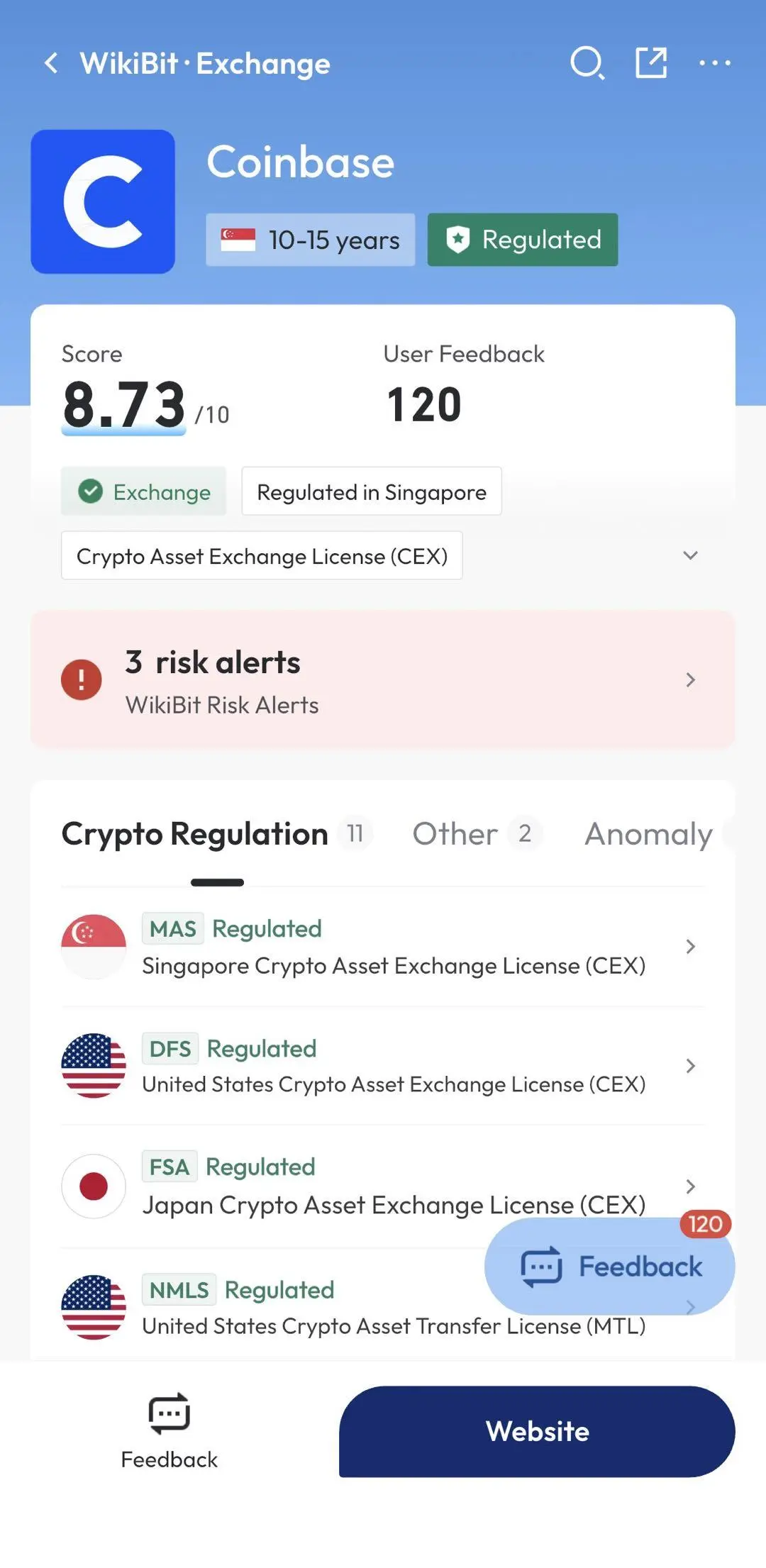
An exchange audited by Deloitte, overseen by the SEC, and listed on Nasdaq — why, then, might a user still lose control of their funds for 16 hours after making a large deposit?
Today, we're going to break it down, layer by layer.
1. Regulatory Compliance: The SEC Lawsuit Is Behind It, but Governance Litigation Is Just Beginning
Coinbase's regulatory credentials: A publicly listed company with Deloitte audits, not just another exchange collecting licenses
Coinbase's compliance credentials put it in a completely different category from most of the offshore-registered exchanges in this series that rely on MSB registrations and a collection of licenses.
It is a publicly traded company operating within the framework of US securities laws. Its financial disclosures, internal controls, related-party transactions, and executive compensation are subject to SEC scrutiny. Its financial statements are audited by Deloitte & Touche in accordance with PCAOB standards.
This level of institutional transparency is something the vast majority of cryptocurrency exchanges simply do not possess.
The SEC lawsuit: Dismissed in February 2025, but at a cost of $50 million
In June 2023, the SEC sued Coinbase, alleging that it was operating as an unregistered securities exchange.
In February 2025, the case was dismissed with prejudice, meaning the SEC could not bring the same claims against Coinbase again.
However, Coinbase reportedly incurred approximately $50 million in legal defense costs during the proceedings.
In 2026, the SEC also publicly acknowledged shortcomings in its previous approach to crypto industry enforcement and withdrew seven related lawsuits, including the Coinbase case.
This was a procedural victory for Coinbase, but it does not mean that every aspect of its business model is now free from regulatory controversy.
March 2026: Shareholder derivative lawsuit alleges misleading statements about customer asset custody
Just when the SEC chapter appeared to be behind Coinbase, another legal challenge emerged.
On March 3, 2026, shareholder Kevin Meehan, acting as a plaintiff on behalf of the company, formally filed a complaint in the US District Court for the District of New Jersey, naming Brian Armstrong and members of Coinbase's board and executive leadership team as defendants.
The complaint centers on two main allegations:
First, executives allegedly made misleading statements about how customer assets were held in custody between April 2021 and June 2023.
Second, the company's approach to listing certain tokens allegedly left unresolved compliance red flags.
The complaint also references Coinbase's $50 million anti-money laundering settlement with the New York State Department of Financial Services (NYDFS) in 2023, arguing that it reflects a broader pattern of governance failures.
Put simply: The SEC lawsuit may be over, but shareholders believe that Coinbase's executives may not have been entirely truthful about how customer assets were managed.
This is not a case of regulators simply making life difficult for a crypto company. It is the company's own shareholders seeking accountability for its corporate governance.
In addition to these cases, Coinbase also agreed to pay $6.5 million to settle a CFTC investigation involving the reporting of false, misleading, or inaccurate trading information.
In 2023, NYDFS imposed a $50 million penalty on Coinbase and required the company to invest an additional $50 million in strengthening its compliance systems. The action followed significant deficiencies in its compliance program, particularly in relation to Bank Secrecy Act (BSA) and Anti-Money Laundering (AML) requirements.
In the United States, such penalties generally follow a regulatory process of public enforcement, financial penalties, and mandated remediation. They do not constitute criminal convictions.
Nevertheless, they demonstrate that Coinbase's historical KYC/AML framework did have significant weaknesses.
Risk Rating: LOW (Regulatory Compliance – Relative to Other Exchanges in This Series)
Coinbase's regulatory transparency and institutional compliance are real and verifiable advantages. That must be acknowledged objectively.
However, the dismissal of the SEC lawsuit does not mean that all governance concerns have been resolved. The shareholder derivative litigation and CFTC settlement show that questions remain regarding two critical areas: customer asset custody and the disclosure of trading information.
2. Account Security and Withdrawals: $1.3 Million, 16 Hours, and the Limits of a “10-Business-Day” Review
$1.3 Million in USDC Frozen for 16 Hours, Triggering Forced Liquidation on Another Platform
On August 9, 2026, a Reddit user published a post titled “How I Lost $1.3 Million on Coinbase.”
According to the user's account, they deposited $1.3 million in USDC into a Coinbase account that they had used several years earlier but had left inactive for an extended period.
Their plan was to withdraw the funds via Arbitrum to Hyperliquid and use them as additional margin for a leveraged trading position.
Coinbase immediately restricted access to the funds and requested supporting documentation. The restriction lasted 16 hours, during which the user's position on Hyperliquid was forcibly liquidated.
Coinbase's publicly disclosed policies state that account reviews may take up to 10 business days or longer. During the review period, cryptocurrency withdrawals may be temporarily suspended. Such reviews can involve identity verification, source-of-funds checks, and transaction risk controls.
What makes this case particularly complicated is that both sides may have legitimate arguments.
From an anti-money laundering and fraud prevention perspective, a previously inactive account suddenly receiving $1.3 million and immediately attempting to transfer the funds to an external derivatives platform is a perfectly reasonable trigger for additional scrutiny.
But from the user's perspective, being unable to access their funds for 16 hours meant that a leveraged position on another platform was liquidated.
Here, two competing considerations collided head-on: the legitimacy of compliance reviews versus the time cost of losing control over one's funds.
May 2026: A Wave of Complaints About Account Closures and Blocked Withdrawals
In May 2026, multiple Coinbase users reported on social media and Reddit that their accounts had been closed without prior warning and that their withdrawal functions had been frozen.
A CoinMarketCap community article documented this pattern, noting that responses from community members confirmed they were unable to withdraw funds from their restricted accounts.
May 2025: Data Breach Exposes 69,461 Customers After Outsourced Support Staff Were Bribed
In May 2025, Coinbase disclosed a serious data breach.
Cybercriminals bribed overseas outsourced customer support personnel to steal information belonging to fewer than 1% of Coinbase's monthly active users.
Coinbase rejected a $20 million extortion demand and offered a $20 million reward for information leading to the attackers' arrest.
Subsequently, documents submitted to the Maine Attorney General's Office identified 69,461 affected customers.
The exposed information included names, addresses, partial Social Security numbers, and images of government-issued identification documents.
One important distinction must be made: This was a data breach, not a theft of customers' cryptocurrency assets.
Coinbase explicitly stated that customer funds were not affected.
Nevertheless, the exposure of personal information belonging to 69,461 individuals creates genuine and potentially long-term risks of phishing, impersonation, and social engineering attacks.
Coinbase currently has a Trustpilot rating of approximately 4/5, placing it among the highest-rated major exchanges.
However, complaints about frozen funds and blocked withdrawals repeatedly appear on both Trustpilot and Reddit.
An exchange can simultaneously have one of the industry's highest Trustpilot ratings and a significant number of genuine complaints about account restrictions.
The reason is simple: ratings reflect the overall distribution of customer experiences, while individual complaints reflect what specific users have gone through.
Across multiple complaint databases, several recurring patterns emerge in Coinbase user complaints:
Large deposits followed by immediate withdrawal attempts: Complaints frequently involve users depositing substantial amounts and then attempting to transfer the funds directly to cold wallets. AI-driven risk management systems may flag this deposit-and-withdrawal pattern as a potential money laundering or fraud indicator.
Restrictions despite completed KYC: Some users report that their accounts were restricted even after completing full identity verification.
Repeated delays beyond promised deadlines: Users complain that review periods repeatedly exceed the originally communicated timelines.
Template-based customer support: Many users describe receiving standardized responses rather than meaningful explanations.
Limited appeal options: Some complainants say they cannot find an effective channel to challenge account restrictions or obtain human intervention.
Risk Rating: MEDIUM-HIGH (Account Security and Withdrawals)
Coinbase's primary risk is not that the exchange will disappear with customers' funds. Rather, it is that users may temporarily lose control over the timing and accessibility of their assets during compliance reviews.
The $1.3 million case, the wave of complaints in May 2026, and Coinbase's official review framework, which allows for reviews lasting up to 10 business days or longer, all point to a practical reality:
Even on a highly regulated platform, the proper execution of compliance procedures and the timely accessibility of customer funds do not always go hand in hand.
3. Reserve Transparency: No Merkle Tree PoR, but a Full Balance Sheet Audited by Deloitte
Coinbase's Approach to Transparency: Public Company Audits Rather Than Crypto-Native Proof of Reserves
Coinbase does not operate a Merkle Tree Proof of Reserves (PoR) program. Instead, it relies on an alternative approach.
As an SEC-regulated publicly traded company, Coinbase files quarterly 10-Q reports and annual 10-K reports. These financial statements cover both assets and liabilities and are audited by Deloitte & Touche in accordance with PCAOB standards.
Coinbase's own position is:
“As a public company, Coinbase has already demonstrated its reserves through audited financial statements.”
From the perspective of liability coverage, this approach may actually be more comprehensive than most Merkle Tree PoR systems.
Most exchanges' PoR reports only demonstrate that their assets are greater than or equal to their customer balances. They do not disclose the full picture of the platform's own liabilities.
By contrast, Coinbase's 10-K and 10-Q filings cover the company's entire balance sheet, including customer custodial funds and the company's own liabilities.
This is also why Kraken's independent attestation reports are considered methodologically stronger: they explicitly reconcile customer liabilities against assets.
But Public Company Audits Have Clear Limitations Too
First, quarterly reporting creates a 90-day visibility gap.
An exchange may have sufficient asset coverage at the end of a reporting quarter, yet experience significant balance sheet changes during the following months. Outside observers may not discover these changes until the next 10-Q filing.
Monthly or even more frequent Merkle Tree PoR updates therefore offer a genuine advantage in terms of reporting frequency.
Second, Deloitte audits the fairness of financial statements, not the on-chain balance of every individual customer coin.
There is a fundamental difference between financial statement-level control testing and crypto-native verification, where users can independently confirm that their individual balances are included in the platform's total liabilities.
These are two different transparency mechanisms.
Third, approximately $715 million of Coinbase's $719 million in Q3 2026 net income came from gains on crypto asset investments, rather than its core trading business.
This means Coinbase's earnings quality is highly sensitive to cryptocurrency prices.
When the market rises, investment gains on its balance sheet can significantly improve reported net income. When the market falls, the opposite effect applies.
On-Chain Wallet Tracking: How to Monitor Coinbase's Asset Movements
Coinbase is one of the few major exchanges in the industry that publicly discloses the structure of its custodial wallet addresses to demonstrate the authenticity of its cold storage arrangements.
Its wallet clusters have also been tracked and labeled by analytics platforms such as Nansen, Arkham, and Glassnode.
There are several practical ways to monitor its on-chain activity:
Cross-check platform assets against 10-Q disclosures: Aggregate the balances of wallet clusters labeled as Coinbase and compare them with the approximately $294.4 billion asset figure reported in its 10-Q filings.
Monitor ETF custody inflows: Coinbase serves as a custodian for several spot Bitcoin ETFs. Large inflows into its cold wallets may correspond to ETF subscriptions rather than customer withdrawals or a liquidity crisis. Misinterpreting ETF inflows as signs of a bank run is one of the most common mistakes beginners make.
Watch for unusual outflows: Large transfers from Coinbase cold wallets to unknown addresses, particularly when not accompanied by a corresponding company announcement, would warrant closer investigation.
Risk Rating: MEDIUM (Reserve Transparency)
Coinbase does not lack transparency; rather, its transparency is expressed through a different institutional framework.
Public company audits cover company-wide liabilities that conventional PoR systems may not capture, but they sacrifice some of the granularity and update frequency of user-verifiable reserves.
Both approaches involve trade-offs. It would be incorrect to claim that having PoR automatically makes an exchange safer, just as it would be wrong to assume that a public company audit guarantees absolute safety.
4. Financial Strength and Trading Depth: $377 Billion in Platform Assets, but Profitability Still Depends on Market Conditions
The Hard Numbers
Platform assets: $377 billion, representing 12.5% of global cryptocurrency market capitalization and returning to peak levels.
Trading volume market share: 10.7%, marking the fourth consecutive quarterly increase, with both spot and derivatives trading gaining ground.
Q3 2026 total revenue: $1.216 billion, down 35% year over year and broadly flat quarter over quarter.
Q3 2026 net income: $719 million, of which approximately $715 million came from crypto asset investment gains. Adjusted net income was $78 million.
Adjusted EBITDA: $333 million, remaining positive for the 15th consecutive quarter.
Subscription and services revenue: Accounted for 49% of net revenue, reflecting a shift away from dependence on pure trading fees toward a more diversified business model.
But the Composition of Those Profits Needs a Closer Look
Of Coinbase's $719 million in net income, approximately $715 million came from the appreciation of crypto assets held by the company itself.
Adjusted net income was only $78 million. This is a more meaningful indicator of the underlying profitability of its core business after excluding investment gains.
This does not mean Coinbase is losing money. However, it does mean that its reported earnings are highly sensitive to market conditions.
When the crypto market enters a prolonged downturn, investment gains may turn into losses. Coinbase recorded a net loss of $394 million in Q1 2026, illustrating this vulnerability.
At that point, the profitability of its core business will come under much closer scrutiny.
Risk Rating: LOW (Financial Strength)
5. Internal Operations and Management: Brian Armstrong Is Publicly Accountable, but So Are the Governance Controversies
Founder and CEO: Brian Armstrong
Coinbase founder and CEO Brian Armstrong is one of the most publicly visible and verifiable executives in this entire series.
He led the company through its Nasdaq listing, navigated 18 months of regulatory battles during the SEC lawsuit, and publicly rejected a $20 million extortion demand following the 2025 data breach, offering a $20 million reward for information leading to the attackers' arrest.
In an industry where anonymous founders are still relatively common, Armstrong's public profile and accountability represent a genuine competitive advantage.
But Shareholder Litigation Has Put Corporate Governance Under the Spotlight
The March 2026 shareholder derivative lawsuit is not fundamentally about whether Armstrong works hard enough.
Its central question is whether executives accurately represented critical issues, including:
How customer assets were held in custody.
Which tokens were approved for listing.
Whether compliance red flags were adequately disclosed.
This is fundamentally different from the situations involving MEXC, where the founder's identity cannot be verified, or BingX, where the co-founder's LinkedIn profile has no verifiable record.
The issue is not that nobody knows who is running the company. It is that people know exactly who is in charge, but shareholders believe those executives may not have provided sufficient clarity on certain critical matters.
The Data Breach Affecting 69,461 Customers: Who Is Responsible for Outsourcing Risks?
The root cause of the 2025 data breach was the bribery of outsourced customer support personnel.
Coinbase is certainly not the only platform to encounter this type of problem when outsourcing customer service.
However, for a publicly listed company managing $377 billion in assets and serving millions of users, the fact that outsourced personnel were able to access and steal the personal information of nearly 70,000 customers raises a serious operational security question.
Risk Rating: MEDIUM (Management and Corporate Governance)
Brian Armstrong's public visibility and crisis management capabilities are positive factors.
However, the shareholder lawsuit and outsourced customer service data breach demonstrate that there is still a meaningful gap between having a publicly accountable CEO and maintaining flawless corporate governance.
6. Product Experience and Trading Depth: The Friction of a Public Company-Grade Exchange
Fees and Product Offering
Coinbase does not belong to the low-fee category in this series.
Its standard spot trading fees are significantly higher than those of platforms such as Binance and OKX.
High-volume traders and Coinbase One subscribers can access discounted fees, but for casual users, the convenience premium charged by Coinbase is very real.
Its product ecosystem covers:
Spot trading.
Derivatives, including options, futures, and perpetual contracts.
Prediction markets, generating more than $200 million in annualized revenue.
Stablecoins, with average USDC holdings of approximately $22 billion.
Trading Functionality Is Solid, but Operational Friction Is Real
The positive side of the product experience:
Coinbase offers substantial liquidity. Its derivatives and options markets rank among the strongest within the regulated exchange segment. Newer products, such as prediction markets, are also experiencing steep growth.
The negative side of the product experience:
The 10-business-day account review framework, unpredictable withdrawal restrictions, and inconsistent quality across outsourced customer support channels remain significant drawbacks.
These are not necessarily problems users encounter while placing trades. They become problems when users need to withdraw their money or seek assistance.
A user may barely notice Coinbase's strict compliance procedures during normal trading. But the moment their account triggers a review, they will become acutely aware of what heavy compliance enforcement actually means.
Risk Rating: MEDIUM (Product Experience)
7. Overall Exchange Runaway Risk Assessment
| Assessment Dimension | Risk Level | Summary |
| Regulatory Compliance | Low | Nasdaq-listed, SEC-regulated, and audited by Deloitte. The SEC lawsuit has been dismissed, but shareholder derivative litigation and the CFTC settlement remain outstanding issues. |
| Account Security Withdrawals | Medium-High | A $1.3 million USDC deposit was reportedly frozen for 16 hours, triggering forced liquidation. Coinbase's review framework allows up to 10 business days or longer. The 2025 data breach affected 69,461 customers. |
| Reserve Transparency | Medium | No Merkle Tree PoR, but Deloitte-audited 10-Q and 10-K filings cover both assets and liabilities. However, quarterly reporting creates a 90-day visibility gap. |
| Financial Strength | Low | $377 billion in platform assets, representing 12.5% of global crypto market capitalization. Adjusted EBITDA has remained positive for 15 consecutive quarters, although net income is heavily influenced by asset appreciation. |
| Management and Operations | Medium | Brian Armstrong is publicly identifiable and verifiable. However, shareholder litigation alleges misleading statements about customer asset custody, while the outsourced customer data breach exposed operational security weaknesses. |
| Product Experience | Medium | Adequate liquidity and a comprehensive product lineup, but unpredictable account reviews create genuine operational friction. |
| Community Feedback | Medium-High | Complaints about frozen accounts and inaccessible funds are recurring themes. |
Overall Rating: Low to Medium Runaway Risk
The probability of the platform disappearing is extremely low, but the risk of individual users experiencing difficulties accessing and controlling their funds is real.
Coinbase is one of the lowest-runaway-risk exchanges in this entire series.
It has a Nasdaq listing, SEC oversight, comprehensive financial statements audited by Deloitte, $377 billion in platform assets, and a publicly identifiable CEO who has navigated multiple major crises.
It is highly unlikely to simply disappear with customers' money, as platforms such as UZX and Azbit might.
However, not running away does not mean your money will always be immediately accessible or available for withdrawal.
Coinbase's primary risk lies in the tension between compliance enforcement and individual user experience.
The $1.3 million case demonstrates that legitimate compliance reviews can seriously conflict with users' need for immediate access to their funds.
When a long-inactive account suddenly receives a large deposit and immediately attempts to withdraw it, triggering a review is a predictable consequence of risk management procedures.
However, 16 hours without access to those funds can be enough to cause actual financial losses in cross-platform leveraged trading.
Public company audits provide broader liability transparency, but they do not offer more frequent user self-verification.
Coinbase's transparency framework covers company-wide liabilities that conventional PoR systems may not capture.
However, the 90-day gap between quarterly reports means users cannot independently verify their balances against total reserves as frequently as they can on exchanges offering regular Merkle Tree PoR updates.
The data breach affecting 69,461 customers demonstrates that even when the platform itself has not been hacked, outsourced operations can become an entry point for identity theft.
Financial security does not automatically mean data security.
The phishing and impersonation risks resulting from exposed personal information can persist for years.
8. Recommendations for New and Existing Users
Recommendations for New Users
Do not equate being a publicly listed company with instant withdrawals.
Coinbase's compliance reviews are real. Its support documentation explicitly states that account reviews may take up to 10 business days or longer.
If you have an urgent need to use your funds, plan ahead. Do not wait until the last minute to initiate withdrawals or transfers between platforms.
If you use cross-platform leveraged trading strategies, do not treat Coinbase as your last-minute margin funding channel.
The $1.3 million case demonstrates how a compliance review delay on one platform can trigger forced liquidation on another.
Funds intended to meet margin requirements should be positioned on the derivatives platform in advance, or you should maintain sufficient time buffers.
Data security is part of your personal operational security (OpSec).
The data breach affecting 69,461 customers means that if you have previously used Coinbase, your name, address, and some personal identification information may have been exposed and could potentially circulate on the dark web.
Remain cautious of any phone call, email, or message claiming to come from Coinbase customer support.
Never provide verification codes or passwords through unofficial channels.
Consider self-custody for large, long-term holdings.
Coinbase's audited balance sheet demonstrates that the company has substantial financial resources.
But having money on the platform and being able to withdraw your own money whenever you want are two different things.
For large amounts intended for long-term holding, consider using a hardware wallet.
Recommendations for Existing Users
Understand what may trigger an account review.
Long-inactive accounts, large deposits followed by immediate withdrawals, and cross-border transfers are all potential triggers for additional scrutiny under anti-money laundering frameworks.
If you plan to conduct similar transactions, consider contacting customer support in advance or structuring transactions in stages to reduce the likelihood of triggering an immediate review.
Keep all communications and transaction records.
If your account is restricted, preserve all emails, chat records, transaction receipts, and documentation submitted for identity verification.
These records are essential foundations for any subsequent appeal or public complaint.
One reason the user behind the $1.3 million case attracted widespread attention was the relatively detailed account of events and the availability of a public platform through which to share the experience.
Monitor developments in the shareholder lawsuit.
The March 2026 derivative lawsuit alleges that executives made misleading statements regarding customer asset custody and token listings.
If the litigation progresses to the discovery stage, additional information about Coinbase's internal governance and asset custody practices may become public.
This could provide useful insights into how the platform operates under pressure.
Do not relax your withdrawal planning simply because Coinbase is a publicly listed company.
An exchange can simultaneously be an SEC-regulated publicly traded company and a platform where an individual user cannot access their money for 16 hours.
These two realities are not contradictory.
They can coexist because regulatory compliance operates at the institutional and financial reporting levels, while withdrawal restrictions are imposed through individual account review procedures.
Final Verdict: Who Should and Shouldn't Use Coinbase?
Who is Coinbase suitable for?
Users who prioritize institutional compliance, publicly audited financial transparency, and the protections available within the US regulatory framework.
Holders who can plan their withdrawal schedules in advance and do not depend on last-minute transfers between platforms.
Long-term users who are willing to accept that compliance reviews may involve additional time costs.
Who is Coinbase less suitable for?
Users who assume that being a publicly listed company means completely frictionless withdrawals. The 10-business-day review framework is a real consideration.
High-leverage traders who depend on precise cross-platform margin transfer timing. The $1.3 million case serves as a clear warning.
Users who cannot tolerate losing temporary control over their funds while an account is under review.
Coinbase occupies a unique position in the crypto industry: the pinnacle of institutional security, but with genuine friction at the individual user level.
Its Nasdaq listing, Deloitte audits, $377 billion in platform assets, and SEC regulatory framework make the possibility of the exchange disappearing with customer funds one of the least likely scenarios in this entire series.
At the same time, an individual user can have $1.3 million frozen for 16 hours after making a deposit. The personal information of 69,461 customers can be exposed through bribed outsourced support personnel. And shareholders can end up in court arguing over whether executives adequately disclosed how customer assets were being held.
An exchange can simultaneously be one of the lowest-risk platforms in terms of runaway risk and a platform where individual withdrawal experiences remain unpredictable.
There is no contradiction here: institutional security and individual account accessibility are two different dimensions of safety.
Coming Next:
WikiBit Exchange Runaway Risk Rankings – Episode 56: BloFin Exchange. Stay tuned!
Risk Disclaimer: This article represents an independent analytical opinion and does not constitute investment advice. Cryptocurrency investments involve significant risks. Please exercise caution before investing.
Information Update: This article's information is current as of November 4, 2026. Please cross-check and verify the latest information through multiple sources.
WikiBit is a regulatory and risk intelligence platform built specifically for cryptocurrency investors. It provides real-time access to global exchange regulatory licenses, credit ratings, risk alerts, industry news, and genuine user reviews, helping investors identify potential risks, stay away from problematic platforms, and make more informed trading decisions.
Before investing in crypto, check WikiBit first!
Download the WikiBit App now and add an extra layer of protection to your crypto assets:
https://wikibit.onelink.me/wgfF/1b1dn69b