






US spot Bitcoin exchange-traded fund (ETF) daily flows aren‘t reliable guides to BTC’s next move as investors tend to chase rallies and sell into slumps, according to DWF Labs.
In a research report published Thursday, DWF found that investors pulled money from the funds during seven of the eight times Bitcoins price dropped at least 15%. All nine rallies of that size drew net inflows. The analysis reviewed 694 trading days dating back to January 2024, when Bitcoin ETFs first launched in the US.
“ETF flows confirm moves; they dont predict them,” DWF said in its report. “The evidence points mostly to investors reacting to price, not driving it.”
Investors tended to put money into Bitcoin ETFs after prices rose and pull it out after prices fell. Those flows offered almost no clue to whether Bitcoin would rise or fall over the next five days.
Each day‘s ETF flows had a moderate relationship with Bitcoin’s price changes over the five trading sessions before that day, with a correlation of 0.54. On a scale where zero means no relationship, the correlation for the following five days was 0.03.
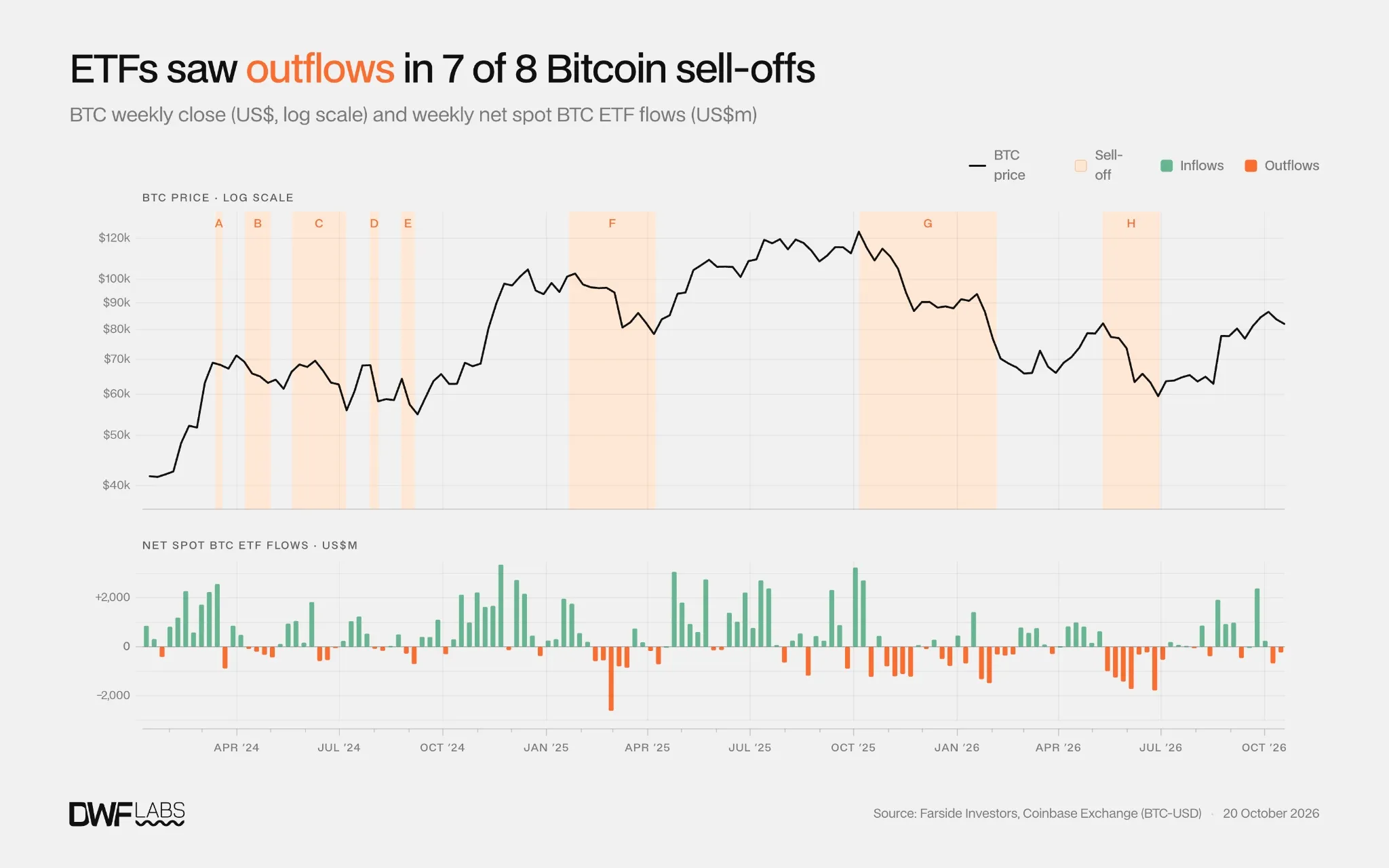
ETF outflows in seven of eight Bitcoin sell-offs. Source: DWF Labs
ETF outflows dont show who sold
The heaviest withdrawals came during the two most recent sell-offs. Investors withdrew a net $6.9 billion between October 2025 and February 2026, followed by $8.2 billion during the May–June decline.
The figures do not show whether institutions or retail investors drove the selling. DWF did not separate the two groups in its analysis.
“We dont have a clear split on the exact buyers/sellers of the ETFs,” a DWF Labs spokesperson told Cointelegraph.
Related: Institutions held crypto through 50% drawdown, Bitwise finds
Some ETF activity also comes from investors buying fund shares while betting against Bitcoin through CME futures to earn the price gap between the two positions. DWF estimated that roughly a fifth of flows may have been hedged this way, although its data could not confirm that the same investors held both sides of the trades.
A CoinShares analysis published in June found that professional investors reduced their Bitcoin ETF exposure by 17% in the first quarter of 2026. Hedge funds and brokerages accounted for roughly 96% of the reduction, while banks increased their holdings.
Bitcoins sell-offs have slowed
Bitcoin has had about three sell-offs of 15% or more a year since the ETFs launched, compared with roughly four a year in 2022–2023 and eight in 2021, the report found.
The declines have also become more gradual, but the losses are still comparable. The median sell-off wiped out 21.3%, against 19.4% in 2022–2023.
“The changes arent solely due to the ETF,” the spokesperson said, noting that volatility and the frequency of sell-offs were already declining before the funds launched in 2024.