






Russia is close to legalizing cryptocurrencies, but not quite.
The State Duma has passed the “Digital Currency and Digital Rights” bill in its first reading, but only within a strictly regulated system shaped by the state.
Legal, but not free?
The bill recognizes crypto as property, but not as legal tender. This means they can be owned and traded, but not used for everyday payments.
State agency TASS reported that only the rouble (and its digital version) will remain valid for transactions.
Crypto use is limited to specific areas like foreign trade, service payments, and transfers of intellectual property.
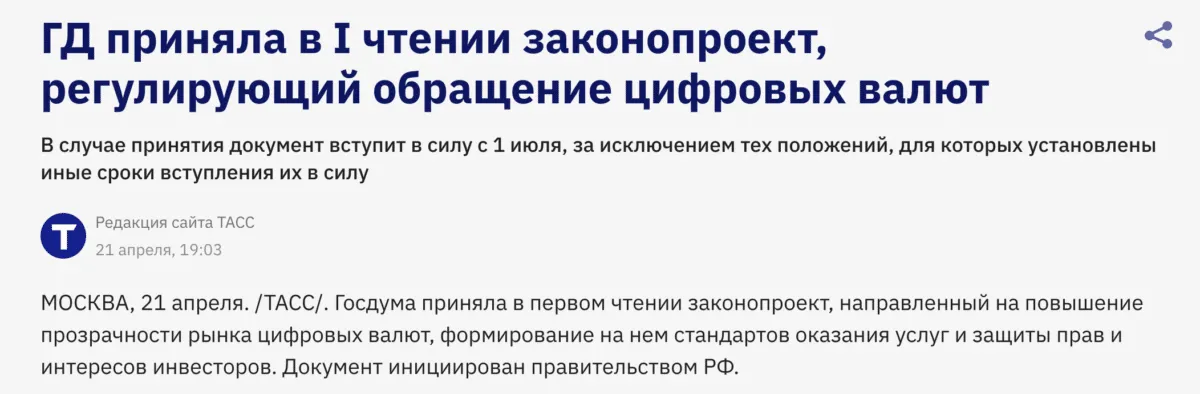
Source: TASS
At the centre of this system is the Bank of Russia. It will act as the main authority overseeing the market. All crypto-related businesses, including exchanges, brokers, and custodians, must get licences to operate. The central bank will also have the power to decide which transactions are allowed and even restrict certain tokens.
Restricted access and a list of approved tokens
People wont be able to buy crypto freely; they must go through licensed intermediaries. Investors will be split into “qualified” and “non-qualified” groups. Those in the second category will need to pass a test and will face an annual investment cap of around 300,000 roubles.
In effect, participation is carefully filtered.
The range of assets available will be just as restricted. Only cryptocurrencies that meet strict rules on market size, liquidity, and track record will be allowed. This likely includes major names like Bitcoin [BTC], Ethereum [ETH], Solana [SOL], Binance [BNB], and Tron [TRX].
Pushback as Russia sets timeline for final approval
Not everyone is convinced though, with some warning that excessive regulations could backfire. There are concerns that strict rules may push users and businesses back into grey or unregulated markets. Questions are also being raised about legal protections; especially for crypto holdings and non-custodial wallets, which remain a grey area.
The timeline for the bill is tight. It will go through revisions before a second reading, with a target for final adoption by July 2026. At the same time, a separate proposal is looking to introduce criminal penalties, including heavy fines and prison terms for illegal crypto use.
Other countries move differently
AMBCrypto previously reported that the United Kingdom is working to integrate crypto into its existing financial system through a unified payments framework. Meanwhile, Uzbekistan recently launched a state-backed crypto mining zone with tax breaks to attract investment.
On the contrary, Russias approach has been much more cautious.
Final Summary
- Russias crypto bill legalizes digital assets, but puts them under strict central bank control.
- Initiative involves tight rules, investor caps and token restrictions.