Introduction: A “Worry-Free” Exchange Where Users Have the Most to Worry About
In the first 37 editions, we examined a series of exchanges ranging from HashKey to GXT. For the 38th edition, we turn to an exchange with an especially ambitious slogan but a much less reassuring reality: Websea.
On paper, Websea has an impressive résumé: “founded in 2023,” “more than 1.5 million registered users worldwide,” “$4 billion in average daily trading volume,” an “ASIC regulatory authorization,” U.S. FinCEN MSB and Canadian FINTRAC MSB registrations, a strategic investment from Hony Capital, principal-protected copy trading, contract insurance, the Yongying Fund, and positioning as a “new-generation worry-free derivatives trading platform.”
Sounds like a rising compliance star, right?
But there is another side to the story.
On April 27, 2026, Websea suddenly suspended withdrawals, shut down its C2C channel, and users began panic-selling, sending the platform tokens USDT price to roughly half its previous level.
Then, starting September 25, 2026, withdrawals were reportedly suspended again for more than four days, with no official explanation from the platform.
On-chain data showed that the platforms hot wallet balance had fallen to just 0.024 ETH and 0.24 USDC.
WikiBit gives Websea a 5.98/10 score and flags it as having no valid regulatory status. FX110 describes it as an “unregulated cryptocurrency investment platform,” while user complaints include reports of withdrawals being stuck, funds not arriving, and money not being returned to the original account.
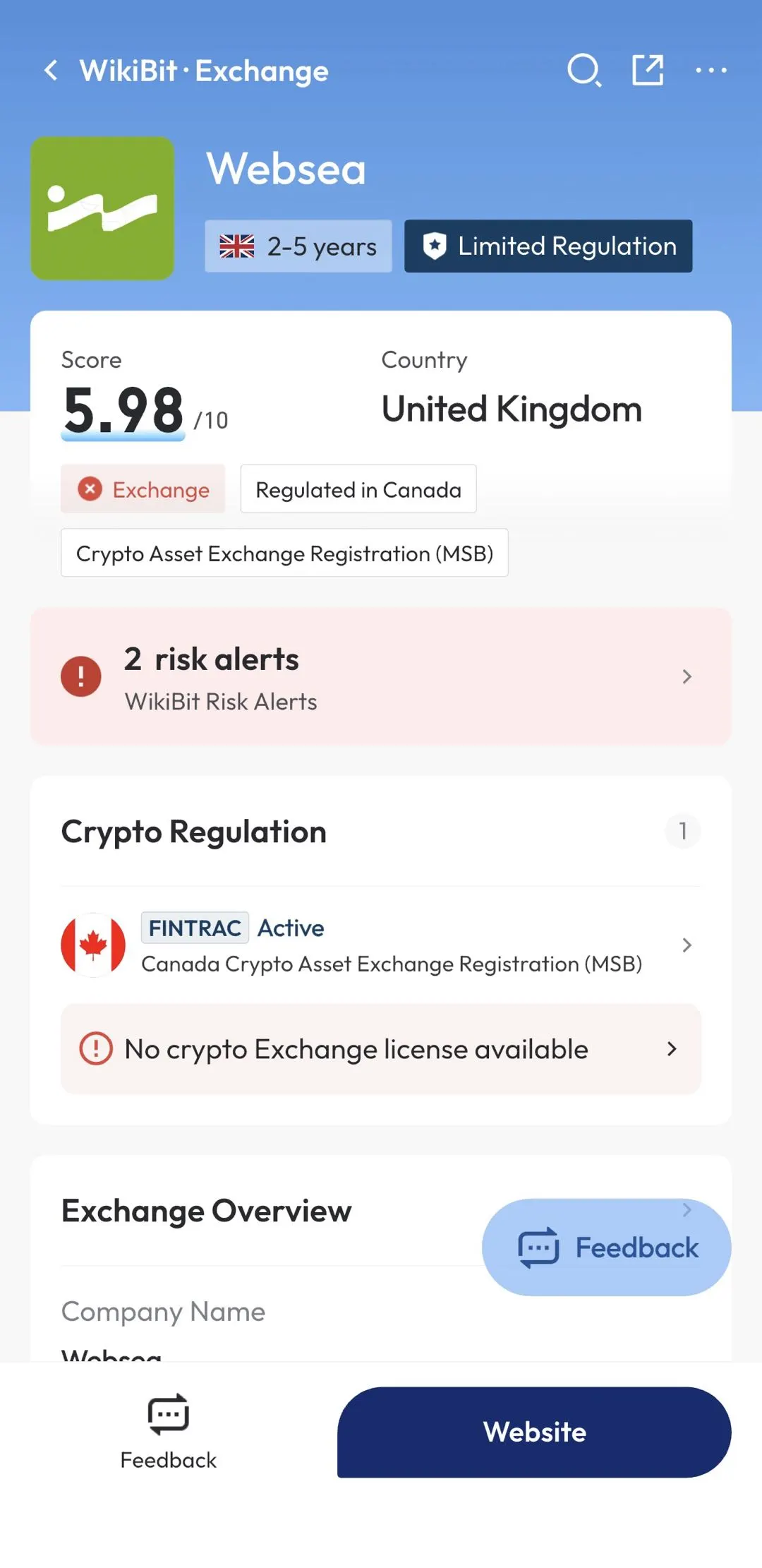
For a platform that calls itself a “worry-free derivatives trading platform,” the biggest worry for users may be the most basic one: Can they get their money out?
Lets examine Websea layer by layer.
1. Regulatory Compliance: The “ASIC Authorization” Appears to Be a Business-Name Registration, Not a Financial License
Webseas “Compliance Package”
Websea has been highly active in promoting its regulatory credentials. According to its official announcements and CoinMarketCap information, the exchange claims:
Australian ASIC “regulatory authorization” — announced on July 1, 2025
U.S. FinCEN MSB registration
Canadian FINTRAC MSB registration
Strategic investment from Hony Capital — announced in December 2025
Websea stated:
“With the implementation of ASIC regulation in Australia, Websea has officially established dual compliance channels across North America and Australia, marking another key step forward in its global compliance strategy.”
That sounds substantial.
But the details require closer examination.
FX110: Websea Could Not Be Found in ASICs Records, While MSB Registration Is Not a Derivatives License
A response from the FX110 Rights Protection Center directly challenges Webseas regulatory claims.
FX110 states that Websea is an unregulated cryptocurrency investment platform and says its searches did not identify the platform in the relevant Australian ASIC or U.S. FinCEN MSB registration lists.
FX110 also says that a company named WEBSEA GLOBAL HOLDING LIMITED can be found in Canadas FINTRAC MSB registration database, providing services involving foreign exchange, remittance, and virtual currencies.
However, FX110 emphasizes that MSB registration with FinCEN or FINTRAC is primarily an anti-money-laundering registration framework, rather than authorization to conduct regulated financial derivatives activities.
In practical terms:
Websea could not be identified in the relevant ASIC records cited by FX110.
Websea could not be identified in the U.S. FinCEN MSB records cited by FX110.
A WEBSEA GLOBAL HOLDING LIMITED entity appears in Canadas FINTRAC MSB framework.
MSB registration does not automatically authorize leveraged foreign-exchange or financial-derivatives activities.
Webseas core products include derivatives such as futures/perpetual contracts, principal-protected copy trading and contract-related insurance products.
This creates a critical regulatory question:
If the company's main products are derivatives, but the registrations it cites do not authorize derivatives activity, what legal entity and regulatory framework actually covers those products?
That question should be answered with specific license numbers, legal entities, jurisdictions and regulator records—not simply the word “MSB.”
What About Hony Capitals “Strategic Investment”?
In December 2025, Websea prominently announced a strategic investment from Hony Capital.
Hony Capital is a major Chinese private-equity investment firm with a large assets-under-management footprint.
But another question follows:
How much was invested? Who made the investment? And was the investment actually completed?
A review of publicly available information cited in the report does not provide clear details on:
The specific investment amount
The exact investment entity
The resulting ownership structure
Whether the funds were actually transferred
Whether Hony Capital obtained an equity stake
In the crypto industry, the phrase “strategic investment” can sometimes refer to arrangements ranging from completed equity investments to strategic partnerships or memoranda of understanding.
Therefore, the existence and substance of the investment should ideally be verified through formal transaction documentation or disclosures from the investor itself.
Where Is Websea Actually Registered?
Webseas corporate and registration information also appears fragmented.
CoinMarketCap lists Websea as being registered in Seychelles.
At the same time, Webseas official announcements have referred to Websea Global obtaining an ASIC business-name registration in Australia, while also announcing operations in Malaysia and Indonesia.
This creates an obvious structural question:
Where is the exchange actually regulated?
A company can have:
A Seychelles corporate registration,
An Australian business-name registration,
Operations across Southeast Asia,
MSB registrations in other jurisdictions,
without those registrations collectively constituting a comprehensive financial-services license.
Corporate registration, business-name registration and financial regulatory authorization are not interchangeable concepts.
Risk Assessment: Extremely High
The regulatory picture raises several material concerns:
ASIC regulatory claims require verification against the actual ASIC entity and license records.
MSB registration should not be interpreted as authorization for derivatives trading.
The claimed Hony Capital strategic investment lacks publicly disclosed transaction details in the materials reviewed.
Webseas corporate and operational footprint spans multiple jurisdictions, making the actual regulated operating entity unclear.
The platform's principal products involve derivatives, making the scope of its regulatory authorization particularly important.
The resulting picture is not simply one of “regulation still being unclear.” It is a situation in which the exchanges promotional compliance claims need to be reconciled with the actual records of the relevant regulators and legal entities.
FX110 characterizes Websea as an unregulated cryptocurrency investment platform. That is a serious allegation, but it should be understood as FX110s assessment, rather than independently treating the characterization as a legal finding of fraud.
For users, the key question is straightforward:
Before trusting an exchange with substantial assets, can its claimed licenses be independently verified through the relevant regulator, under the exact legal entity operating the exchange?
2. Account Security and Withdrawals: Withdrawals Suspended for 4 Days, Hot Wallet Balance Nearly Zero
Screenshots provided by X user @GMM12173393 show two alarming sets of on-chain data.
EVM Address: 0C67f1b6d6e89D0c7cb51C1AdC6b5c6Cc8A
ETH balance: 0.02419194 ETH (approximately $65.05)
USDT balance: <0.01 USDT
USDC balance: 0.24 USDC
An exchange claiming $4 billion in average daily trading volume has only about $65 worth of ETH and $0.24 in USDC in the referenced EVM hot wallet.
TRON Address: gMBqmwyH8hQg9cgF...
Token balance: 45,677.44673332 tokens (approximately $1,325)
Combined, the two on-chain addresses hold less than $1,400.
This is the Websea “hot wallet” identified by the user-provided evidence.
For an exchange claiming 1.5 million users and $4 billion in average daily trading volume, a hot-wallet balance of less than $1,400 is an extraordinary discrepancy.
April 27, 2026: Withdrawals Suspended and C2C Shut Down
On April 27, 2026, multiple media outlets, including ChainCatcher and Gate News, reported that Websea had suspended withdrawals and shut down its C2C (peer-to-peer) channel.
The reports said multiple users suspected that the exchange had entered an “exit scam” or “runaway” situation. According to the reports, the platform initially restricted withdrawals before eventually shutting down its C2C channel altogether, triggering panic selling of its native token and sending its price to roughly 50% of its previous level.
That was a major blow to Webseas “worry-free” positioning.
May 18, 2026: Withdrawals “Resumed” — But Under a Snapshot-Based, Batch-Release Model
On May 13, 2026, Websea announced:
“Websea will officially reopen withdrawals at 08:00 (UTC) on May 18, 2026.”
But there was a critical detail in the announcement: withdrawal limits would be determined based on a snapshot of users account assets taken on April 25, 2026.
In other words, funds deposited after April 25 might not have been included in the withdrawal calculation.
This was therefore not necessarily a conventional return to unrestricted withdrawals. It was a snapshot-based, phased withdrawal release.
For users, the practical implication was that their withdrawal entitlement could be tied to their account status on April 25. Funds deposited or earned after that date could face different treatment.
From September 25, 2026: Withdrawals Suspended Again, With No Official Statement
According to screenshots provided by users:
“Withdrawal suspended for over 4 days, no official statement whatsoever, community feedback yields no results, the platform's hot wallet is already empty, the reserve gold verification address heavily promoted by the platform has already gone to zero, everyone can download and verify it themselves.”
The claim that “the reserve verification address has already gone to zero” is particularly significant because it can potentially be checked independently on-chain.
A platform can experience temporary liquidity-management issues without necessarily being insolvent. However, if a heavily promoted reserve-verification address subsequently shows little or no balance, users have a legitimate reason to demand an explanation of where the assets were moved, which wallets now hold them, and whether those wallets still correspond to customer reserves.
FX110 User Complaint: “The Withdrawal Is Stuck, and the Funds Have Not Been Returned”
An FX110 user filed a complaint on May 7, 2026, stating that:
“The Websea withdrawal is stuck. The funds have not arrived, nor have they been returned to the original account. I don't know where the withdrawal went.”
A withdrawal that neither arrives at the destination nor returns to the originating account is obviously a serious user-experience and asset-custody concern.
Risk Assessment: Extremely High
The combination of:
Withdrawals reportedly suspended for more than four days
Referenced hot-wallet balances totaling less than $1,400
A reserve-verification address reportedly showing a zero balance
A previous snapshot-based, phased withdrawal mechanism
User complaints about withdrawals being stuck or funds not being returned
creates a high-severity withdrawal and custody risk profile.
However, one important distinction should be maintained: a low balance in a particular hot wallet does not, by itself, prove that an exchange has no customer assets or is insolvent. Exchanges commonly distribute assets across multiple hot, warm and cold wallets, custodians and operational addresses.
The critical issue is whether the wallets can be reliably identified and reconciled with the exchange's claimed customer liabilities.
3. Proof of Reserves Transparency: PoR Is Live, but the “Zero-Balance Verification Address” Raises Questions
Official PoR: Launched on August 18, 2026
On August 18, 2026, Websea announced the launch of its Proof of Reserves (PoR) system.
According to the platform:
Verification date: August 16, 2026
Covered assets: BTC, ETH, USDT and WBS
Reserve ratios: USDT 111%, BTC 100%, ETH 102%, WBS 174%
Merkle tree root hash: 220ba74c375afbc0586e262836a9c95e931900823cad1e5cc9c27faa38476210
Open-source verification tool: Published on GitHub
Websea stated that every user asset was backed by an equivalent amount of real assets and promised to publish reserve data on a regular basis.
But Users Reported That the Verification Address Had Reached Zero
According to the user-provided screenshot:
“The reserve gold verification address heavily promoted by the platform has already gone to zero.”
If independently verified, this would raise an important question.
Websea published its PoR based on an August 16 snapshot, reporting a USDT reserve ratio of 111%. Less than a month later, users reportedly found that the balance of the referenced verification address had fallen to zero.
This highlights an inherent limitation of snapshot-based PoR systems:
A Proof of Reserves report is a point-in-time verification, not necessarily a continuous guarantee that the same assets remain in the same wallets afterward.
An exchange could theoretically have sufficient reserves at the moment of the snapshot and subsequently transfer those assets elsewhere.
Therefore, the key question is not simply:
“Did Websea have sufficient reserves on August 16?”
It is also:
“Where are those reserves now, and can the current on-chain assets be independently reconciled with current customer liabilities?”
A snapshot is effectively a photograph of a specific moment. It does not automatically prove the exchange's financial position weeks later.
CoinMarketCaps “Reserve Data”
Websea's reserve information displayed on CoinMarketCap is reportedly submitted directly by the exchange.
That is different from an independent financial audit or a third-party assurance engagement.
This distinction matters:
Self-reported reserve data = information supplied by the exchange
On-chain verification = blockchain evidence that can potentially be independently checked
Third-party attestation/audit = external verification subject to defined procedures and scope
For an exchange claiming $4 billion in average daily trading volume, the combination of self-reported reserve figures, snapshot-based verification and extremely low balances in the referenced hot-wallet addresses warrants closer scrutiny.
Risk Assessment: Extremely High
Websea has implemented a PoR system, which is more transparent than providing no reserve information at all.
However, if the specific verification addresses promoted by the platform subsequently show zero or negligible balances, the PoR system raises further questions about asset continuity and the relationship between historical snapshots and current reserves.
The existence of a PoR report should therefore not be interpreted as proof that an exchange is continuously solvent or that all customer assets remain fully available for withdrawal.
4. Asset Strength: 1.5 Million Users and $4 Billion in Daily Volume — Yet Referenced Hot Wallets Hold Only About $1,400
The Headline Numbers
Websea has promoted a series of impressive operating figures:
Founded: August 2023
Registered users worldwide: More than 1.5 million
Daily active users: More than 30,000
Average daily trading volume: Up to $4 billion
Cumulative principal-protected copy-trading participation: More than $250 million
Contract insurance coverage: More than $70 million
Yongying Fund subscription volume: More than 10 million WBS
WBS total supply: 10 billion tokens
WBS token burn: 57 million tokens reportedly burned in December 2025
On paper, these figures suggest a substantial platform.
But on-chain data presents a different question.
30,000 Daily Active Users vs. a Referenced Hot-Wallet Balance of About $1,400
An exchange claiming more than 30,000 daily active users reportedly had only about $1,400 across the specific hot-wallet addresses identified in the user-provided evidence.
What does that mean?
It does not automatically prove that the 30,000 users are fake or that the exchange has no other reserves.
The more precise conclusion is that the cited wallet balances appear wildly inconsistent with the scale of activity claimed by the platform, unless substantial customer assets are held elsewhere.
If Websea has additional hot, warm, cold or custodial wallets, the platform should be able to identify and reconcile them with its PoR data.
$4 Billion in Daily Trading Volume vs. a Zero-Balance Reserve Address
The same discrepancy appears in trading volume.
An exchange claiming $4 billion in average daily trading volume would ordinarily be expected to maintain substantial liquidity and operational reserves.
If the reserve-verification address promoted by the exchange subsequently shows a zero balance, the natural question is whether the reported trading volume represents actual economic activity and liquidity, rather than merely internal or aggregated platform figures.
Trading volume and customer asset reserves are not the same thing, so neither figure should be treated as direct proof of the other.
WBS Token Fell by Roughly 50%
Following the April 27 withdrawal suspension, reports indicated that Websea's native WBS token fell to roughly half its previous price.
A sharp decline in an exchange token following a withdrawal suspension can amplify liquidity and confidence concerns because the token's value is closely connected to perceptions of the platform's operating health.
Risk Assessment: Extremely High
The contrast is striking:
1.5 million registered users + $4 billion daily trading volume + $250 million in principal-protected copy trading
versus
approximately $1,400 across the referenced hot-wallet addresses + a reportedly zero-balance reserve-verification address + a roughly 50% decline in WBS.
These figures should not be treated as conclusive proof that Websea has no assets. But they do create a major transparency and asset-verification gap.
For users, the most important question is not how large the platform's headline numbers look. It is whether those numbers can be independently reconciled with verifiable on-chain reserves, identifiable custody wallets and current customer liabilities.
5. Internal Operations and Team: The CEO Is “Calvin,” the CMO Is “Bitcoin Man” — But What Are Their Full Names?
Team Information: Names Without Verifiable Backgrounds
Two of Webseas most publicly visible executives are:
CEO Calvin: He appeared as Webseas CEO in an anniversary interview in August 2025, stating that he had been involved with the Websea project from its inception.
CMO Herbert R. Sim: He describes himself as the “Bitcoin Man.” He has claimed to have previously served as Operations Director at HUOBI and Chief Marketing Officer at Cryptology, and holds an MBA from the University of Wolverhampton.
But several questions remain.
First, What Is CEO Calvins Full Name?
In the publicly available materials reviewed, only the name “Calvin” appears.
There is no clearly disclosed surname, LinkedIn profile, or detailed record of previous projects.
For an exchange claiming to have operated for three years with 1.5 million registered users, the limited public identification of its CEO raises a basic transparency question:
Who exactly is the person running the company?
Second, Questions Surround Herbert R. Sims Professional Background
Herbert R. Sim has stated that he previously served as an Operations Director at HUOBI.
However, his claimed employment history should be independently verified against official company records and historical executive information.
He has also described himself as an “economics PhD candidate,” but publicly accessible academic records cited in the report do not clearly substantiate this claim.
These points do not by themselves establish that his credentials are false. They do, however, illustrate the difficulty of independently verifying key elements of the team's publicly presented background.
Third, Who Else Is on the Team?
Beyond Calvin and Herbert R. Sim, Websea's core team is difficult to identify through publicly available information.
The report does not identify clearly verifiable senior executives such as:
CTO
COO
Chief Compliance Officer
Head of Risk
Head of Security
For a derivatives platform handling substantial customer assets, the ability to identify senior management and compliance personnel is an important element of corporate transparency.
Fourth, Who Founded Websea?
Search results even include questions such as “ใครเป็นผู้ก่อตั้ง WebSea?” — Thai for “Who is the founder of WebSea?”
The fact that users in other language communities are asking who actually founded the platform illustrates the broader transparency issue.
Risk Assessment: High
The public profile currently presents a relatively limited picture:
CEO publicly identified only as “Calvin”
CMO's professional background contains claims that require independent verification
Other senior executives are difficult to identify
Founder information is unclear
This does not prove wrongdoing, but it creates a high level of management-transparency risk for users considering entrusting significant assets to the platform.
6. Product Experience and Trading Depth: A “Worry-Free” Platform Where Users Have the Most to Worry About
Product Line: From Futures to “Principal-Protected Copy Trading” and the “Yongying Fund”
Websea offers a relatively broad product range, including:
Spot trading
Futures and derivatives
Principal-protected copy trading
Contract insurance
Yongying Fund products
The platform describes its copy-trading product as offering principal protection, with cumulative participation reportedly exceeding $250 million.
Its contract-insurance product reportedly provides more than $70 million in coverage.
The Yongying Fund reportedly exceeded 10 million WBS in subscription volume.
However, these product labels deserve careful scrutiny.
“Principal Protection” Is a High-Risk Claim That Requires Detailed Explanation
The phrase “principal-protected copy trading” should immediately prompt users to ask how the protection mechanism actually works.
A conventional copy-trading product does not normally guarantee that users will not lose their principal. If a platform makes a principal-protection commitment, users should understand:
Who provides the protection?
What assets back the guarantee?
What are the eligibility conditions?
What happens if the platform itself becomes insolvent?
Is there a cap on compensation?
Who bears the ultimate loss?
It is therefore not enough to rely on the word “protected.”
“Contract Insurance”: Who Is Actually Providing the Coverage?
Websea also promotes contract insurance.
But who is the actual insurer?
If the platform itself provides the protection, users need to understand the potential conflict of interest and counterparty structure.
If an independent insurance provider is involved, the identity of the insurer, underwriting terms, policy conditions and claims mechanism should be disclosed.
Without those details, “insurance” can sound much more comprehensive than the underlying protection actually is.
“Yongying Fund”: The 2.0 Upgrade
In an April 2026 announcement, Websea announced a “2.0 upgrade” for the Yongying Fund.
The changes reportedly included modifications to:
Principal-protection mechanisms
Yield rates
Interest-distribution arrangements
For users, this is important because changes to the structure of a financial product can materially alter its risk and return characteristics.
In simple terms, a product whose protection mechanism changes after launch deserves careful review of the new terms rather than relying on the original “principal-protected” marketing language.
Game Wallet Was Removed
In a May 2026 announcement, Websea said that its Game Wallet function would be removed.
Users were required to manually transfer MH and WBS into their spot accounts before the deadline. The announcement warned that assets not transferred could face a risk of becoming unrecoverable.
When a platform removes a wallet function while warning users that assets may become unrecoverable if they fail to transfer them, this is a significant operational-risk event.
It should not automatically be characterized as an asset liquidation or “clear-out,” but it does demonstrate why users need to pay close attention to platform migration deadlines and custody arrangements.
Risk Assessment: Extremely High
The product structure combines several concepts that require unusually careful scrutiny:
Principal-protected copy trading + contract insurance + fund products
The key issue is not the marketing terminology itself, but whether the underlying protection mechanisms are legally enforceable, adequately funded, independently verified and still operational during periods of platform stress.
The withdrawal incidents described elsewhere in this report make those questions particularly important.
7. Community Feedback: FX110 Calls It “Unregulated,” While Users Say “I Don't Know Where My Money Went”
External Assessments
FX110: Describes Websea as an unregulated cryptocurrency investment platform and advises users to stay away.
Gate News: Reported that Websea appeared to be facing a suspected “exit scam” situation after its withdrawal channels were closed.
Bitget: Reported that Websea's withdrawal channel had been closed and that there were suspicions the platform might be exiting the market.
These are third-party assessments and media reports, not independent legal findings that Websea committed fraud.
User Complaints
User A — FX110:
“The Websea withdrawal is stuck. The funds have not arrived, nor have they been returned to the original account. I don't know where the withdrawal went.”
User B — Social Media:
“Withdrawal suspended for over 4 days, no official statement whatsoever.”
User C — User-reported experience:
“In the second half of 2024, WebSea encountered its first situation where users were unable to withdraw. The company suddenly announced that withdrawals were unavailable, then said it might face dissolution, and reportedly came close to being unable to pay salaries.”
These reports should be treated as user allegations and self-reported experiences, rather than independently verified evidence.
Risk Assessment: Extremely High
The combination of external warnings, reported withdrawal suspensions and user complaints about inaccessible funds represents a serious customer-protection concern.
8. Overall Exit-Risk Assessment
| Dimension | Risk Level | Summary |
| Regulatory compliance | Extremely High | Websea's claimed ASIC status requires verification; MSB registration does not itself constitute derivatives authorization; FX110 describes it as unregulated |
| Account security / withdrawals | Extremely High | Withdrawals reportedly suspended for four days; referenced hot-wallet balances around $1,400; reserve-verification address reportedly at zero |
| Reserve transparency | High | PoR launched in August, but users later reported the verification address had reached zero; snapshot-based verification has important limitations |
| Asset strength | Extremely High | 1.5 million users vs. roughly $1,400 across the referenced wallets; $4 billion claimed daily volume vs. questions surrounding on-chain reserves |
| Team / operations | High | CEO publicly identified only as “Calvin”; some executive credentials require verification; founder information remains unclear |
| Product / user experience | Extremely High | Principal-protection, insurance and fund products require detailed verification of their actual mechanisms; Game Wallet removal created additional custody concerns |
| Community feedback | Extremely High | FX110 describes the platform as unregulated; multiple media reports raised exit-scam concerns; users reported unresolved withdrawals |
Overall Assessment: Extremely High Exit Risk
Websea now joins the highest-risk group examined in this series alongside exchanges such as Azbit, FameEX, CoinUp, BiFinance, OrangeX, Hibt, BVOX, MGBX, Zoomex, Hotcoin, Biconomy, KCEX, Deepcoin, CoinW, Ourbit, Toobit and GXT.
Several characteristics stand out.
1. The Referenced Hot-Wallet Balance Is Only About $1,400
This is an on-chain figure that can potentially be independently verified.
It is not merely a user complaint or a data-platform rating.
However, it is important to clarify that the balance of one or two wallets does not prove that the entire exchange has only $1,400 in assets. Exchanges can maintain multiple hot, warm and cold wallets.
The key question is:
If the assets are elsewhere, can Websea identify those wallets and reconcile them with its claimed reserves and customer liabilities?
2. The Reserve-Verification Address Was Reportedly Reduced to Zero
Websea launched its PoR system on August 18 and reported a 111% USDT reserve ratio based on its August 16 snapshot.
If users subsequently verified that the promoted reserve address had reached zero, that would demonstrate an important limitation of snapshot-based PoR: historical reserve verification does not necessarily establish current asset availability.
It would therefore be inaccurate to conclude solely from this observation that Websea “used PoR as a cover and transferred the money away” unless the wallet movements and destination addresses are independently traced and the ownership of those wallets is established.
3. Withdrawals Reportedly Suspended for Four Days With No Official Statement
Users reported:
“Withdrawal suspended for over 4 days, no official statement whatsoever, community feedback yields no results.”
A prolonged withdrawal suspension without clear communication is a major operational and customer-protection concern.
But it should not automatically be described as proof that the platform is conducting an “exit scam.” That conclusion would require additional evidence.
4. “Principal-Protected Copy Trading + Contract Insurance + Yongying Fund”
These products use language associated with protection and risk reduction.
The critical question is whether those protections are legally enforceable and financially backed, particularly during a liquidity crisis.
“Principal protected” does not automatically mean risk-free, and “insurance” does not automatically mean that customer losses are guaranteed to be reimbursed.
5. Snapshot-Based, Phased Withdrawals
Websea's previous withdrawal “resumption” was reportedly based on a snapshot taken on April 25, with withdrawals released in batches.
That is materially different from unrestricted withdrawal access.
Users should therefore distinguish between:
“Withdrawals have resumed”
and
“All customer balances are freely and fully withdrawable.”
Those are not necessarily the same thing.
Bottom Line
The available evidence presents a combination of withdrawal interruptions, unresolved questions surrounding regulatory authorization, limited management transparency, snapshot-based PoR, disputed reserve-wallet balances, and user complaints about inaccessible funds.
These factors justify treating Websea as a very high-risk platform from a customer-asset and withdrawal perspective.
At the same time, specific claims such as “the exchange has no money,” “the reserves were transferred away,” or “Websea is definitely an exit scam” require broader on-chain wallet tracing, verification of all relevant custody addresses, and reconciliation against actual customer liabilities before they can be established as facts.
For existing users, the central issue is therefore not Websea's marketing claims or headline user numbers. It is whether current customer assets can be independently verified, withdrawals are functioning normally, and the platform can clearly demonstrate where customer funds are held and how those assets are reconciled with its liabilities.
9. Recommendations for New and Existing Users
For New Users
1. Stay away from Websea.The combination of approximately $1,400 in the referenced hot wallets, a reportedly zero-balance reserve-verification address, FX110 describing the platform as unregulated, and multiple media reports raising suspected exit-scam concerns makes this one of the clearest cases in this series for exercising extreme caution. The on-chain data warrants serious scrutiny.
2. If you have already registered but have not deposited funds, do not deposit.Avoid making any deposits to Websea until its regulatory status, current reserves and withdrawal functionality can be independently verified.
3. Be cautious with “principal-protected copy trading” claims.In crypto, the word “principal-protected” should never be treated as equivalent to “risk-free.” Users should examine who actually provides the protection, how it is funded, and under what conditions compensation would be available.
4. Be cautious about the “Hony Capital strategic investment” claim.The publicly available information reviewed does not clearly disclose the specific investment amount, investing entity or resulting ownership structure. A “strategic investment” announcement should therefore be distinguished from independently verified evidence of a completed equity investment.
For Existing Users
1. Stop making additional deposits immediately.This is the most important step. Do not increase your exposure while withdrawal and reserve-related questions remain unresolved.
2. Try a small withdrawal now.A small test withdrawal can help establish whether your account is currently able to process withdrawals. Do not assume that because the platform previously announced a withdrawal resumption, all funds are currently freely withdrawable.
3. If your withdrawal fails, do not pay for “unlocking” your funds.Be extremely cautious if anyone asks you to pay additional money for:
“Risk-control review”
“KYC verification”
“Security deposits”
“Tax payments”
“Account unlocking fees”
“Withdrawal processing fees”
Before making any additional payment, independently verify the requirement through the relevant regulator or financial institution. Paying additional funds does not guarantee that your original assets will be released.
4. Preserve all evidence.Take screenshots and securely retain:
Your account balance
Deposit and withdrawal records
Withdrawal transaction IDs
Customer-service conversations
Relevant emails and announcements
On-chain wallet addresses
Blockchain transaction hashes
Any payment requests or “unlock” instructions
These records may be important if you need to file a complaint or report a suspected financial crime.
5. Consider reporting the matter to law enforcement or relevant regulators.If you have suffered a substantial financial loss or believe your funds are being improperly withheld, consider contacting your local police and the relevant financial regulator. Provide the evidence you have preserved, including transaction records and blockchain transaction hashes.
Final Takeaway
Based on the evidence reviewed in this report, Websea presents a very high level of risk for users concerned about withdrawals, asset custody and transparency.
The platform has promoted claims including:
More than 1.5 million registered users
Approximately $4 billion in average daily trading volume
Principal-protected copy trading
A strategic investment from Hony Capital
At the same time, the evidence discussed in this report raises serious questions about:
Referenced hot-wallet balances of only around $1,400
A reserve-verification address reportedly showing a zero balance
Repeated withdrawal interruptions
The scope of its actual regulatory authorization
The transparency of its management team
The verifiability of its reserve data
However, the balance of a particular wallet should not automatically be interpreted as proof of an exchange's total assets. Exchanges can hold customer funds across multiple wallets and custodians. Likewise, a zero balance in a previously promoted verification address does not, by itself, prove that the assets have disappeared.
The decisive issue is whether Websea can identify its current custody wallets, demonstrate that they belong to the platform, reconcile those assets with customer liabilities, and provide normal, unrestricted withdrawals.
For a platform marketed as a “worry-free derivatives trading platform,” the most important concern for users is precisely whether their funds can be withdrawn when needed.
Next Episode
WikiBit Exchange Exit Risk Ranking #39 — Tokocrypto
Stay tuned.
Risk Disclaimer: This article represents an analytical assessment based on publicly available information and user-reported evidence. It does not constitute investment advice. Cryptocurrency investments involve substantial risks. Please conduct your own research and exercise caution before making any investment or trading decision.
The information in this article was updated on September 29, 2026. For the latest developments, readers should cross-check information with multiple authoritative sources.