






Summary
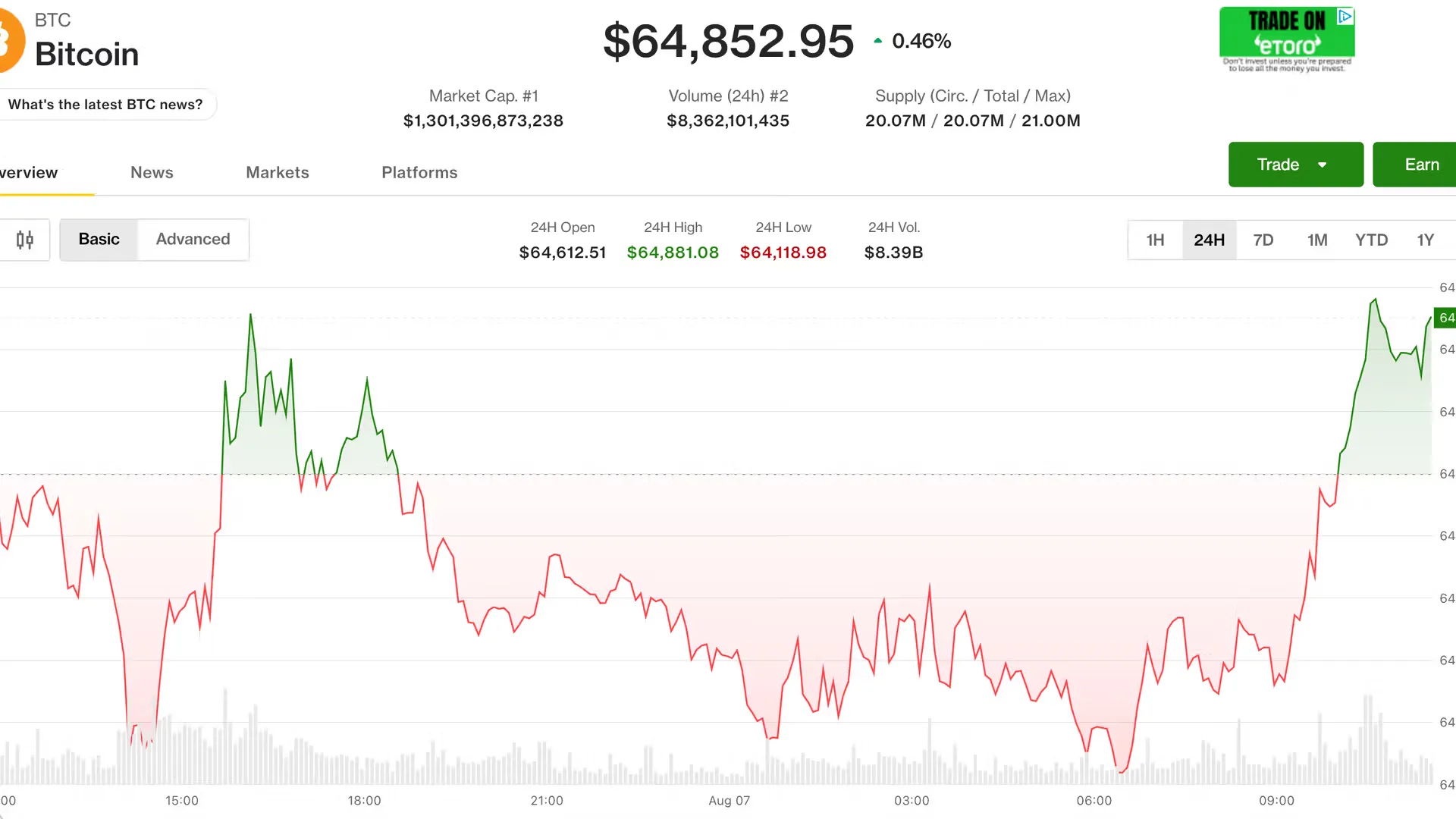
- Bitcoin is holding near $64,700 Friday, barely changed over the last 24-hour period, while the broader CoinDesk 20 index is down 0.2% over the period.
- Brent crude has meanwhile moved to over $83 a barrel after Yemens Iran-linked Houthis attacked Saudi Arabia, further escalating tensions in the Middle East.
- Gold has meanwhile maintained its recovery, moving up 1.5% to now trade at $4,300 per ounce as investors move toward safety in the face of uncertainty.
Bitcoin is holding near $64,700 Friday, barely changed over the last 24-hour period, while the broader CoinDesk 20 (CD20) index is down 0.2% over the period.
Brent crude has meanwhile moved to over $83 a barrel after Yemens Iran-linked Houthis attacked Saudi Arabia, further escalating tensions in the Middle East.
Treasury yields have seen a slight correction, but remain at 4.67% for the 10-year note, a level Fidelitys Director of Global Macro Jurrien Timmer said “history suggests that nothing good happens.”
Higher oil could add to inflation pressure if sustained, while elevated Treasury yields tighten financial conditions. Together, they could limit expectations for near-term rate cuts and weigh on bitcoin and other risk assets.
Gold has meanwhile maintained its recovery, moving up 1.5% to now trade at $4,300 per ounce as investors move toward safety in the face of uncertainty.
Derivatives positioning
- Long-short taker ratio:The crypto futures markets long-short taker ratio has returned to neutral after leaning bullish on Thursday, suggesting traders may be adopting a more cautious stance ahead of the U.S. payrolls report.
- CC token leads OI growth:Canton Networks CC token is down 13% in 24 hours, yet its futures open interest (OI) has surged over 5%. The combination is said to validate the downtrend, especially as the 24-hour OI-adjusted cumulative volume delta remains negative, indicating sellers are more aggressive by shorting futures via market orders rather than passive limit orders.
- Open Interest Movers:DOGE, XRP, and SUI are open interest gainers, while SHIB has seen a drop.
- CVD Indicator:The CVD indicator paints a bearish picture for the market, as most majors (excluding ADA, HBAR, and ETH) show negative CVD readings.
- Volatility Indexes:The BVIV index, representing BTC‘s annualized 30-day implied volatility, remains near a long-held floor of 36%, showing little signs of stress despite the Clarity Act delay and the impending U.S. jobs report. The same holds true for ether’s volatility index (EVIV).
- Options Activity:In Deribit-listed options, puts (bearish bets) at the $60,000 and $62,000 strikes dominate the 24-hour volume rankings for BTC, while the $2,000 call is the most popular for ETH.
Token Talk
- Sui is adding quantum-resistant security to its accounts, integrating two post-quantum signature schemes approved by the U.S. standards body NIST, per The Block. The upgrade lets users optionally adopt quantum-safe keys derived from their existing recovery phrases, so nobody has to generate a new seed or move funds to a new address to be protected.
- The threat it's guarding against is specific to crypto.In most systems an attacker has to break in before they can go after a key. Onchain, the public key is exposed permanently the moment an account transacts, which opens the door to “harvest-now, forge-later,” where attackers collect exposed keys today and crack them once quantum computers are capable enough to run Shor's algorithm, the technique that could break the elliptic-curve cryptography securing most wallets. No quantum hardware is needed to start collecting.
- Sui is using two schemes for two risk levels.ML-DSA-65 covers everyday accounts at the protocol level, and the hash-based SLH-DSA-SHA2-128s runs inside Move smart contracts for high-value vaults. The two rest on different math, so a weakness in one doesn't compromise the other. Sui went with a higher security tier after a July incident where an AI model halved the effective strength of a different post-quantum candidate, a reason to carry margin rather than pick the cheapest option.
- It's a feature add, not a rebuild.Sui says it was built for “cryptographic agility,” meaning new signature schemes slot in without touching consensus or existing balances, so this ships as a routine protocol update. That contrasts with bitcoin and ethereum, where quantum-proofing is a heavier lift, and lands the same month Strategy and BlackRock formed a consortium to prepare bitcoin for the same threat. SUI traded around [X], per CoinDesk data.